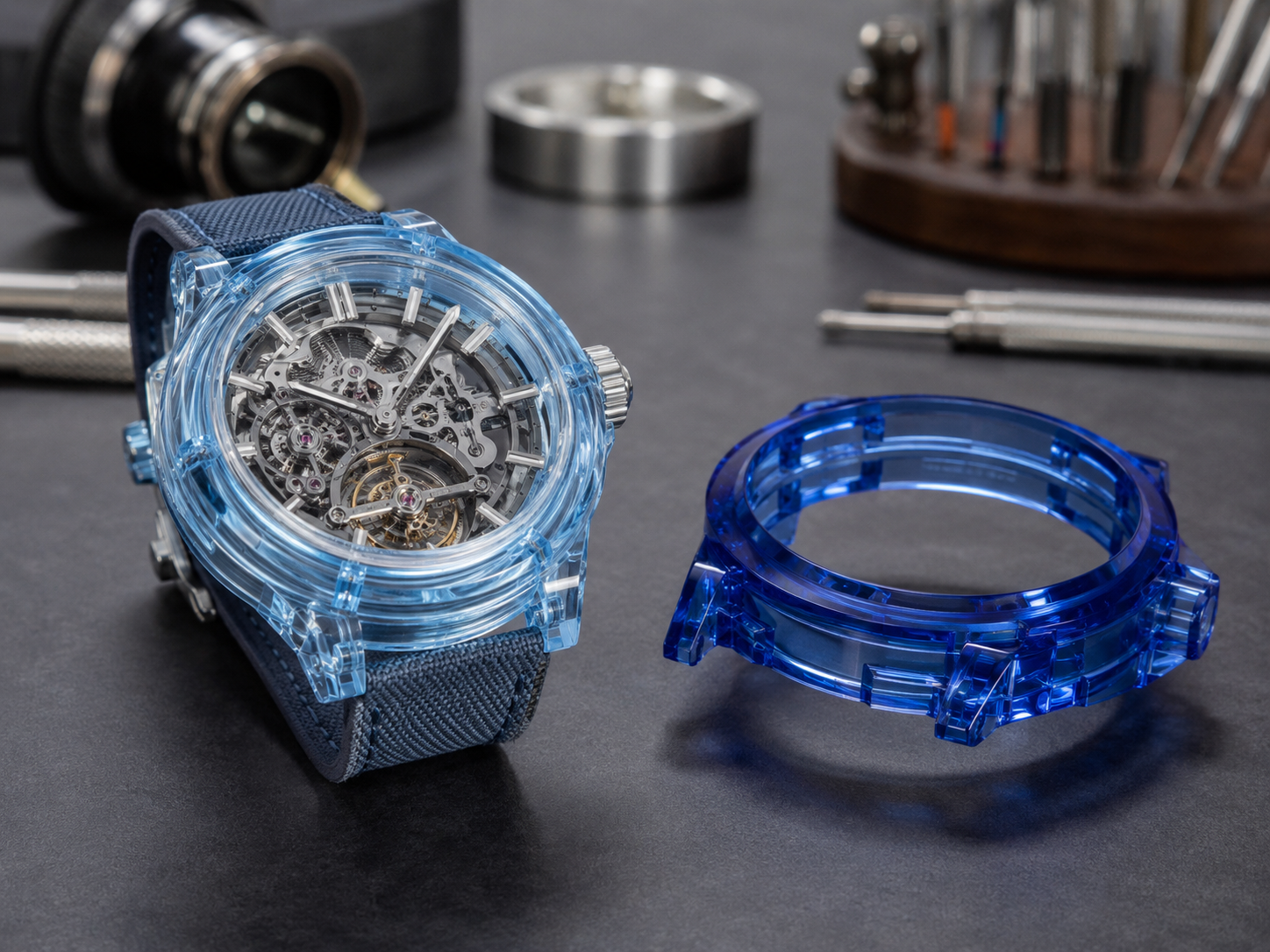
Transparent sapphire has already changed the visual language of high-end mechanical watches. Instead of hiding the movement behind metal case walls, a sapphire watch case allows the movement, bridges, screws, gears and internal architecture to remain visible from multiple directions.
In 2026, however, the focus is moving beyond completely clear sapphire.
Sky blue, sea blue, royal blue and other transparent colors are becoming increasingly important in luxury watch design. These colors retain the depth and transparency that make sapphire unique while giving designers a stronger visual identity than a conventional clear case.
But a colored sapphire watch case is not simply a clear sapphire case with a different appearance.
Producing transparent color while maintaining optical clarity, dimensional accuracy, surface quality and structural reliability introduces additional engineering challenges throughout crystal preparation, machining, polishing and final inspection.
For watch brands developing a custom sapphire watch case, understanding these challenges is essential before moving from concept to prototype.
From Clear Sapphire to Transparent Color
Clear sapphire remains one of the most distinctive case materials in modern watchmaking.
Synthetic sapphire is a single-crystal aluminum oxide material with a Mohs hardness of approximately 9. It offers excellent scratch resistance, good chemical stability and high optical transparency.
Its most important advantage for watch design, however, is structural transparency.
Traditional transparent watch design normally relies on a sapphire crystal on the front and an exhibition caseback on the rear. A full sapphire case changes this concept completely.
The wearer can potentially see the movement through:
- the front crystal
- the caseback
- the side walls
- the lugs
- the bezel
- internal case structures
The case itself becomes part of the movement display.
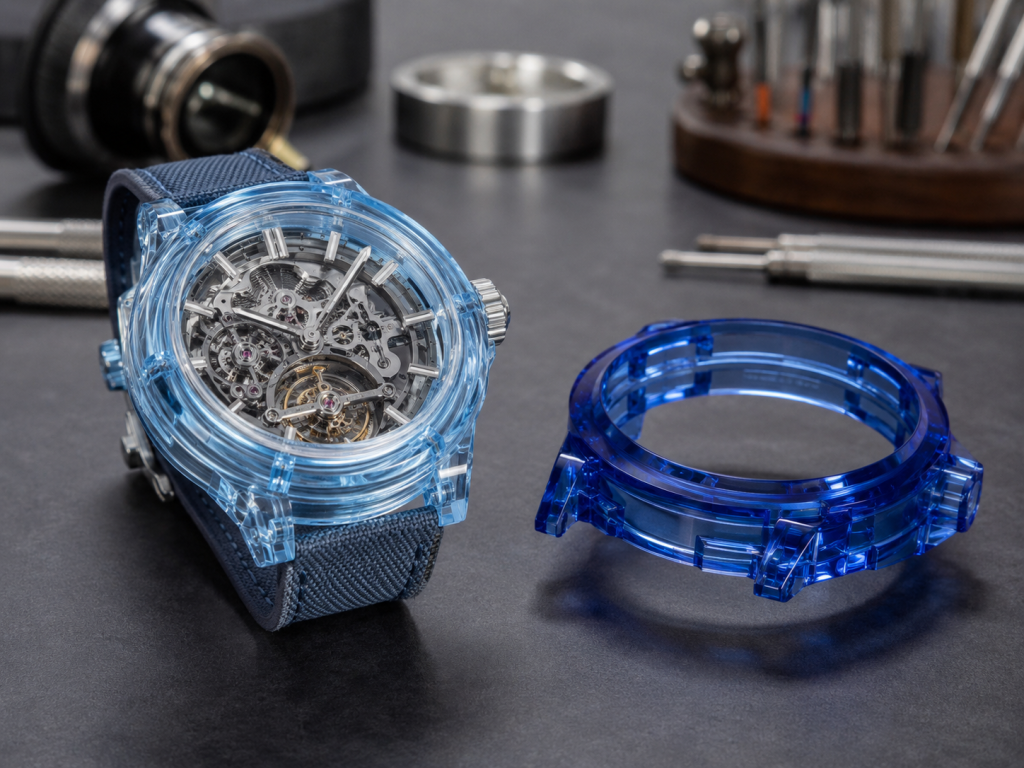
Colored sapphire adds another dimension. Instead of creating an almost invisible enclosure around the movement, the case becomes a visible optical structure with its own color, reflections and depth.
This is one reason blue sapphire watch cases are attracting growing attention in high-end watchmaking.
Why Blue Is Especially Suitable for Transparent Sapphire Cases
Among colored sapphire options, blue has several advantages for watch design.
Blue is strongly associated with technical, modern and luxury aesthetics, but more importantly, it works particularly well with transparent mechanical architecture.
A light sky-blue sapphire case can preserve a high level of movement visibility while giving the outline of the case a distinct visual presence.
A deeper royal-blue sapphire case creates stronger contrast and can make polished metal bridges, gears and skeletonized components appear more dramatic.
This creates two very different design directions.
Sky Blue Sapphire
Sky blue is generally designed to maintain a lighter and more transparent appearance.
It works especially well when the objective is to maximize movement visibility while adding a subtle color effect.
Typical visual characteristics include:
- light blue transparency
- high perceived brightness
- softer edge coloration
- strong interaction with natural light
- good visibility of internal components
For skeleton watches and highly open movements, sky blue can provide color without visually overpowering the movement.
Royal Blue Sapphire
Royal blue produces a deeper and more saturated visual effect.
The stronger color can make the watch case itself a major part of the design rather than simply a transparent enclosure.
It is particularly suitable for:
- bold luxury watches
- limited-edition designs
- strongly skeletonized movements
- contrasting metallic movement finishes
- architectural case geometries
However, deeper color also requires more careful control because the apparent shade can change noticeably with material thickness.
Colored Sapphire Is Not Simply a Surface Coating
One important distinction in custom sapphire manufacturing is the difference between colored sapphire and a colored surface treatment.
For a true colored sapphire component, the color is associated with the crystal material itself rather than simply being painted onto the finished surface.
This means the color remains visible through the thickness of the component.
That creates the three-dimensional visual depth that is difficult to achieve with conventional coatings.
But it also makes color control more complicated.
A sapphire case may contain thin walls, thick lugs, curved sections, screw bosses and reinforced structural areas. Light travels through different amounts of material in each of these locations.
As a result, the same sapphire material can appear lighter in a thin wall and significantly darker around a thick corner or lug.
For this reason, color evaluation cannot be separated from case geometry.
Wall Thickness Changes the Perceived Color
This is one of the most important engineering considerations when designing a colored sapphire watch case.
Suppose two components are produced from the same blue sapphire material.
One section has a wall thickness of 1.5 mm, while another section is 4 mm thick.
Even if the crystal material is identical, the thicker section can appear noticeably more saturated because light travels through a greater optical path length.
This effect becomes particularly important in areas such as:
- lugs
- crown guards
- bezel edges
- case corners
- screw mounting areas
- internal shoulders
- caseback interfaces
A CAD model may show a uniform blue case, but the physical prototype can display different shades depending on the geometry.
Therefore, when developing a custom colored sapphire case, the target color should ideally be evaluated on representative material thicknesses rather than only on a thin flat sample.
Color Consistency Is a Manufacturing Requirement
For luxury watch applications, simply producing “blue sapphire” is usually not enough.
The case manufacturer must consider whether the color is visually consistent between different components and different production batches.
A multi-part sapphire watch case may contain:
- sapphire middle case
- sapphire bezel
- sapphire caseback
- sapphire crown components
- sapphire pushers
- decorative sapphire parts
If these parts are made from different crystal blanks, small color differences may become obvious after assembly.
The problem becomes even more noticeable when highly polished components are positioned next to each other.
For projects requiring close color matching, the specification should therefore define the expected color range and visual acceptance method.
Reference samples can be especially useful during prototype development.
Transparency Still Depends on Surface Quality
Color alone does not create a premium transparent sapphire case.
The visual quality of the finished watch depends heavily on machining and polishing.
After rough machining, sapphire surfaces can contain microscopic grinding marks and subsurface damage. These defects scatter light and make the material appear cloudy or milky.
For a high-end sapphire watch case, polishing is therefore both an aesthetic process and an optical process.
Critical areas may include:
- exterior case walls
- internal case walls
- curved surfaces
- lug surfaces
- bezel faces
- caseback surfaces
- openings around the crown
- movement-viewing areas
A beautifully polished exterior cannot fully compensate for a poorly finished interior surface.
When the case is transparent, internal machining quality becomes visible.
This is a fundamental difference between sapphire and traditional metal watch cases.
Internal Surfaces Matter More in a Transparent Case
Metal watch cases can hide many internal machining features.
Sapphire cannot.
Tool marks, transitions, drilled holes, internal radii and assembly interfaces may all be visible through the finished case.
Designers therefore need to think about the watch case from both outside and inside.
The inner wall is not simply a functional surface. It becomes part of the visual architecture.
This is especially important for skeleton watches.
A movement may look excellent from the front, but an unfinished internal pocket or visually distracting screw structure can reduce the overall appearance when viewed through the side of a transparent sapphire case.
For this reason, the relationship between the movement and the sapphire case should ideally be considered during the early design stage.
Sapphire Hardness Does Not Eliminate Structural Risks
Sapphire is extremely hard, which provides excellent scratch resistance.
But hardness should not be confused with toughness.
Like other hard crystalline materials, sapphire can still be vulnerable to chipping or cracking when subjected to concentrated mechanical stress.
This makes certain watch-case features especially important during design.
Examples include:
- sharp internal corners
- very thin walls
- small holes located close to edges
- narrow bridges between openings
- aggressive thread geometries
- insufficient corner radii
- concentrated screw-loading areas
These features can create local stress concentration.
A design that is easy to machine in titanium or stainless steel may require modification when transferred directly to sapphire.
Design for sapphire should therefore consider machining feasibility and mechanical reliability at the same time.
Machining Colored Sapphire Watch Cases
Machining sapphire is significantly different from machining metal.
Because of its hardness, sapphire normally requires diamond-based tooling and carefully controlled grinding and finishing processes.
A typical custom sapphire watch case project may involve several stages:
- Sapphire crystal blank preparation
- Material inspection
- Rough shaping
- Precision grinding
- CNC machining of structural features
- Hole and opening machining
- Fine grinding
- Edge finishing
- Multi-stage polishing
- Dimensional inspection
- Optical inspection
- Trial assembly
The exact process depends on case geometry.
Simple round components are generally less challenging than complex monobloc structures containing integrated lugs, crown guards, deep internal cavities or multiple cross-holes.
As geometry becomes more complicated, manufacturing yield becomes increasingly important.
Sky Blue vs. Royal Blue: Which Is Better for a Watch Project?
There is no single answer.
The correct choice depends on the intended visual effect, movement architecture and case geometry.
Choose Sky Blue When:
- movement visibility is the main priority
- the watch uses a highly skeletonized movement
- a light and modern appearance is preferred
- case walls are relatively thick
- subtle color is more important than strong saturation
Choose Royal Blue When:
- the case itself should become a strong design element
- deeper color contrast is desired
- movement components use bright metallic finishes
- the watch has a bold architectural design
- stronger visual identity is required
In both cases, prototype evaluation is recommended because CAD renderings cannot perfectly reproduce the way transparent sapphire interacts with real light.
Color Should Be Defined With Physical References
Terms such as “sky blue,” “sea blue” and “royal blue” are useful for communication, but they should not automatically be treated as universal material specifications.
Different lighting environments, monitor settings and material thicknesses can significantly affect how a transparent blue appears.
For serious watch development projects, it is better to define the target using a combination of:
- reference photographs
- physical color samples
- representative sapphire samples
- expected case wall thickness
- lighting conditions
- acceptable color variation
This reduces misunderstandings between the design team and sapphire manufacturer.
Monobloc and Multi-Part Colored Sapphire Cases
Colored sapphire can be used for both monobloc and multi-component watch-case structures.
Monobloc Sapphire Case
A monobloc structure can create a highly integrated appearance because the main case body is machined from a single sapphire blank.
Advantages can include:
- continuous visual appearance
- fewer visible material interfaces
- strong structural transparency
- distinctive premium positioning
However, complex monobloc cases can also increase machining difficulty and production risk.
Multi-Part Sapphire Case
A multi-part structure may use separate components for the middle case, bezel and caseback.
This can provide more flexibility in:
- assembly
- sealing
- component replacement
- manufacturing
- mixed-color designs
The main challenge for colored sapphire is maintaining good color consistency between individual parts.
Mixed-Color Sapphire Creates New Design Possibilities
The next stage of transparent watch design does not necessarily require every sapphire component to have the same color.
Designers can combine:
- clear sapphire middle case + blue sapphire bezel
- sky blue case + clear sapphire caseback
- royal blue sapphire case + transparent crown components
- different blue shades across structural layers
This allows sapphire to function almost like an architectural material.
Instead of treating the watch case as one homogeneous shell, different transparent layers can visually separate the movement, bezel, caseback and functional components.
For independent watch brands and limited-edition projects, this creates substantial room for differentiation.
What to Specify When Ordering a Custom Colored Sapphire Watch Case
To evaluate a custom project efficiently, the sapphire manufacturer should receive as much technical information as possible.
Recommended information includes:
- 2D engineering drawings
- STEP or other 3D CAD files
- overall case dimensions
- target sapphire color
- reference color sample if available
- critical dimensional tolerances
- required polished surfaces
- movement dimensions
- movement-to-case clearance
- crown and stem position
- caseback structure
- bezel structure
- screw locations
- gasket design
- assembly method
- prototype quantity
- expected production quantity
For early-stage projects, even an incomplete CAD model can be useful for initial manufacturability review.
Prototype Before Production
Prototype development is particularly important for colored sapphire cases.
A prototype allows the watch designer to evaluate several characteristics that are difficult to predict digitally:
- actual color under natural light
- color changes caused by wall thickness
- movement visibility
- internal reflections
- optical distortion
- edge appearance
- polishing quality
- dimensional fit
- assembly clearance
- overall visual balance
For this reason, the first prototype should be treated not only as a dimensional sample but also as an optical and aesthetic validation sample.
Changes to wall thickness, corner geometry or internal structure may significantly improve the final appearance.
The Future of Colored Sapphire Watch Cases
The evolution of sapphire watch cases is moving from simple transparency toward controlled transparency.
Clear sapphire answers the question:
“How can we make the mechanical movement visible?”
Colored sapphire creates a more advanced question:
“How can transparency itself become part of the design?”
Sky blue provides a light and highly transparent aesthetic. Royal blue creates stronger visual depth and contrast. Other transparent colors can further expand the possibilities available to watch designers.
But successful colored sapphire watch cases require more than choosing an attractive shade.
Color, wall thickness, crystal quality, machining geometry, polishing, internal surfaces, assembly design and movement architecture all interact with one another.
For luxury watch brands, independent watchmakers and design studios, the most successful sapphire projects therefore begin by treating the case not simply as an enclosure, but as an optical and structural component of the entire watch.
Custom Colored Sapphire Watch Case Manufacturing
We support custom sapphire watch case development for watch brands, independent watchmakers and engineering teams.
Available project options can include:
- clear sapphire watch cases
- sky blue sapphire watch cases
- sea blue sapphire watch cases
- royal blue sapphire watch cases
- custom transparent sapphire colors
- monobloc sapphire cases
- multi-part sapphire case structures
- sapphire bezels
- sapphire casebacks
- sapphire crowns and structural components
- prototype and small-batch production
Projects can be evaluated from 2D drawings, 3D CAD files or existing case designs.
For new designs, early manufacturability review can help identify potential issues involving wall thickness, sharp internal corners, polishing accessibility, hole positioning and assembly structure before prototype machining begins.
If you are developing a custom transparent or colored sapphire watch case, send us your drawings, STEP files, target color, dimensions and estimated quantity for technical review.
FAQ
Is a colored sapphire watch case coated or colored throughout the material?
For true colored synthetic sapphire, the color is associated with the crystal material rather than simply being a decorative paint layer on the surface. This allows the case to maintain a transparent, three-dimensional color effect.
Why can the same blue sapphire appear darker in some areas of a watch case?
Material thickness affects the optical path through the sapphire. Thick areas such as lugs, corners and structural sections can therefore appear more saturated than thin case walls.
Can sapphire watch cases be customized in different shades of blue?
Yes. Light sky-blue, sea-blue and deeper royal-blue appearances can be considered, depending on material availability, crystal processing and the requirements of the project. A physical reference sample is recommended when close color matching is required.
Is sapphire suitable for a skeleton watch?
Yes. Sapphire is particularly suitable for skeleton and open-worked movements because transparent case walls allow movement architecture to remain visible from the front, back and sides.
Can a complex metal watch case design be produced directly in sapphire?
Not always without modification. Features such as thin walls, sharp corners, small edge holes and complex internal structures may need to be optimized for sapphire machining and structural reliability.
What files are required for a custom sapphire watch case quotation?
A 3D STEP file together with a 2D drawing is ideal. The drawing should identify critical dimensions, tolerances, polished surfaces, assembly features and any special optical or color requirements.