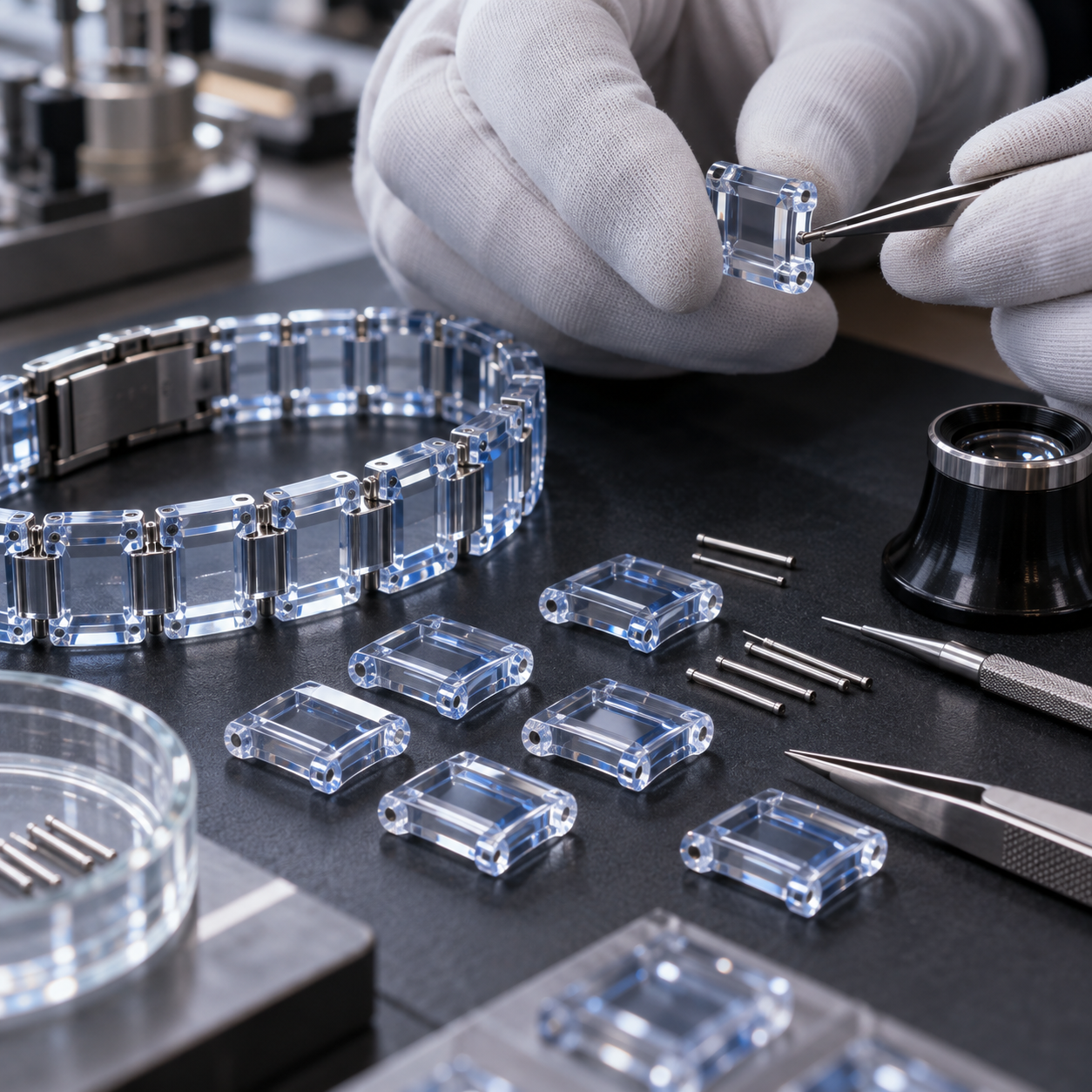
Transparent sapphire is no longer limited to watch crystals and cases.
For high-end transparent watches, sapphire bracelets and individual sapphire links can extend the visual language of the case through the entire watch. Clear, smoke, blue or other colored sapphire links can create a continuous crystalline structure that cannot be reproduced with conventional stainless steel or titanium bracelets.
However, a sapphire bracelet is not simply a metal bracelet manufactured from a different material.
Each individual link may contain precision pin holes, curved external surfaces, narrow wall sections, polished edges and interfaces with metal pins, screws or connecting components. Because synthetic sapphire is extremely hard but brittle, these details must be considered together from the beginning of the design.
The key challenge is not producing one attractive sapphire link.
It is producing dozens of links that assemble into a bracelet with consistent appearance, controlled movement and reliable tolerances.
Why Sapphire Bracelet Links Are Difficult to Manufacture
A sapphire watch case is usually one relatively large component.
A bracelet is different.
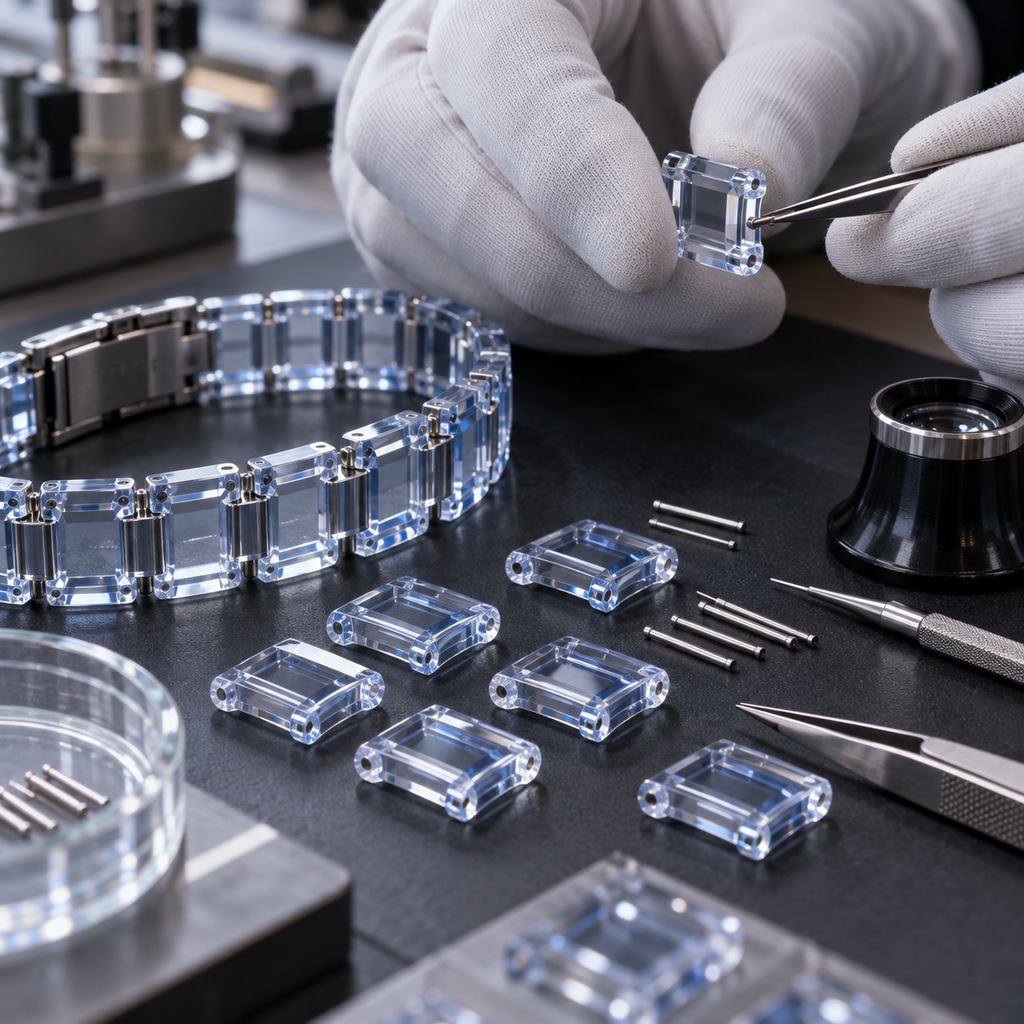
A complete bracelet may require many individual parts, including:
- Center links
- Side links
- End links
- Connecting links
- Clasp-interface links
- Pin or screw interfaces
- Metal inserts
- Decorative components
Each component must be manufactured individually and then assembled into a system.
A small dimensional variation in one watch case may affect one interface.
A small variation repeated across 15 or 20 bracelet links may accumulate and influence the overall bracelet length, articulation and alignment.
This makes tolerance control especially important.
Sapphire also introduces another difficulty.
Unlike stainless steel, titanium or gold, sapphire cannot plastically deform around a pin or screw to compensate for a dimensional mismatch.
If a metal pin is too large, too tight or misaligned, the sapphire does not simply stretch.
Local stress may increase around the hole and potentially cause micro-chipping or cracking.
For this reason, bracelet engineering should begin with the relationship between the sapphire component and the connecting hardware.
Pin Holes Are One of the Most Critical Features
Almost every articulated bracelet requires some type of connection between adjacent links.
This may involve:
- Straight pins
- Screwed pins
- Metal sleeves
- Bushings
- Spring-loaded components
- Titanium connectors
- Stainless steel connectors
For a sapphire link, the hole is a critical structural feature.
The drawing should not define only the nominal diameter.
It should also consider:
- Hole diameter tolerance
- Hole position tolerance
- Hole-to-hole spacing
- Hole perpendicularity
- Entry edge condition
- Exit edge condition
- Chamfer or radius
- Distance from the hole to the external edge
- Remaining sapphire wall thickness
Precision holes in sapphire can develop chipping around their entrance or exit edges during machining, especially when the remaining material becomes thin. This is why hole geometry and edge treatment should be treated as functional specifications rather than cosmetic details.
Hole Position Can Matter as Much as Hole Diameter
Consider a bracelet link with two holes.
Each hole may individually meet its diameter specification.
However, if the center-to-center distance between the holes is incorrect, the link may still fail during assembly.
Possible problems include:
- Difficult pin insertion
- Uneven articulation
- Misalignment between adjacent links
- Excessive clearance
- Local side loading
- Bracelet twisting
- Uneven visual gaps
For this reason, the engineering drawing should define the functional relationship between the holes rather than treating each hole independently.
For complex links, positional tolerances based on defined datums may be more useful than a collection of unrelated ± dimensions.
Avoid Placing Holes Too Close to the Edge
A visually thin sapphire link may look elegant in a CAD rendering.
But if a pin hole is positioned too close to the outer surface, only a narrow bridge of sapphire remains between the hole and the edge.
This region can become vulnerable during:
- Hole machining
- Edge polishing
- Pin insertion
- Bracelet assembly
- Impact
- Repeated articulation
There is no single minimum wall thickness suitable for every sapphire bracelet.
The required geometry depends on:
- Link thickness
- Hole diameter
- Hole orientation
- Pin diameter
- Pin material
- Assembly load
- External geometry
- Edge radius
- Expected mechanical loading
This is why manufacturability review should happen before the bracelet geometry is frozen.
Sharp Internal Corners Should Be Reviewed Carefully
Luxury watch design frequently uses sharp lines and highly defined geometric transitions.
These features may be straightforward in titanium.
They can be more difficult in sapphire.
Sharp internal corners can create local stress concentrations and can also make grinding and polishing more difficult.
Where the design permits, controlled radii can improve manufacturability.
Important regions include:
- Hole transitions
- Recesses
- Pin seats
- Internal shoulders
- Link-to-link contact areas
- Narrow bridges
- Deep slots
The objective is not to make every sapphire link rounded.
The objective is to identify which sharp details are visually important and which can be modified slightly without changing the design intent.
Edge Chipping Must Be Controlled Throughout Production
Edge chipping is one of the recurring risks in sapphire machining.
Because sapphire combines very high hardness with brittle behavior, uncontrolled machining loads can result in micro-chipping, subsurface damage or cracking. Research on sapphire machining consistently identifies its high hardness and relatively low fracture toughness as important manufacturing challenges.
For bracelet links, edge chipping can occur during several stages.
Rough Machining
The sapphire blank is shaped into the approximate external geometry.
Aggressive material removal may create hidden subsurface damage that becomes visible later.
Hole Machining
Entry and exit edges around pin holes are particularly sensitive.
Fine Grinding
The geometry approaches final dimensions, leaving less material available for removing defects.
Polishing
A small chip may become more visually noticeable after the surrounding surface reaches optical clarity.
Assembly
A link that passes cosmetic inspection can still be damaged if a pin is forced into an undersized or misaligned hole.
Therefore, edge quality should be controlled throughout the complete production process rather than inspected only at the final stage.
Small Chamfers Can Have a Large Effect
A perfectly sharp transparent edge may look attractive in a rendering.
In manufacturing, a controlled micro-chamfer or radius may significantly improve edge stability.
Edge treatment can help:
- Reduce fragile knife edges
- Improve handling
- Reduce assembly damage
- Improve polishing consistency
- Reduce local stress concentration
At the same time, the chamfer changes how light reflects through the sapphire.
A polished chamfer can create a bright optical line around the link.
Therefore, edge design affects both mechanical reliability and visual character.
For luxury sapphire components, it should be intentionally designed rather than treated as an uncontrolled result of polishing.
Link Geometry Controls Bracelet Articulation
A bracelet must move.
This sounds obvious, but it creates one of the major differences between a sapphire bracelet and a sapphire case.
Adjacent links require sufficient clearance to rotate without colliding.
If the clearance is too small, the bracelet may feel stiff.
If it is too large, the bracelet may feel loose and gaps may become visually inconsistent.
Important dimensions may include:
- Pin center distance
- Link width
- Link thickness
- Adjacent-link gap
- Rotation clearance
- Contact radius
- Maximum articulation angle
- End-link geometry
These parameters should be evaluated as an assembly rather than as individual components.
A digital assembly model can help identify collision risks before machining begins.
Physical prototypes remain important because bracelet feel cannot be evaluated from CAD geometry alone.
Transparent Sapphire Makes Internal Details Visible
Metal bracelets hide many internal features.
Transparent sapphire does not.
Through a clear link, the customer may be able to see:
- Pin surfaces
- Sleeves
- Bushings
- Internal hole finish
- Assembly gaps
- Dust
- Adhesive residue, if adhesive is used
- Small scratches
- Machining marks
This means engineering and aesthetics cannot be separated.
A mechanically acceptable internal surface may still be visually unacceptable if it can be seen through the finished bracelet.
Manufacturers should define visible and non-visible zones during the drawing review stage.
Polishing a Bracelet Link Is a Multi-Surface Problem
A sapphire bracelet link may contain:
- Flat top surfaces
- Curved sidewalls
- Polished chamfers
- Internal holes
- Recessed surfaces
- Convex transitions
- Concave transitions
Different surfaces require different polishing access.
A geometry that can be machined successfully may still be difficult to polish.
This is especially important around narrow gaps and internal transitions.
The polishing strategy should therefore be considered during DFM rather than after CNC machining is complete.
If a polishing tool cannot reach a surface effectively, the manufacturer may have difficulty achieving the expected optical appearance.
High Gloss Is Not the Only Surface Option
Most transparent sapphire bracelets use highly polished surfaces to emphasize optical depth.
But a complete bracelet can also combine different finishes.
Possible treatments include:
- Optical polish
- Satin-like matte sapphire
- Frosted surfaces
- Polished chamfers
- Selectively polished windows
- Contrasting transparent and matte areas
Mixed finishing can visually define individual links and reduce the appearance of fingerprints on selected surfaces.
However, each additional finish transition increases process complexity.
The drawing should clearly identify where each finish starts and stops.
Assembly Tolerance Is Different From Part Tolerance
One of the biggest mistakes in bracelet development is evaluating individual parts without evaluating the finished assembly.
Imagine that each link width is allowed to vary by a small amount.
That variation may appear insignificant on a single part.
Across many links, it can affect:
- Total bracelet length
- Link alignment
- Gap consistency
- Clasp position
- End-link fit
This is a tolerance stack-up problem.
The same applies to pin positions.
Small deviations repeated through a bracelet can gradually change the alignment of the complete assembly.
Critical dimensions should therefore be categorized into:
Individual component dimensions
and
assembly-critical dimensions.
The second category often requires tighter process control.
Clearance Between Sapphire and Metal Pins
Metal connecting elements are usually required because sapphire itself is not suited to conventional flexible pin structures.
Titanium and stainless steel are common engineering candidates for pins and connecting components.
The sapphire-to-metal interface needs controlled clearance.
Too much clearance can cause:
- Bracelet looseness
- Noise
- Uneven gaps
- Link movement in unwanted directions
Too little clearance can cause:
- Difficult assembly
- High insertion force
- Local stress
- Sapphire chipping
- Cracking during service
The target fit should be determined by the complete assembly concept rather than copied directly from a steel bracelet.
Surface Finish of the Pin Also Matters
The sapphire hole may be precision manufactured, but a rough or poorly finished metal pin can still damage the interface.
Pin considerations may include:
- Diameter consistency
- Surface roughness
- Burr control
- Coating thickness
- End geometry
- Straightness
A burr that would be harmless in a metal bracelet may scratch or concentrate stress inside a sapphire hole.
Both sides of the interface therefore need specification control.
Clear, Smoke and Colored Sapphire Require Visual Matching
For transparent sapphire bracelets, dimensional matching is only part of the problem.
Optical matching between links can also be important.
For clear sapphire, manufacturers should consider:
- Crystal clarity
- Internal inclusions
- Polishing consistency
- Reflection consistency
For colored sapphire, additional factors may include:
- Crystal batch
- Dopant concentration
- Material thickness
- Optical path length
- Link geometry
- Viewing angle
A thick center link can appear darker than a thin side link even if both were manufactured from the same nominal sapphire color.
For this reason, visual color approval should ideally be performed on actual production geometry rather than only on small material samples.
End Links Are Often the Most Difficult Components
The end link connects the bracelet to the watch case.
It may require:
- Complex curvature
- Tight dimensional fit
- Spring-bar or pin holes
- Multiple polished surfaces
- Case-matching geometry
- Narrow material sections
At the same time, this region strongly influences the visual transition from case to bracelet.
For an integrated sapphire watch design, the interface between case and bracelet should therefore be developed as one system.
The end link should not be designed only after the case design has already been finalized.
Inspection Should Include More Than Cosmetic Appearance
A finished sapphire bracelet link may look perfect under normal lighting while still having dimensional problems.
Inspection should therefore combine cosmetic and dimensional evaluation.
Depending on the project, important checks can include:
Dimensional Inspection
- Link width
- Link thickness
- Hole diameter
- Hole location
- Hole spacing
- Flatness
- Profile geometry
Edge Inspection
- External edge chipping
- Hole-edge chipping
- Microcracks
- Bevel consistency
Surface Inspection
- Scratches
- Pits
- Polishing marks
- Haze
- Contamination
Assembly Inspection
- Link articulation
- Pin fit
- Gap consistency
- Bracelet straightness
- Maximum rotation
- End-link fit
A bracelet project should not be approved based only on loose sapphire components.
The assembled bracelet must also be evaluated.
First Article Assembly Is Essential
Before moving into batch production, a complete first article bracelet should be assembled.
The first article should verify:
- Visual appearance
- Total bracelet length
- Articulation
- Link spacing
- Pin installation
- End-link interface
- Clasp connection
- Color matching
- Surface quality
This is also the stage where design assumptions can be tested physically.
For example, a CAD model may show sufficient clearance between links, but actual polishing radii and dimensional variation may reduce that clearance.
The first article therefore acts as the bridge between theoretical tolerance design and production reality.
Do Not Copy a Metal Bracelet Directly Into Sapphire
A common starting point for a sapphire bracelet project is an existing stainless steel or titanium bracelet design.
This can be useful for establishing proportions.
However, the geometry should usually be reviewed before manufacturing it in sapphire.
Features that may need modification include:
- Very thin walls
- Sharp internal corners
- Extremely tight pin fits
- Holes close to edges
- Narrow unsupported sections
- Press-fit structures
- Deep inaccessible polishing areas
The goal is not to compromise the original design.
It is to translate the design into a geometry appropriate for a hard, brittle crystal.
What Information Should Be Included in an RFQ?
For a custom sapphire watch bracelet or sapphire link project, the RFQ should ideally include:
- 3D STEP file
- 2D dimensional drawing
- Bracelet layout
- Link quantity per bracelet
- Sapphire color
- Surface finish
- Critical dimensions
- Pin or screw material
- Pin diameter
- Target clearances
- End-link interface
- Clasp interface
- Cosmetic requirements
- Prototype quantity
- Production quantity
If metal connecting parts are already designed, drawings for those components should also be provided.
The sapphire manufacturer cannot correctly evaluate pin-hole tolerances without understanding the mating hardware.
Prototype Before Committing to Mass Production
Sapphire bracelet development should normally proceed in stages.
A typical workflow may include:
- Design review
- DFM evaluation
- Sapphire material selection
- Prototype link manufacturing
- Dimensional inspection
- Surface finishing
- Trial assembly
- Full bracelet prototype
- First article approval
- Batch production
This approach allows geometry and assembly issues to be identified before a large number of expensive sapphire components are manufactured.
Sapphire Bracelet Manufacturing Is an Assembly Engineering Problem
A successful sapphire bracelet is not defined by a single perfectly polished link.
It is defined by how all the components work together.
Pin holes must align.
Adjacent links must articulate.
Edges must remain intact.
Polished surfaces must match.
Metal pins must fit without introducing excessive stress.
Colored links must appear consistent.
And dimensional variation must remain controlled across the entire bracelet.
For this reason, custom sapphire bracelet manufacturing should be approached as an integrated engineering project involving:
material selection + link geometry + precision machining + hole control + edge protection + polishing + tolerance management + final assembly.
When these factors are considered together from the design stage, sapphire can be extended beyond the watch case to create a complete transparent or colored watch architecture.
For luxury watch brands and independent watchmakers developing sapphire bracelets, early cooperation between the watch designer, sapphire manufacturer and bracelet assembly team can significantly reduce redesign risk and improve the transition from prototype to batch production.
Planning a custom sapphire bracelet or sapphire watch link project?
Send your 2D drawings, STEP files, sapphire color requirements, pin design and target quantity for a manufacturability review.