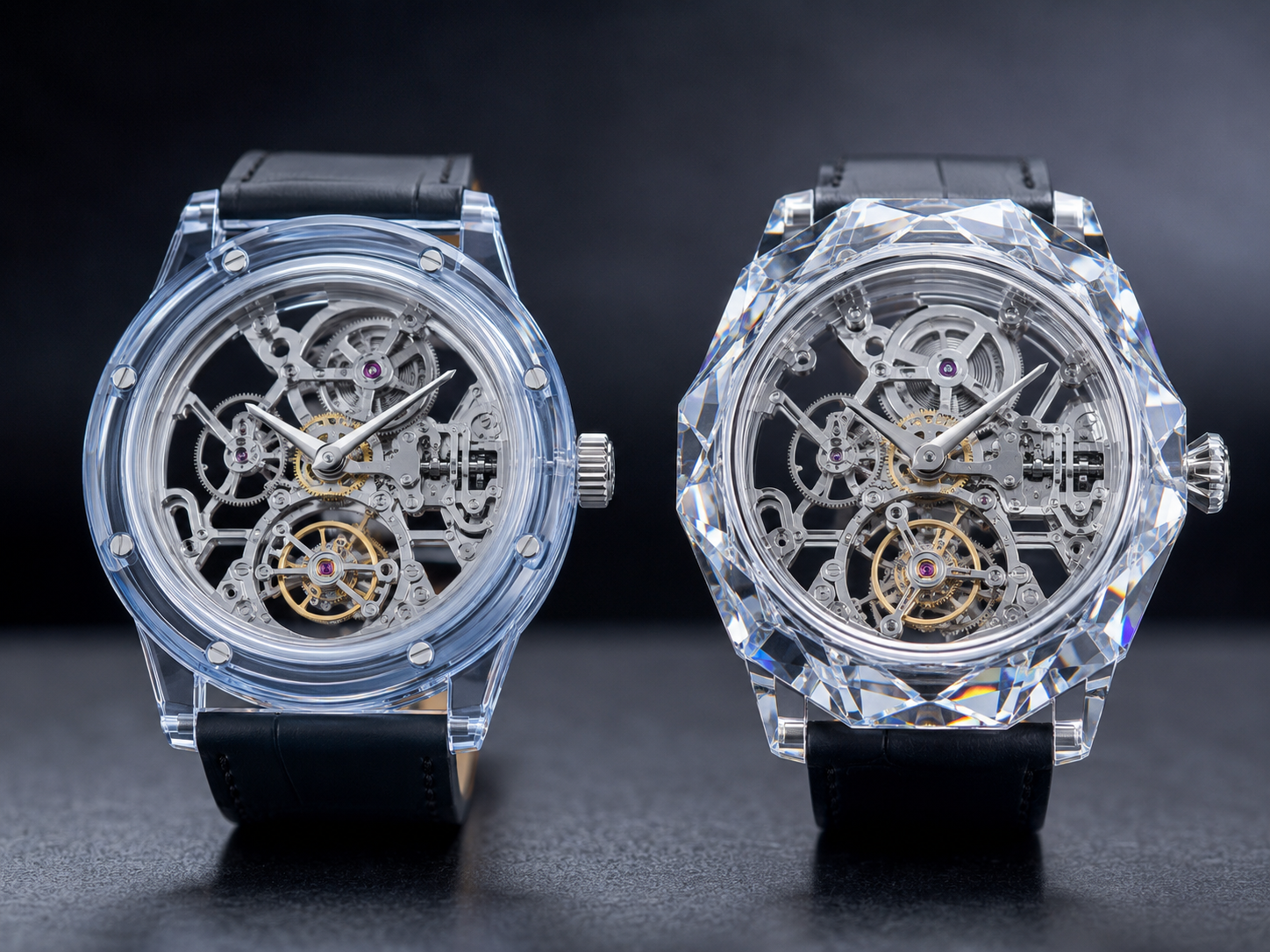
Transparent watch cases have moved from experimental concepts into one of the most technically interesting areas of contemporary high-end watchmaking.
For years, synthetic sapphire has been the dominant transparent structural material used for luxury watch cases. Its combination of hardness, optical clarity, chemical stability and established machining methods has made it particularly suitable for skeleton watches, tourbillons and other mechanical watches where the movement is intended to remain visible from multiple angles.
In 2026, however, another ultra-hard transparent material is attracting attention: moissanite.
At Watches and Wonders 2026, a complete watch case made from laboratory-grown moissanite demonstrated that transparent luxury watchmaking may no longer be limited to sapphire. The development has created an interesting engineering question for watch brands and designers:
If moissanite is harder and more optically brilliant than sapphire, could it become the next major material for transparent watch cases?
The answer is more complicated than comparing hardness numbers.
For real watch-case production, crystal availability, optical behavior, machining difficulty, polishing, case geometry, manufacturing yield, cost and repeatability may be more important than hardness alone.
This article compares sapphire and moissanite from the perspective of custom luxury watch-case manufacturing.
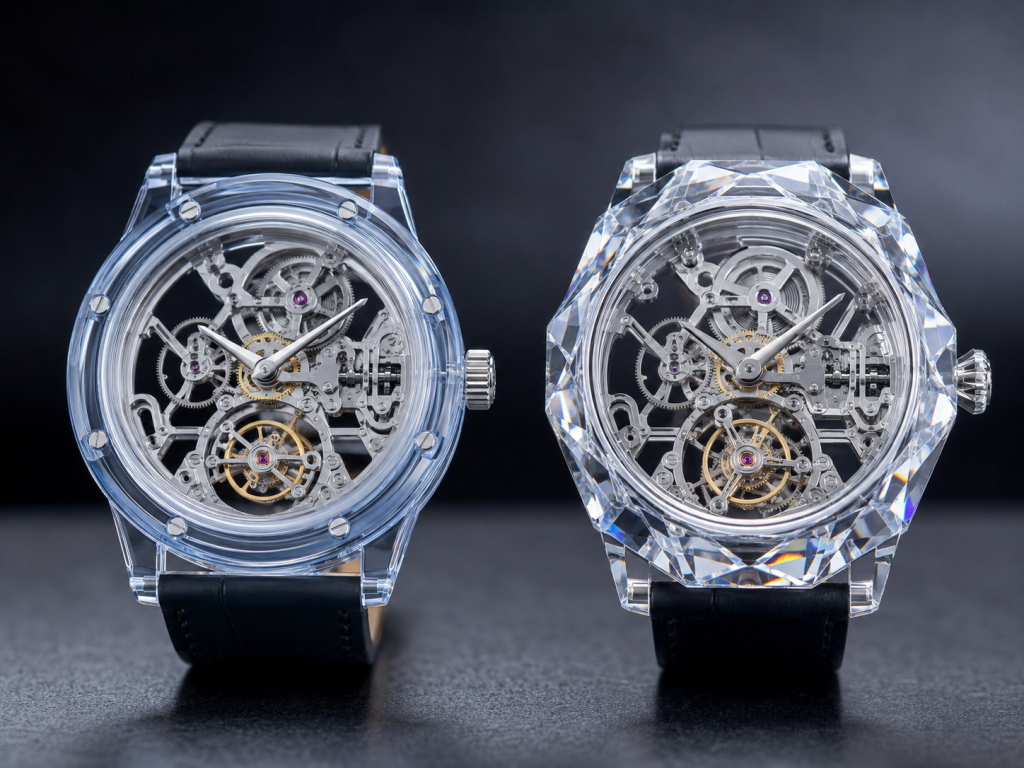
What Are Sapphire and Moissanite?
Although both materials can appear transparent and extremely hard, sapphire and moissanite are fundamentally different crystals.
Synthetic Sapphire
Synthetic sapphire is single-crystal aluminum oxide:
Al₂O₃
It has been used extensively in watches as:
- watch crystals
- exhibition casebacks
- transparent bezels
- full sapphire watch cases
- sapphire crowns
- decorative structural components
Sapphire has a Mohs hardness of approximately 9 and a refractive index of around 1.77.
Because synthetic sapphire can be produced in relatively large, high-quality crystal blanks, it has developed into a practical engineering material for complex watch components.
Synthetic Moissanite
Moissanite is silicon carbide:
SiC
Natural moissanite is extremely rare, so material used for jewelry and experimental watchmaking applications is generally laboratory-grown.
Synthetic moissanite has a Mohs hardness of approximately 9.25 to 9.5.
Its refractive index is significantly higher than that of sapphire, and its optical dispersion is also extremely high.
This gives moissanite a much stronger “fire” or rainbow-like light separation than sapphire.
For jewelry, this optical property is highly desirable.
For a transparent mechanical watch case, however, it creates a completely different visual effect.
Sapphire vs. Moissanite: Key Material Differences
| Property | Sapphire | Moissanite |
|---|---|---|
| Chemical composition | Al₂O₃ | SiC |
| Mohs hardness | Approx. 9 | Approx. 9.25–9.5 |
| Refractive index | Approx. 1.76–1.77 | Approx. 2.65–2.69 |
| Optical dispersion | Relatively low | Very high |
| Scratch resistance | Excellent | Extremely high |
| Transparency for watch cases | Clear and neutral | Highly brilliant and prism-like |
| Large structural case manufacturing | Established | Extremely specialized |
| Complex machining | Difficult | Even more difficult |
| Industry maturity | Relatively mature | Emerging |
| Best current application | Custom transparent watch cases | Experimental ultra-luxury pieces |
The most important conclusion is clear:
Moissanite is harder than sapphire, but that does not automatically make it a better watch-case material.
Hardness: Is Moissanite Better Than Sapphire?
Hardness is one of the easiest characteristics to compare.
Sapphire is approximately 9 on the Mohs scale.
Moissanite is approximately 9.25 to 9.5.
Diamond remains the benchmark at 10.
On paper, moissanite therefore has an advantage.
For a watch case, this suggests excellent resistance to surface scratching and abrasion.
However, Mohs hardness primarily measures resistance to scratching.
It does not directly tell us:
- how easily a material chips
- how it behaves around screw holes
- how it responds to impact
- how easily internal corners crack
- how difficult it is to machine
- how stable production yield will be
This distinction is especially important for structural watch components.
A watch case is not a flat optical window.
It may contain:
- integrated lugs
- crown openings
- screw holes
- gasket grooves
- deep cavities
- curved surfaces
- thin walls
- internal shoulders
Therefore, a small increase in hardness does not automatically result in a more reliable finished case.
In fact, higher hardness can make manufacturing significantly more difficult.
Scratch Resistance Is Only One Part of Watch-Case Performance
Consumers often associate scratch resistance with durability.
From an engineering perspective, durability is more complex.
A luxury watch case must survive not only surface contact but also mechanical loads during:
- machining
- polishing
- assembly
- screw tightening
- movement installation
- strap installation
- daily wear
- accidental impact
Sapphire already provides extremely high scratch resistance for normal watch use.
Moving from Mohs 9 sapphire to approximately 9.25–9.5 moissanite may provide additional theoretical scratch resistance, but the practical benefit has to be weighed against manufacturing complexity.
For most custom watch projects, sapphire already offers far greater scratch resistance than conventional metal cases.
Transparency: Sapphire Produces a Cleaner Optical Effect
One of sapphire’s strongest advantages is its relatively neutral transparency.
When sapphire surfaces are properly polished, the material can produce a clean, glass-like visual effect.
This is ideal for skeleton watches because it allows the movement to remain the visual focus.
The viewer can see:
- bridges
- gears
- balance wheels
- barrels
- tourbillons
- screws
- movement plates
without excessive visual interference from the case material.
This is why sapphire is particularly effective when designers want the case to appear almost invisible.
Moissanite Produces More Optical Fire
Moissanite behaves very differently.
It has an exceptionally high refractive index and very high optical dispersion.
Instead of simply transmitting light, a faceted moissanite surface can separate white light into visible spectral colors.
This produces the characteristic brilliance and rainbow “fire” associated with moissanite jewelry.
For a watch case, this can create a spectacular effect.
Edges and facets can generate flashes of:
- blue
- green
- yellow
- orange
- red
as the viewing angle changes.
This can transform the case itself into a major visual feature.
But it also means moissanite does not behave like an optically neutral transparent enclosure.
Sapphire Shows the Movement; Moissanite Shows the Material
This is perhaps the most important aesthetic difference.
A clear sapphire case can almost disappear around the movement.
Its purpose is often to reveal what is inside.
Moissanite tends to call attention to itself.
Its high refractive index and strong dispersion can make the material visually dominant.
This creates two different design philosophies.
Sapphire Watch Case
The message is:
Look through the case at the movement.
Moissanite Watch Case
The message becomes:
Look at the movement and the optical behavior of the case at the same time.
Neither approach is automatically better.
They are simply suitable for different types of luxury watch design.
Refractive Index Changes How the Movement Appears
Refractive index describes how strongly a material bends light.
Sapphire has a refractive index of approximately 1.77.
Moissanite is significantly higher at roughly 2.65–2.69.
This difference can dramatically affect the appearance of a mechanical movement viewed through a thick case wall.
Higher refractive index can increase:
- visual distortion
- reflections
- apparent magnification
- edge brilliance
- optical depth
- light splitting
For a heavily faceted watch case, these characteristics can become intentional design elements.
For a minimalist skeleton watch where movement readability is the main objective, they may become distracting.
This makes optical simulation and physical prototyping especially important for moissanite case designs.
Case Geometry Matters More With High-Dispersion Materials
A simple flat transparent plate behaves very differently from a complicated watch case.
A luxury case may include dozens of different angles, curves and surface transitions.
Each surface affects the way light enters and exits the crystal.
With sapphire, these effects already need to be considered.
With moissanite, they become even more pronounced.
Faceted surfaces can act like small prisms.
Curved sections can behave like lenses.
Thick edges may show significantly stronger optical effects than thin walls.
This means a moissanite case may need to be designed specifically around its optical characteristics rather than simply copying an existing sapphire case geometry.
Sapphire Has a More Mature Watchmaking Ecosystem
Sapphire has been used in watches for decades.
Initially, most applications involved flat or curved crystals.
Manufacturing technology later expanded to include increasingly complex components such as:
- bezels
- casebacks
- crowns
- complete middle cases
- monobloc cases
- colored sapphire cases
As a result, there is now a much larger body of manufacturing knowledge surrounding sapphire.
Manufacturers have experience controlling:
- crystal orientation
- blank preparation
- diamond machining
- grinding
- drilling
- polishing
- dimensional inspection
- optical inspection
This does not make sapphire easy to process.
A complex sapphire watch case is still a highly demanding component.
But the manufacturing pathway is relatively well understood.
Moissanite Case Manufacturing Is Still Extremely Specialized
Moissanite is another level of difficulty.
Its extreme hardness means conventional machining approaches are unsuitable.
The 2026 emergence of complete moissanite watch cases demonstrates that the material is technically possible, but these projects remain exceptional rather than routine.
Producing a complex moissanite case may require specialized proprietary processes for:
- cutting
- grinding
- facet generation
- hole machining
- dimensional correction
- surface finishing
- polishing
This has a direct effect on production economics.
Manufacturing difficulty generally increases:
- machining time
- tooling wear
- process development
- inspection requirements
- scrap risk
- prototype cost
For experimental haute horlogerie, this may be acceptable.
For commercial small-batch production, it becomes much more important.
Machining Sapphire Is Already Difficult
Sapphire cannot be machined like stainless steel or titanium.
Its hardness requires abrasive and diamond-based processing.
A typical sapphire watch case may involve:
- Crystal blank preparation
- Rough shaping
- Diamond grinding
- CNC precision machining
- Hole machining
- Fine grinding
- Edge finishing
- Multiple polishing stages
- Dimensional inspection
- Optical inspection
- Trial assembly
Complex geometry substantially increases machining time.
Features that create particular difficulty include:
- deep cavities
- integrated lugs
- very thin walls
- small holes
- tight internal radii
- crown guards
- multiple polishing surfaces
Even with an established material such as sapphire, manufacturability must be evaluated early.
Moissanite Pushes These Problems Further
If sapphire is difficult to machine, moissanite presents an even more demanding challenge.
The slightly higher Mohs hardness does not sound dramatic numerically.
But Mohs hardness is not a linear engineering scale.
The difference in actual machining behavior can therefore be much more significant than the numbers 9 and 9.5 suggest.
For watchmakers, this means moissanite currently makes the most sense when the difficulty of manufacturing is itself part of the product story.
The rarity and engineering challenge become part of the watch’s luxury positioning.
Crystal Blank Availability Matters
Before machining begins, the manufacturer needs a suitable raw crystal blank.
This is an important but often overlooked difference between concept design and real production.
The crystal blank must be sufficiently large to contain the complete case geometry.
It must also meet requirements for:
- internal defects
- inclusions
- color
- transparency
- orientation
- usable volume
Large synthetic sapphire crystals are already produced for numerous industrial and optical applications.
This supports a relatively developed supply chain for custom sapphire components.
Large optical-quality moissanite suitable for complete structural watch cases is much more specialized.
For designers, this means raw material availability may limit:
- case diameter
- case thickness
- shape
- production quantity
- color
- delivery schedule
before machining even begins.
Manufacturing Yield Can Determine the Real Cost
Raw material cost is only one part of the final watch-case cost.
Yield can be even more important.
Imagine a complex transparent case that requires many hours of machining and polishing.
If cracking, chipping or optical defects occur near the end of the process, much of the previous work may be lost.
This makes manufacturing yield extremely important.
The cost of an ultra-hard transparent case therefore includes:
material + machining + polishing + inspection + failed parts + development risk
A material that is slightly more expensive but predictable may ultimately be more economical than one with extremely low production yield.
This is another reason sapphire currently has an advantage for repeatable custom production.
Polishing Is Critical for Both Materials
Machining alone does not create transparency.
After grinding, the surface of a hard crystal contains microscopic damage and roughness.
These defects scatter light.
Without sufficient polishing, even high-quality transparent crystal can appear:
- cloudy
- hazy
- dull
- uneven
The case therefore requires multiple finishing stages.
For a transparent mechanical watch, internal surfaces can be just as important as external surfaces.
When the wearer can see through the case, an unfinished inner wall becomes part of the visual experience.
Complex geometry can make polishing extremely difficult.
Deep cavities, narrow corners and small internal radii should therefore be considered during the original CAD design.
Sapphire Offers More Mature Color Options
Another advantage of sapphire is the growing variety of transparent colors available for watchmaking.
Possible designs may include:
- clear sapphire
- sky blue
- sea blue
- royal blue
- pink
- red
- orange
- smoky tones
- other customized transparent colors
Colored sapphire allows the designer to combine transparency with brand identity.
For example:
- clear case + blue bezel
- royal blue case + clear caseback
- colored middle case + transparent crown
- multi-color transparent case structures
This provides significant design freedom while retaining the familiar optical character of sapphire.
Moissanite is currently more interesting for its exceptional brilliance and dispersion than for a mature range of watch-case color options.
Which Material Is Better for Skeleton Watches?
For most skeleton watches, sapphire currently offers the more practical balance.
A skeleton watch is normally designed to showcase the movement.
Sapphire’s relatively clean transparency supports this objective.
It can reveal:
- movement bridges
- tourbillon structures
- gear trains
- finishing details
- movement architecture
from several directions while remaining visually restrained.
Moissanite creates a different effect.
Its stronger reflections, refraction and dispersion can make the case compete visually with the movement.
For highly artistic or experimental watches, that can be desirable.
For maximum mechanical visibility, sapphire may remain the better choice.
Which Material Offers Greater Design Freedom?
Today, sapphire generally provides more practical design freedom.
Watch brands can already develop:
- round cases
- tonneau cases
- rectangular cases
- monobloc cases
- multi-part cases
- transparent cases
- colored cases
- sapphire bezels
- sapphire crowns
The manufacturing difficulty still varies greatly by geometry, but there is broader experience available.
Moissanite watch cases remain closer to frontier engineering.
Design freedom exists theoretically, but manufacturing feasibility can become the primary limitation.
Sapphire vs. Moissanite for Small-Batch Production
For an independent watch brand planning tens or hundreds of pieces, repeatability becomes important.
Every case should maintain consistent:
- dimensions
- optical quality
- polishing
- hole position
- fit
- assembly performance
Sapphire already has a considerable advantage in this area because the material has been used extensively in precision optical and watch components.
Moissanite may be attractive for ultra-limited editions where exclusivity outweighs manufacturing efficiency.
For broader production, sapphire is currently easier to integrate into a structured manufacturing process.
Is Moissanite Going to Replace Sapphire?
Probably not.
At least not in the foreseeable future.
Moissanite and sapphire are likely to serve different areas of luxury watchmaking.
Moissanite may become an important material for extreme, experimental and ultra-limited pieces where the material itself is the main innovation.
Sapphire is more likely to remain the principal transparent structural material for custom watch cases because it provides a stronger balance of:
- transparency
- scratch resistance
- material availability
- machining experience
- color options
- dimensional repeatability
- production scalability
Rather than replacing sapphire, moissanite expands the range of possibilities available to high-end watch designers.
A New Material Hierarchy Is Emerging
The transparent luxury-watch market may eventually develop several material levels.
Conventional Sapphire Crystal
Used for front crystals and exhibition casebacks.
Full Sapphire Watch Case
Used for high-end skeleton watches, tourbillons and transparent luxury watches.
Colored Sapphire Watch Case
Adds stronger visual identity while maintaining structural transparency.
Moissanite Watch Case
Represents a much more experimental category focused on extreme hardness, brilliance, optical dispersion and rarity.
This hierarchy gives brands new ways to position watches through material engineering rather than only complications or precious metals.
What Should a Watch Brand Choose?
The decision should begin with the design objective.
Choose Sapphire If:
- maximum movement visibility is required
- a completely clear case is preferred
- colored transparency is required
- complex case geometry is planned
- prototype development is required
- small-batch or repeat production is expected
- dimensional repeatability is important
- manufacturing risk needs to be controlled
Consider Moissanite If:
- extreme material exclusivity is central to the product
- very high brilliance is desired
- faceted optical effects are part of the design
- the watch is an ultra-limited edition
- development cost is less important
- substantial process development is acceptable
In other words:
Sapphire is primarily an advanced engineering material for transparent watch cases.
Moissanite is currently closer to an experimental haute-horlogerie material.
Design Matters More Than Material Hardness
A successful transparent watch case cannot be selected from a material property table alone.
Designers must consider the complete interaction between:
- crystal material
- wall thickness
- internal geometry
- screw positions
- crown structure
- polishing surfaces
- movement location
- optical behavior
- gasket design
- assembly method
A perfectly selected material can still fail if the case geometry is not suitable for brittle crystal machining.
Likewise, a well-designed sapphire case can provide exceptional durability and visual impact even though another material has a slightly higher hardness number.
This is why design-for-manufacturability should begin before prototype machining.
The Importance of Prototyping
CAD rendering cannot accurately reproduce every optical effect of a thick transparent crystal case.
Physical prototypes allow designers to evaluate:
- transparency
- movement visibility
- reflections
- edge brilliance
- optical distortion
- wall thickness
- polishing
- case-to-movement clearance
- assembly fit
- overall visual balance
For new transparent materials such as moissanite, prototype validation becomes even more important because optical behavior may be a major part of the final design.
Conclusion
The arrival of complete moissanite watch cases in contemporary haute horlogerie demonstrates how far transparent watchmaking materials have evolved.
Moissanite offers extraordinary hardness and unusually strong optical brilliance.
It proves that sapphire is no longer the only possible ultra-hard transparent structural material for a luxury watch.
But material performance cannot be judged by hardness alone.
A practical watch case also requires:
- suitable crystal blanks
- predictable machining
- precise tolerances
- controlled polishing
- acceptable manufacturing yield
- assembly reliability
- repeatable production
In these areas, sapphire currently remains the more mature and versatile choice.
For most custom skeleton watches, tourbillons and transparent mechanical watches, sapphire offers an excellent balance between visual transparency, durability, design freedom and manufacturing feasibility.
Moissanite represents something different.
It is a glimpse into the next frontier of extreme-material watchmaking.
Rather than replacing sapphire, it may push the entire industry toward more ambitious uses of transparent engineered crystals.
Custom Sapphire Watch Case Manufacturing
We support custom sapphire watch case development for watch brands, independent watchmakers and design teams.
Available options can include:
- clear sapphire watch cases
- colored sapphire watch cases
- monobloc sapphire cases
- multi-part sapphire cases
- sapphire bezels
- sapphire casebacks
- sapphire crowns
- structural transparent components
- skeleton watch cases
- tourbillon watch cases
- prototype development
- small-batch production
Projects can be evaluated from 2D engineering drawings, 3D STEP files or existing watch-case designs.
Early technical review can help identify potential manufacturing issues involving:
- minimum wall thickness
- internal radii
- screw-hole position
- polishing accessibility
- deep cavities
- crown alignment
- movement clearance
- gasket grooves
- assembly structure
If you are developing a transparent luxury watch case, send us your drawings, STEP files, case dimensions, target material and estimated quantity for technical evaluation.
FAQ
Is moissanite harder than sapphire?
Yes. Synthetic moissanite is approximately 9.25–9.5 on the Mohs hardness scale, while sapphire is approximately 9. Both materials provide extremely high scratch resistance.
Is moissanite more transparent than sapphire?
They have very different optical behavior. Sapphire provides relatively clean and neutral transparency, while moissanite has a much higher refractive index and optical dispersion, producing stronger brilliance and rainbow-like fire.
Why is sapphire more commonly used for complete watch cases?
Sapphire has a more established manufacturing ecosystem, wider raw-material availability and greater experience in precision grinding, machining and polishing of complex optical components.
Can moissanite be used for a complete watch case?
Yes. Complete laboratory-grown moissanite watch cases have already been demonstrated in high-end watchmaking. However, manufacturing remains extremely specialized and is currently much less common than sapphire-case production.
Is sapphire suitable for small-batch custom watch production?
Yes. Sapphire is especially suitable for high-end prototype and small-batch watch projects when the geometry has been properly designed for sapphire machining.
Which is better for a skeleton watch: sapphire or moissanite?
For most projects where clear movement visibility and manufacturability are priorities, sapphire is currently the more practical choice. Moissanite is particularly interesting for experimental watches where extreme brilliance, rarity and material innovation are central to the design.