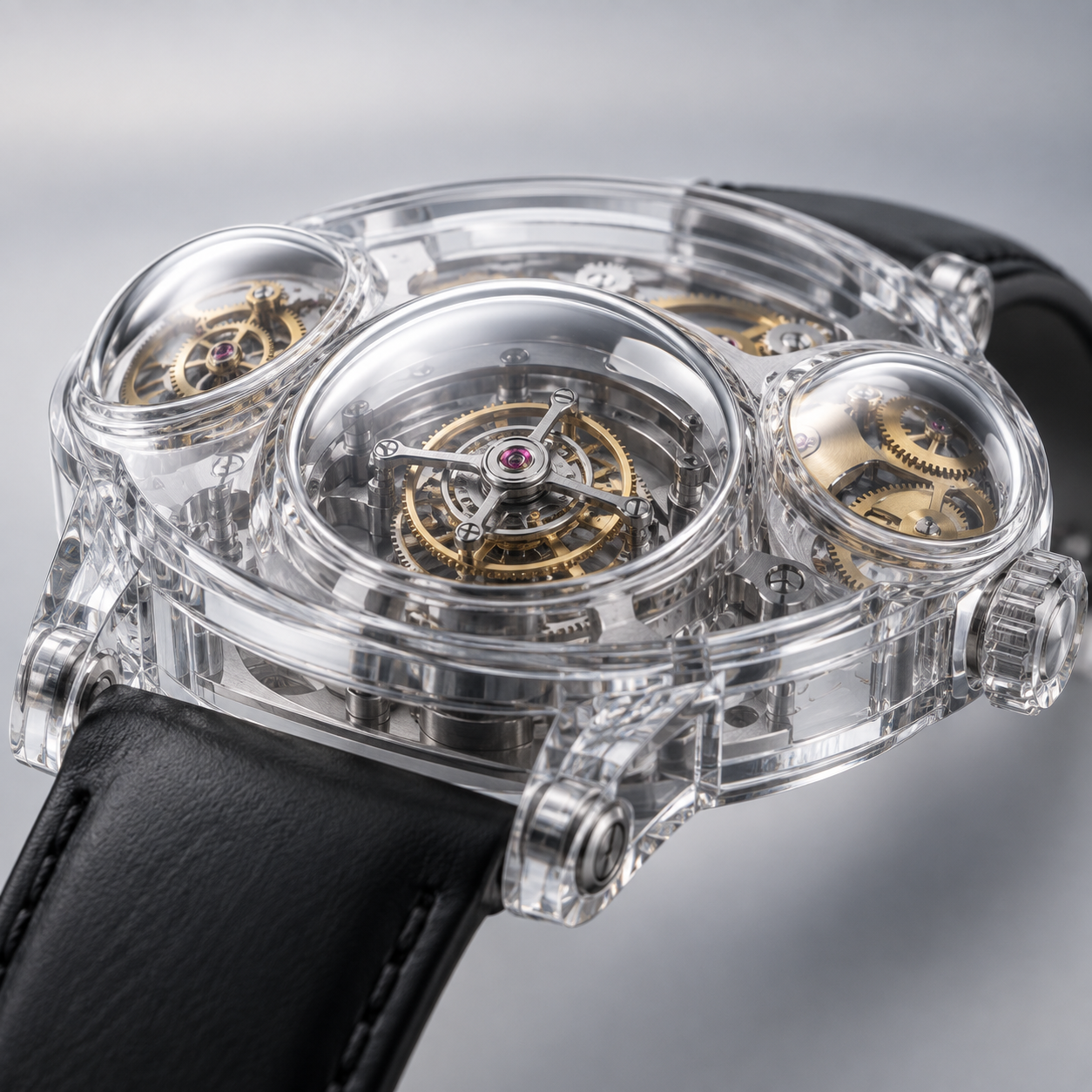
Sapphire watch cases are entering a new stage of development.
For many years, the main objective of a sapphire case was relatively straightforward: create a transparent enclosure that allows the mechanical movement to be viewed from multiple directions.
Today, some high-end watchmakers are going further.
Instead of treating sapphire only as a transparent structural material, designers are beginning to incorporate curved sapphire surfaces that behave like optical elements. Domes, convex windows, concave case flanks and lens-like structures can enlarge specific parts of the movement, increase perceived depth and create visual effects that cannot be achieved with a conventional flat sapphire crystal.
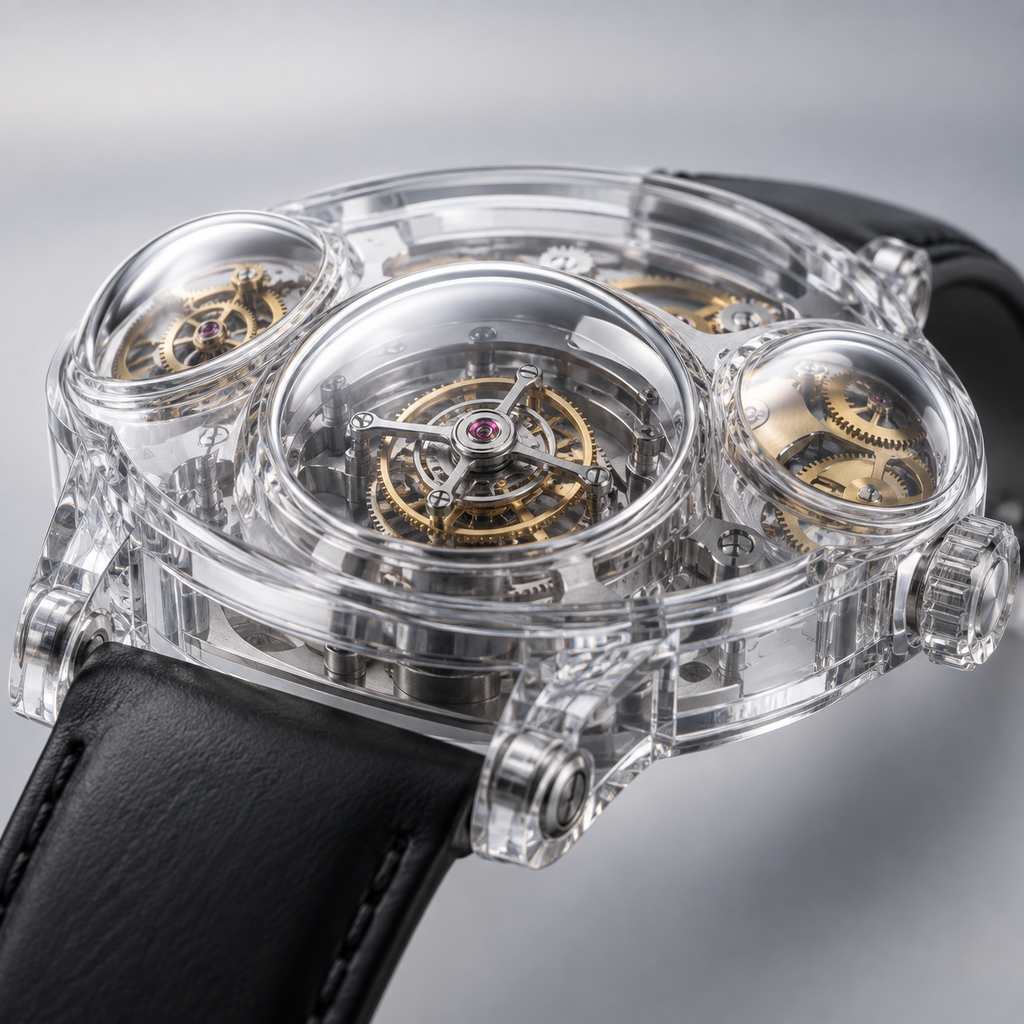
One notable 2026 example is the ArtyA Complexity, presented at Watches & Wonders 2026. Its sapphire architecture incorporates a triple-concave middle and two integrated sapphire domes positioned above its inclined tourbillons. According to ArtyA, the domes function as natural magnifying lenses, while the highly complex case requires successive 5-axis machining and extensive polishing operations.
For sapphire watch case manufacturers, this development represents an important shift.
The challenge is no longer simply:
Can we machine a transparent sapphire case?
The more difficult question is:
Can we machine a sapphire case whose geometry also performs an optical function?
That requires closer control of surface curvature, wall thickness, optical distortion, transition geometry, polishing removal and dimensional consistency.
What Is an Optical-Dome Sapphire Watch Case?
An optical-dome sapphire watch case incorporates one or more deliberately curved transparent surfaces designed to influence how the wearer sees the movement beneath them.
The dome can perform several functions simultaneously:
- Protect the movement
- Form part of the structural case
- Magnify a tourbillon or other complication
- Increase apparent mechanical depth
- Redirect reflected light
- Create visual separation between different movement zones
- Become part of the external case design
This is fundamentally different from installing a conventional flat sapphire crystal on top of a metal case.
The optical surface and the mechanical case structure may be machined from the same sapphire component.
That dramatically increases manufacturing complexity.
Why Optical Domes Are Becoming Interesting in High-End Watchmaking
High-complication movements are increasingly three-dimensional.
Tourbillons, multi-axis regulators, astronomical displays and sculptural bridges often extend vertically rather than remaining within a traditional flat movement architecture.
A flat crystal allows the mechanism to remain visible, but it does not necessarily emphasize its geometry.
A carefully designed sapphire dome can create localized magnification.
For example, if a tourbillon sits beneath a convex sapphire region, the dome may enlarge the apparent dimensions of the cage when viewed from above.
This gives designers another visual tool.
Instead of simply opening a larger window, they can manipulate:
- Magnification
- Apparent depth
- Viewing angle
- Light reflection
- Visual focus
The sapphire itself becomes part of the watch’s optical architecture.
ArtyA describes the two sapphire domes on its 2026 Complexity as natural magnifying lenses positioned over the two inclined regulators. The brand states that the domes are polished to optical tolerances to enhance detail while avoiding notable distortion.
For custom sapphire case development, this concept opens a completely different category of design possibilities.
Sapphire Case Geometry Becomes Lens Geometry
Once a curved sapphire surface is expected to provide magnification, its geometry should no longer be evaluated only as industrial design.
It also needs to be considered as an optical surface.
Important parameters can include:
- Radius of curvature
- Dome height
- Clear aperture
- Local wall thickness
- Inner surface radius
- Outer surface radius
- Dome center position
- Transition radius
- Optical axis
- Distance between dome and movement
- Viewing distance
Small changes in these dimensions can visibly change the appearance of the mechanism underneath.
This means that a designer cannot simply specify:
“Make this area curved.”
The curvature should ideally be defined mathematically in the CAD model.
Inner and Outer Curvature Matter
A sapphire dome normally contains at least two functional surfaces:
Outer surface
This determines the external shape and contributes significantly to optical refraction.
Inner surface
This determines wall thickness and influences how light passes from the movement through the sapphire.
If the two surfaces are poorly coordinated, the dome may introduce unwanted visual effects.
These can include:
- Excessive magnification
- Uneven magnification
- Local distortion
- Movement details appearing stretched
- Visual displacement
- Blurred edges
- Strong reflections
Therefore, controlling only the external shape is insufficient.
Both inner and outer geometries need to be considered during design and manufacturing.
Wall Thickness Uniformity
For a conventional sapphire case wall, moderate changes in thickness may be acceptable if mechanical requirements are satisfied.
For a lens-like sapphire feature, thickness variation can become visually significant.
Consider a dome where the nominal wall thickness is designed to remain relatively consistent.
If polishing removes substantially more material from one side than another, the local optical power can change.
The dome may still look perfectly transparent, but the movement underneath may appear distorted.
This creates a difficult manufacturing requirement:
Cosmetic perfection does not automatically mean optical accuracy.
The component must satisfy both.
Why 5-Axis Machining Is Important
Simple sapphire rings and flat crystals can often be manufactured using relatively straightforward grinding operations.
Optical-dome cases are different.
They may contain continuously changing surface normals, compound curves and transitions between convex and concave regions.
These structures are much better suited to multi-axis machining.
A 5-axis process allows the cutting or grinding tool to approach the sapphire surface from different orientations while maintaining controlled contact with the workpiece.
This is especially useful for:
- Convex domes
- Concave sidewalls
- Organic case profiles
- Undercut-like regions
- Curved internal cavities
- Complex crown openings
- Smooth transitions between surfaces
ArtyA specifically states that its triple-concave sapphire case requires successive 5-axis machining and hand-polishing operations.
This illustrates an important manufacturing trend.
Future luxury sapphire cases are likely to depend increasingly on true three-dimensional machining rather than relatively simple contour grinding.
Rough Machining Cannot Be Treated Like Metal CNC
Sapphire has a Mohs hardness of approximately 9 and is extremely resistant to conventional cutting processes.
It also behaves very differently from titanium or stainless steel.
Sapphire is brittle.
A machining process that creates excessive local force can cause:
- Micro-chipping
- Subsurface damage
- Edge fractures
- Cracking
- Local pits
These defects may become more visible during later polishing.
In severe cases, they can cause an expensive component to fail close to the end of the production process.
Therefore, optical-dome machining generally requires gradual material removal.
The manufacturer needs to balance machining efficiency against damage depth.
Typical Manufacturing Sequence
A simplified process may include:
- Sapphire blank selection
- Crystal orientation confirmation
- Rough external shaping
- Rough internal cavity machining
- Semi-finishing of curved surfaces
- 5-axis precision machining
- Hole and interface machining
- Edge conditioning
- Intermediate dimensional inspection
- Fine grinding
- Pre-polishing
- Multi-surface optical polishing
- Final dimensional inspection
- Optical and cosmetic inspection
- Cleaning
- Assembly testing
The exact sequence depends heavily on case geometry.
A highly complex case may require multiple inspection stages because it becomes increasingly expensive as processing progresses.
Why Multi-Surface Polishing Is Difficult
A simple flat sapphire crystal is comparatively easy to conceptualize.
A curved sapphire case may contain many connected surfaces:
- Convex dome
- Concave sidewall
- Flat sealing face
- Internal cavity
- Chamfer
- Edge radius
- Screw region
- Lug transition
- Crown opening
These surfaces do not exist independently.
They must transition continuously from one to another.
This makes polishing much more difficult.
Polishing Changes Geometry
Polishing is a material-removal process.
This is important because an optical dome may already be close to its final geometry after fine grinding.
If excessive material is removed during polishing, several dimensions can change:
- Dome height
- Radius
- Wall thickness
- Edge thickness
- Flatness
- Transition geometry
For a decorative curved sapphire component, a small change may be acceptable.
For an optical dome, the same change can affect magnification or distortion.
Therefore, polishing allowance should be incorporated into the original machining strategy.
Maintaining Surface Continuity
Another challenge occurs where the dome connects to the rest of the case.
An abrupt transition may create several problems.
Mechanically, it can increase stress concentration.
Optically, it can produce abrupt changes in reflection.
Cosmetically, it may appear as a visible polishing boundary.
A well-designed transition usually incorporates a controlled tangent relationship or blending radius.
This helps create a continuous visual surface.
For high-end sapphire watch cases, such transitions may be among the most difficult regions to finish consistently.
Distortion Control
Perfect transparency is not the same as distortion-free viewing.
A sapphire component can appear completely clear while still changing the apparent position or shape of objects beneath it.
Optical distortion can arise from several factors.
Curvature Error
If the actual surface radius differs from the design, magnification changes.
Uneven Wall Thickness
Local thickness variations may change the optical path through different portions of the dome.
Surface Form Error
Small deviations from the intended 3D surface can cause localized distortion.
Inner-to-Outer Surface Decentration
If the inner and outer curves are not correctly aligned, magnification may become asymmetric.
Polishing Non-Uniformity
Manual polishing can gradually change a carefully machined surface.
This is why optical-dome sapphire cases require dimensional inspection after polishing, not only before it.
Distortion Can Sometimes Be Intentional
Not every optical effect should be eliminated.
Some watch designers may intentionally want:
- Strong magnification
- Edge distortion
- Kaleidoscopic reflections
- Dramatic depth
- Different appearance at different viewing angles
In these cases, the manufacturer’s job is not to minimize distortion but to reproduce the intended optical behavior consistently.
This creates an important distinction between:
Uncontrolled distortion
and
Designed optical distortion.
A good RFQ should clarify which is acceptable.
Positioning the Dome Over the Movement
The position of the sapphire dome relative to the mechanical component underneath is also critical.
Imagine a dome intended to magnify a tourbillon.
If the dome is displaced from the tourbillon center by even a noticeable amount, the visual effect may appear asymmetric.
The required positional relationship can involve:
- X-axis position
- Y-axis position
- Dome center
- Movement center
- Optical axis
- Case datum
- Movement mounting datum
Therefore, the sapphire case and movement architecture should ideally be developed together.
This is particularly important for watches using several optical domes.
Two-Dome and Multi-Dome Sapphire Cases
The 2026 ArtyA Complexity demonstrates the possibility of incorporating two optical domes into one sapphire case, positioned at 12 and 6 o’clock above two inclined tourbillons. Its case measures 42 × 48 × 13 mm and uses a triple-concave sapphire middle around the movement.
From a manufacturing perspective, multiple domes increase difficulty rapidly.
The manufacturer must control:
- Relative dome position
- Individual curvature
- Dome-to-dome symmetry
- Wall thickness between domes
- Transition geometry
- Remaining structural cross-section
- Polishing consistency
A dimensional error that is barely visible on one isolated dome may become obvious when two nominally symmetric domes are placed opposite each other.
Structural Strength Still Matters
Optical performance cannot be considered separately from mechanical reliability.
Sapphire remains a brittle material.
A large protruding dome may create thin regions around its perimeter or sharp curvature transitions.
Potential weak points include:
- Dome-to-case transition
- Thin internal walls
- Nearby screw holes
- Crown openings
- Tight internal radii
- Corners of movement cavities
The designer must therefore balance visual ambition with sufficient sapphire volume.
A beautiful optical feature is not useful if it makes the case excessively fragile during machining, assembly or daily wear.
Internal Stress and Geometry
One reason smooth organic sapphire shapes can be attractive from an engineering perspective is that continuous radii may reduce certain stress concentrations compared with abrupt sharp transitions.
ArtyA states that the curved architecture of the Complexity was developed not only for appearance but also to support structural resistance and limit internal stresses.
This principle is relevant to custom sapphire manufacturing more broadly.
When converting a watch design into sapphire, geometry originally developed for metal should not always be copied directly.
Corners, pockets and wall transitions may need to be redesigned for a brittle crystal material.
Edge Chipping Around Complex Surfaces
Edge chipping remains one of the major production risks in sapphire machining.
Optical-dome structures often contain difficult boundary regions where a curved polished surface terminates at:
- A flat surface
- An opening
- A chamfer
- Another curved surface
These regions need controlled edge treatment.
Too sharp an edge increases chipping risk.
Too large a radius may change the desired visual profile.
This is why edge radius should be specified as part of the engineering drawing instead of being left completely to final polishing.
Surface Quality
For a transparent sapphire case, surface defects can become visually prominent because the user may view the same defect through multiple layers of transparent material.
Typical cosmetic concerns include:
- Scratches
- Pits
- Haze
- Polishing lines
- Edge chips
- Local waviness
- Internal reflection artifacts
- Residual grinding marks
Optical domes add another layer of difficulty because curved surfaces can magnify some defects.
As a result, inspection should consider not only the surface itself but also how defects appear through the completed case.
Measuring Complex Sapphire Surfaces
Traditional calipers and basic gauges are not sufficient for advanced optical-dome cases.
Depending on the specification, inspection methods may include:
- Coordinate measuring machines
- Optical profilers
- 3D scanning
- Form measurement
- Microscopy
- Custom gauges
- Interferometric methods for selected optical surfaces
Important measured parameters may include:
- Dome height
- Surface radius
- 3D profile deviation
- Case dimensions
- Hole location
- Wall thickness
- Parallelism
- Flatness of sealing interfaces
For highly optical surfaces, measurement strategy should ideally be agreed before manufacturing begins.
Cosmetic Inspection Should Use Multiple Viewing Angles
A sapphire case can look perfect under one lighting condition and reveal polishing defects under another.
Final inspection may therefore include:
- Dark-background inspection
- Bright diffuse illumination
- Directional lighting
- Magnified inspection
- Multiple viewing angles
For dome structures, movement simulation or a reference pattern beneath the sapphire can also help evaluate visible distortion.
CAD Data Is Essential
For conventional watch components, a detailed 2D drawing may sometimes be sufficient.
For an optical-dome sapphire case, high-quality 3D CAD data is extremely important.
The file should define:
- Outer surface geometry
- Inner surface geometry
- Dome curvature
- Transition surfaces
- Hole positions
- Datum structure
STEP or another precise solid-model format is generally more useful than mesh-only data for manufacturing.
The accompanying 2D drawing can then specify tolerances and critical dimensions.
Avoid Over-Constraining Every Surface
There is another important DFM consideration.
Specifying extremely tight tolerances on every cosmetic surface can make the component unnecessarily expensive or even impractical.
Instead, engineering drawings should distinguish between:
Optically critical surfaces
and
Cosmetically shaped surfaces.
For example, the central optical dome may require tighter profile control than a non-functional curved sidewall.
This allows manufacturing resources to be focused where they directly influence performance.
What Should Be Included in an RFQ?
For a custom optical-dome sapphire watch case, the RFQ should ideally include the following information.
3D Data
STEP or equivalent CAD file
General Dimensions
Overall width
Overall length
Case height
Maximum dome height
Sapphire Requirements
Synthetic sapphire grade
Transparent or colored sapphire
Crystal orientation if specified
Optical requirements
Dome Geometry
Outer radius
Inner radius
Dome diameter
Dome height
Clear aperture
Required magnification if applicable
Dimensional Tolerances
Profile tolerance
Wall thickness tolerance
Hole tolerance
True position
Flatness
Parallelism
Surface Requirements
Polished areas
Ground areas
Surface quality
Acceptable cosmetic defects
Edge requirements
Optical Requirements
Permitted distortion
Required magnification
Optical inspection method
Critical viewing zone
Assembly Information
Movement position
Case-back design
Crown location
Screw positions
Seal interface
Water-resistance target
Providing these requirements at the quotation stage allows the sapphire manufacturer to perform a meaningful DFM review.
Prototype Before Mass Production
For complex optical sapphire cases, prototype development is particularly valuable.
A first prototype can reveal problems that may not be obvious from a CAD model.
These can include:
- Unexpected optical distortion
- Insufficient magnification
- Excessive magnification
- Difficult polishing transitions
- Fragile wall regions
- Assembly interference
- Unexpected reflections
The designer can then adjust dome radius, thickness or positioning before larger-scale production.
For extremely complicated cases, more than one prototype iteration may be reasonable.
Manufacturing Cost Is Driven by More Than Material Volume
A larger sapphire blank certainly increases raw-material cost.
However, for complex cases, machining and polishing time may dominate.
The ArtyA Complexity illustrates the scale that extremely sophisticated sapphire structures can reach: the manufacturer states that its solid sapphire case requires more than 120 hours of diamond machining and more than 140 hours of polishing.
While these figures should not be treated as typical for all sapphire cases, they illustrate an important principle:
Complexity is often driven by surface geometry rather than simply case size.
A smaller component with multiple convex and concave optical surfaces may be substantially more difficult to manufacture than a larger but geometrically simple sapphire case.
From Transparent Material to Optical Architecture
The next generation of sapphire watch cases may increasingly blur the distinction between:
- Watch case
- Crystal
- Optical lens
- Structural component
- Design element
Instead of placing a separate flat sapphire crystal above the movement, designers can use the case itself to control how the mechanics are viewed.
A tourbillon may sit beneath a sapphire magnifying dome.
An astronomical indication may be viewed through a dedicated curved window.
Several complications may each receive their own optical zone.
Concave and convex surfaces can manipulate reflection and depth across an entire watch.
This creates enormous creative freedom.
But it also raises the manufacturing standard.
Producing such components requires close coordination between industrial design, optical geometry, sapphire machining, polishing, metrology and final assembly.
For custom sapphire watch case projects, the most important step is therefore early DFM evaluation.
Before machining begins, the manufacturer should review the 3D model, identify optically critical surfaces, evaluate minimum wall thickness, study transition radii and determine which dimensions must remain controlled after polishing.
When these factors are considered from the beginning, sapphire can become much more than a transparent case material.
It can become an active optical element within the watch itself.