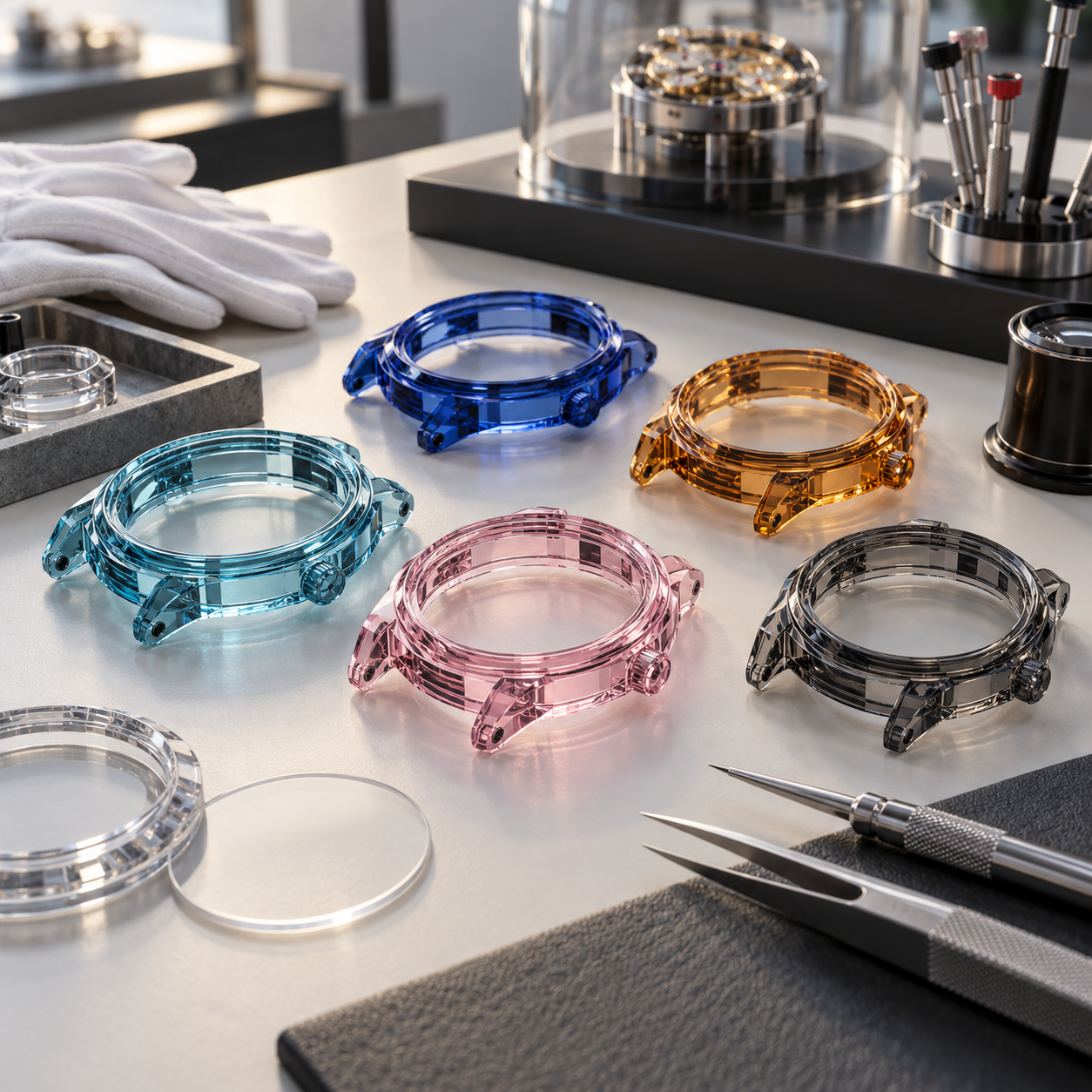
Colored sapphire watch cases are moving beyond novelty.
For luxury watch brands and independent watchmakers, transparent blue, pink, red, amber, smoke and other sapphire colors can now become part of the visual architecture of a watch rather than simply a decorative surface treatment.
But producing a colored sapphire case is significantly more difficult than selecting a color from a digital chart.
The final appearance of a sapphire watch case is determined by the crystal itself, the concentration and distribution of color-producing elements, crystal-growth conditions, blank thickness, finished wall geometry, polishing quality and even the direction from which the finished watch is viewed.
For this reason, the next generation of colored sapphire watch cases will increasingly be defined not only by new colors, but by color consistency, optical homogeneity, defect control and production repeatability.
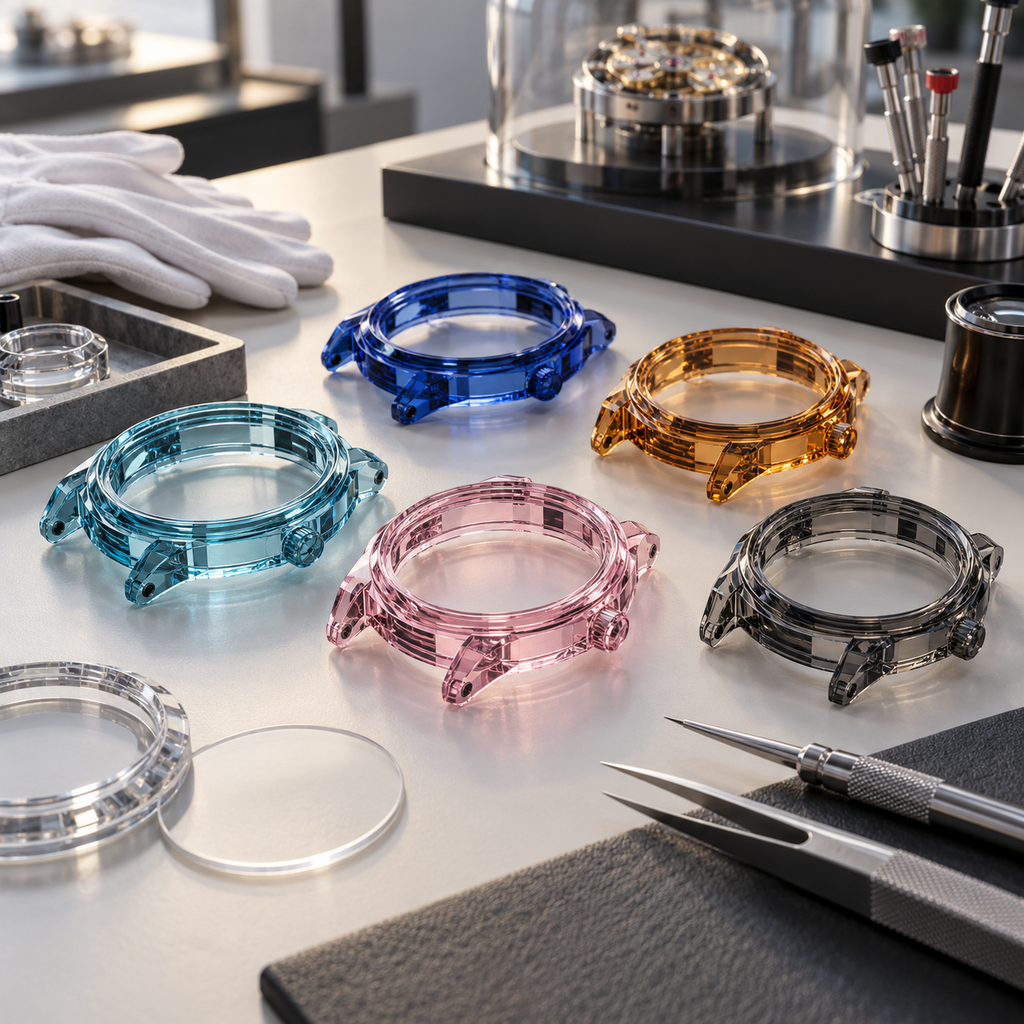
Colored Sapphire Starts Inside the Crystal
Unlike painted, anodized or PVD-coated metal cases, the color of a colored sapphire component is generally created within the sapphire material.
Synthetic sapphire is single-crystal aluminum oxide, Al₂O₃. Controlled incorporation of selected elements during crystal growth can change how the crystal absorbs and transmits visible light.
This is fundamentally different from applying a colored coating after machining.
The advantage is important for watchmaking: the visible color exists through the material rather than only on its outer surface. Deep polishing, curved surfaces and transparent sidewalls can therefore maintain a three-dimensional color effect that is difficult to reproduce with conventional metal finishing.
The challenge is equally important.
Once color becomes part of the crystal-growth process, the watch-case manufacturer must consider not only geometry and surface finish but also the optical quality and uniformity of the starting sapphire blank.
A nominal specification such as “blue sapphire” is therefore not enough for a production project.
Two blue sapphire blanks may have noticeably different saturation, transmission or color distribution even when both fall into the same general color family.
Why Crystal Doping Is Closely Connected to Defect Control
Recent sapphire crystal-growth research highlights an important manufacturing issue: changing dopant conditions can also change the behavior of defects inside the growing crystal.
For example, research on chromium-containing sapphire has shown that increasing chromium content can increase red or pink coloration while growth conditions simultaneously influence bubble entrapment.
Studies of titanium-doped sapphire have also demonstrated that dopant concentration can alter melt convection and the distribution, morphology and location of bubbles within the crystal.
For watch-case applications, this matters because a case is much larger and more visually exposed than a small optical component.
A bubble or inclusion that might be acceptable in a hidden technical component can become immediately visible in:
a polished lug,
a transparent case flank,
a thick corner,
the bezel,
or the area surrounding a crown opening.
Once the entire movement is visible through the case, the sapphire itself becomes part of the cosmetic surface.
This means that crystal growth quality directly affects both machining yield and final visual acceptance.
Color Uniformity Is More Difficult in a Three-Dimensional Watch Case
A colored sapphire watch case does not have a constant optical path length.
Some sections may be only a few millimeters thick, while lugs, shoulders, structural bridges and screw areas may contain much more sapphire.
As light travels through more material, the perceived saturation can increase.
A relatively light blue sapphire blank can therefore produce:
lighter-colored thin sidewalls,
medium saturation through flat sections,
and noticeably darker areas around thick lugs or structural corners.
This effect can be intentional and visually attractive, but it must be considered during product development.
A color approved using a small flat reference coupon may not look identical after the material is transformed into a complex 44 mm watch case.
This is one reason why physical samples at representative thicknesses are far more useful than relying exclusively on Pantone numbers, screen images or digital renderings.
The geometry itself becomes part of the color specification.
Transparency and Saturation Must Be Balanced
More color is not always better.
For skeletonized watches and highly complicated movements, the purpose of a sapphire case is often to expose as much of the movement architecture as possible.
Increasing saturation can create a stronger visual identity, but excessive optical absorption may reduce movement visibility.
Designers therefore have to balance two competing objectives:
color intensity and structural transparency.
A light sea-blue sapphire may provide strong visual distinction while maintaining excellent visibility of bridges, gears and tourbillon structures.
A deeper royal-blue direction may create a stronger visual statement but alter the brightness and apparent contrast of the movement inside.
The optimum specification depends on the watch.
A colored sapphire case designed around an openworked movement may require a different optical target from a case intended primarily as a bold exterior design element.
This is why optical evaluation should be performed with the actual movement, dial architecture, case-back structure and surrounding metal components whenever possible.
Wall Thickness Becomes a Color-Engineering Parameter
With conventional case materials, wall thickness is mainly a structural and manufacturing consideration.
With transparent colored sapphire, it is also an optical parameter.
Imagine one sapphire case containing a 2.0 mm transparent wall, a 4.5 mm lug area and a substantially thicker structural shoulder.
Even if all three regions come from the same crystal, they may not appear to have exactly the same color.
Internal reflections make the problem more complex.
Curved walls, chamfers, polished internal surfaces and adjacent titanium or gold components can change the way light travels through the case.
As a result, CAD development for a colored sapphire case should consider not only machining access and mechanical strength, but also how local material volume influences the finished appearance.
For highly visible luxury projects, a prototype remains one of the most reliable ways to validate these interactions before series production.
Batch Matching Is One of the Most Important Production Challenges
A prototype can be beautiful and still be difficult to manufacture consistently.
For a limited edition of 20, 50, 100 or several hundred watches, the challenge changes from producing one attractive colored case to producing many cases that appear to belong to the same collection.
Batch matching may involve the case middle, bezel, case back and sometimes additional sapphire components.
If these parts come from different crystal-growth batches, small differences in saturation or optical transmission may become visible when assembled side by side.
This is especially noticeable when two polished sapphire components directly touch each other.
Production planning should therefore consider raw-material allocation at the beginning of the project.
Where possible, parts intended to form one visible assembly should be produced from material whose optical appearance has been evaluated for compatibility.
For demanding projects, batch records can include raw-crystal identification, blank allocation, machining history, polishing stage and final cosmetic inspection results.
This turns color control into a traceable manufacturing process rather than a subjective final inspection.
Polishing Can Change How the Same Sapphire Color Is Perceived
Surface finishing also influences color appearance.
A high-polished sapphire surface creates strong reflections and maximum clarity. Light travels through the component with relatively little surface scattering, making internal structures highly visible.
A frosted or matte area behaves differently.
Instead of producing mirror-like reflections, it diffuses light and can make the same sapphire material appear softer, lighter or more opaque.
Combining polished and frosted surfaces can therefore create interesting visual contrast without changing the sapphire chemistry.
However, mixed finishing increases manufacturing complexity.
Transitions between polished and frosted zones must be precisely controlled, especially around corners, grooves, logos and narrow structural areas.
The designer should therefore determine cosmetic surfaces early enough for the manufacturing process to be planned around them.
Defects Affect Both Appearance and Production Yield
Colored sapphire cases already require long machining and polishing processes because sapphire is extremely hard and brittle.
An internal defect makes this process even more challenging.
A bubble or inclusion may not always be visible when the initial blank is inspected from one direction. After material is removed during CNC grinding and polishing, the defect may become exposed or move closer to a critical cosmetic surface.
The component may already have accumulated substantial machining value by that stage.
This is why incoming blank inspection is directly connected to production economics.
Typical inspection objectives include identifying major internal inclusions, bubbles, cracks, abnormal color zones and other defects that could affect final appearance or structural integrity.
The stricter the cosmetic requirements, the greater the importance of selecting suitable material before complex machining begins.
Improving yield does not simply mean machining faster.
It means preventing unsuitable material from entering expensive downstream processes.
From Prototype Color to Production Color Standard
One of the most effective approaches for a custom colored sapphire watch project is to establish an approved physical sample.
That sample becomes the visual reference for later production.
Color evaluation should ideally be performed under controlled lighting and with a defined representative thickness.
The acceptance standard can then account for reasonable variation rather than attempting to define sapphire using a digital RGB or Pantone value alone.
For multi-component cases, evaluation should also be performed after assembly.
A sapphire bezel inspected independently may appear acceptable but still look slightly different once mounted next to the case middle.
Final approval should therefore consider the watch as a complete optical system.
Production Yield Must Be Designed From the Beginning
The production yield of colored sapphire cases depends on several stages working together.
Crystal quality determines whether the blank contains acceptable color and internal defects.
Blank orientation and cutting determine how efficiently suitable material is used.
CNC machining determines whether complex features can be produced without excessive edge damage.
Grinding and polishing determine clarity and final geometry.
Inspection determines whether cosmetic differences remain within the agreed standard.
A design that ignores these relationships may be technically machinable but commercially difficult to produce.
For example, extremely sharp internal corners, very thin walls next to thick colored structures, deep narrow holes and large polished transitions can significantly increase manufacturing risk.
Early design-for-manufacturing review is therefore especially valuable for colored sapphire projects.
The objective is not necessarily to simplify the watch.
It is to preserve the designer’s visual concept while identifying where small geometric changes can improve machining stability and production yield.
The Future of Colored Sapphire Watch Cases
The evolution of sapphire watchmaking is increasingly moving from simply demonstrating that a transparent case can be manufactured to controlling exactly how that case looks.
Recent luxury-watch releases continue to demonstrate demand for transparent colored sapphire structures, particularly blue-toned cases paired with skeletonized movements.
The next stage is likely to focus more heavily on repeatability.
Watch brands will increasingly expect manufacturers to control not only dimensional tolerances but also crystal quality, color distribution, optical clarity, component matching and cosmetic consistency across an entire production batch.
That changes the definition of a successful colored sapphire case.
It is no longer enough for one prototype to look spectacular.
The real manufacturing challenge is producing the second, twentieth and hundredth case with the same visual identity.
For high-end watchmakers, this combination of crystal engineering, precision machining, optical control and batch-level quality management is what will define the next generation of colored sapphire watch cases.
Developing a Custom Colored Sapphire Watch Case
For a new colored sapphire case project, the engineering discussion should begin with more than the requested color.
The movement dimensions, case architecture, representative wall thickness, sapphire components, crystal orientation requirements, cosmetic surfaces, surface finishes, target production quantity and acceptable color variation should all be considered together.
A drawing, 3D model and physical color reference allow the sapphire manufacturer to evaluate the project more accurately before quotation and prototype production.
For complex projects, early material selection and engineering review can significantly reduce the risk of color mismatch, unexpected optical effects and low production yield.