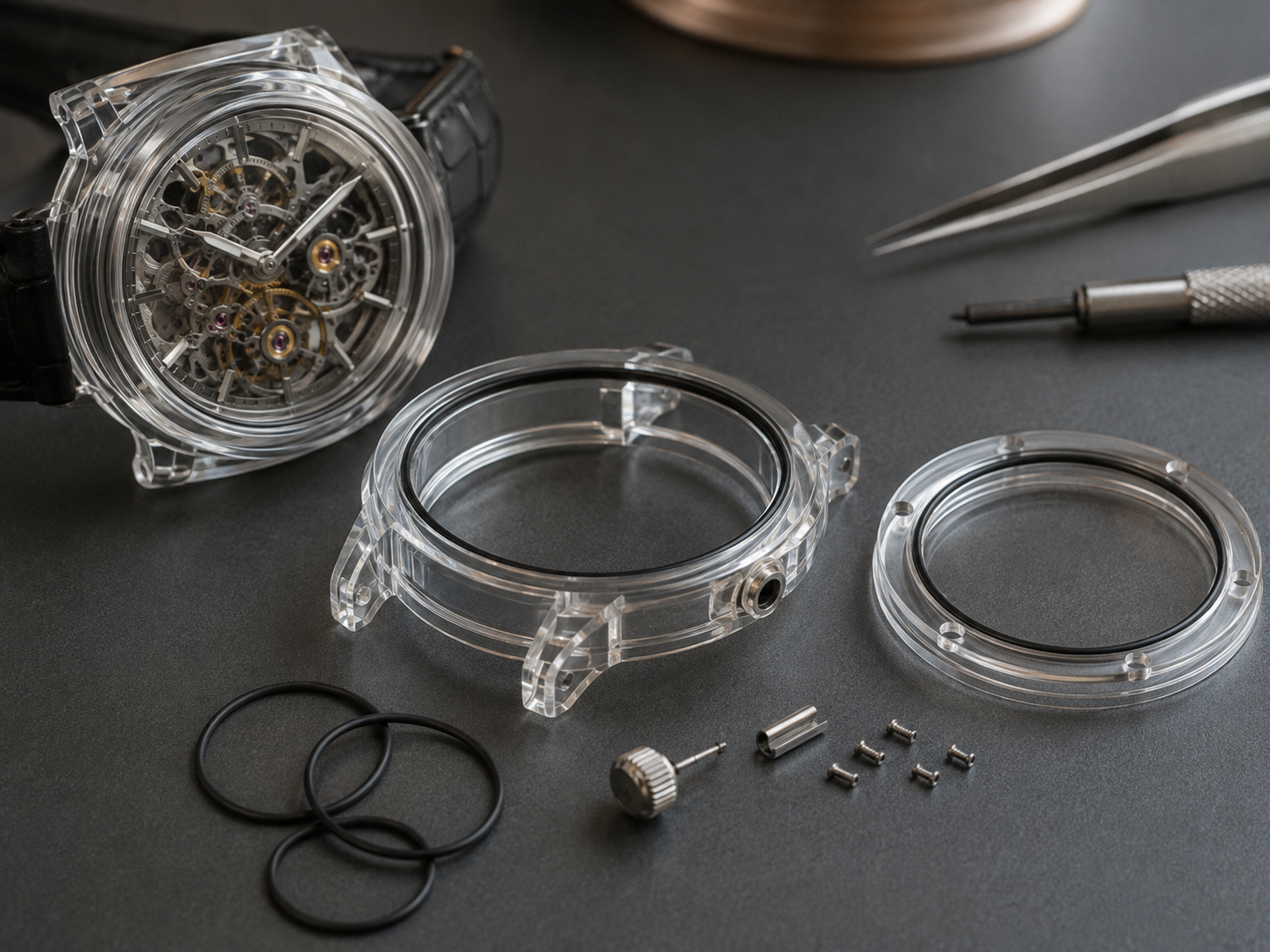
A transparent sapphire watch case creates a very different engineering challenge from a conventional stainless-steel or titanium case.
The material is extremely hard, highly scratch resistant and optically transparent, but sapphire is also a brittle single-crystal material. It does not tolerate localized stress, sharp internal corners or uncontrolled screw loading in the same way as a metal case.
For this reason, creating a water-resistant sapphire watch case is not simply a matter of copying the sealing structure of an existing metal watch.
The complete system must be designed around the mechanical behavior of sapphire.
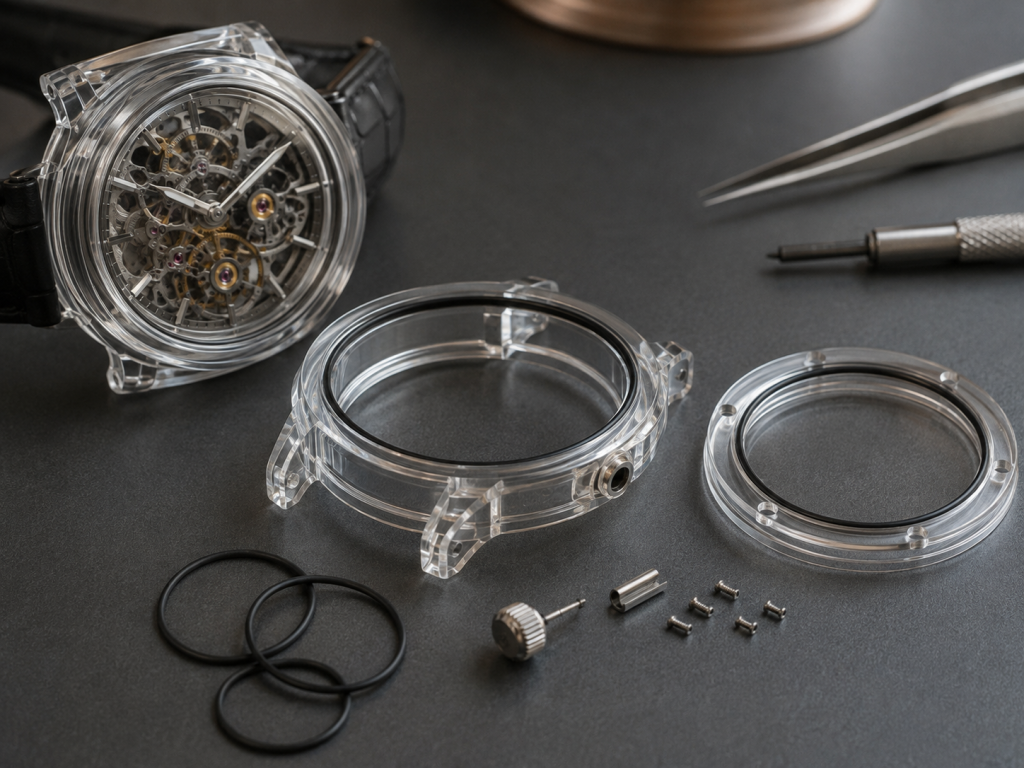
Key areas include:
- gasket groove geometry
- gasket compression
- bezel and caseback interfaces
- screw preload
- crown and stem sealing
- crystal sealing
- dimensional tolerances
- surface quality
- pressure testing
- prototype validation
For watch brands and engineering teams developing a custom sapphire watch case, these details should be considered before prototype machining begins.
Why Water Resistance Is More Difficult With Sapphire
Water resistance depends on controlled compression between multiple components.
In a conventional metal watch case, the housing can tolerate a certain amount of elastic deformation during assembly. Threads, screw seats and sealing surfaces can also be machined with relatively high design freedom.
Sapphire behaves differently.
Because sapphire is very hard and comparatively brittle, excessive local pressure can create:
- edge chipping
- microcracks
- stress concentration
- cracking around holes
- cracking near sharp corners
- damage during screw tightening
This means a sapphire watch case must achieve sufficient gasket compression without creating excessive structural load.
The engineering objective is therefore not maximum tightening force.
It is controlled and evenly distributed sealing force.
Water Resistance Is a System, Not a Single Gasket
A watch case can contain several potential leakage paths.
Typical sealing locations include:
- front crystal interface
- bezel interface
- caseback interface
- crown tube
- winding stem
- pushers
- screws
- decorative inserts
- case joints
A successful design must control every path.
If one gasket seals perfectly but the crown system leaks, the entire watch fails the water-resistance requirement.
This is why sapphire case development should begin with a sealing map.
The engineering team should identify every opening between the external environment and the movement cavity.
Each opening then requires a defined sealing strategy.
Gasket Groove Design Is Critical
The gasket groove determines how the sealing element is positioned and compressed.
If the groove is too deep, the gasket may not receive enough compression.
If it is too shallow, excessive compression can increase assembly force and create damaging stress in the sapphire.
The groove must therefore be designed according to:
- gasket cross-section
- gasket material
- target compression
- sealing direction
- assembly method
- operating pressure
- dimensional tolerance
- thermal expansion
- service requirements
There is no universal groove dimension that works for every sapphire case.
The gasket manufacturer’s compression recommendations should be considered together with the actual watch-case geometry.
O-Ring vs. Flat Gasket
Two common sealing concepts are O-rings and flat gaskets.
O-Ring Sealing
O-rings are widely used because they provide predictable elastic compression.
They may be suitable for:
- casebacks
- crowns
- tubes
- cylindrical interfaces
- certain bezel structures
Advantages include relatively simple geometry and good repeatability.
However, the groove must prevent excessive gasket displacement or extrusion during assembly.
Flat Gasket Sealing
Flat gaskets can provide a larger sealing contact area.
They may be used between:
- sapphire case and caseback
- bezel and middle case
- sapphire and metal interfaces
Flat gaskets can work well when compression is distributed across a broad, flat surface.
For sapphire, this can be beneficial because distributed load is generally preferable to concentrated point loading.
Gasket Compression Must Be Controlled
A gasket seals by being compressed.
Too little compression may cause leakage.
Too much compression can create several problems:
- excessive assembly force
- permanent gasket deformation
- increased friction
- distortion of adjacent parts
- excessive stress in sapphire
- difficulty during servicing
For metal cases, slight case deformation may absorb part of this force.
For sapphire cases, designers should be more conservative.
Compression should be controlled through geometry rather than through aggressive tightening.
A properly designed sealing system should reach the required gasket compression before the sapphire structure experiences dangerous loading.
Groove Corners Should Avoid Sharp Stress Concentrations
Sharp internal corners are generally undesirable in sapphire components.
This applies to gasket grooves as well.
A sharply machined rectangular groove can create stress concentration at its corners, especially when the groove is close to the outer edge of the case.
Where design allows, appropriate radii should be introduced.
The design should also maintain sufficient material around the groove.
Particular attention is required near:
- lugs
- screw holes
- crown openings
- thin case walls
- narrow structural bridges
A gasket groove should never weaken a critical structural area unnecessarily.
Surface Finish Affects Sealing Performance
A gasket seals against a physical surface.
Therefore, the quality of that surface matters.
A sealing face with:
- grinding marks
- scratches
- chips
- uneven polishing
- local waviness
can create potential leakage paths.
For sapphire watch cases, sealing surfaces should be specifically identified on the engineering drawing.
They may require different finishing requirements from purely decorative areas.
The surface should be smooth enough to create consistent gasket contact while maintaining dimensional accuracy.
Flatness Can Be More Important Than Visual Polishing
A highly polished surface is not automatically a good sealing surface.
If the interface is not sufficiently flat, the gasket may receive uneven compression.
One section may be tightly compressed while another receives insufficient sealing pressure.
This is particularly important for large sapphire casebacks or transparent sapphire middle cases.
Critical sealing interfaces should therefore consider:
- flatness
- parallelism
- surface roughness
- dimensional tolerance
Optical appearance and mechanical sealing performance must be controlled separately.
Screw Load Is One of the Biggest Risks
Many sapphire watch cases use screws to connect the bezel, middle case and caseback.
This creates a critical engineering issue.
The screws must generate enough clamping force to compress the gasket.
But excessive screw torque can crack the sapphire.
The problem becomes especially serious when:
- screws are close to an edge
- holes are small
- surrounding sapphire is thin
- screw loading is uneven
- sharp counterbores are used
- metal screws contact sapphire directly
Screw design therefore deserves much more attention in sapphire watches than in conventional metal cases.
Torque Is Not the Same as Clamping Force
A common mistake is to specify screw torque without considering the actual clamping system.
The same torque can produce different preload depending on:
- thread condition
- lubrication
- screw material
- thread pitch
- friction
- washer design
- contact geometry
The real objective is controlled clamping force.
During prototype development, tightening procedures should therefore be validated experimentally.
Production assembly should use a repeatable torque-control method rather than manual tightening by feel.
Load Distribution Is Essential
Point loading should be minimized.
Instead of allowing a small screw head to press directly against a thin sapphire surface, the design can use structures that distribute the load over a larger area.
Depending on the design, this may include:
- metal washers
- metal inserts
- load-distribution plates
- larger contact surfaces
- controlled counterbores
- intermediate metal structures
The purpose is to prevent high localized stress from entering the sapphire.
This is especially important near countersunk screws.
Aggressive countersink geometries can create wedge-like forces and should be evaluated carefully.
Screw Tightening Sequence Matters
Even a well-designed case can be damaged by incorrect assembly.
If one screw is fully tightened before the others, the caseback may tilt and create uneven gasket compression.
The sapphire may also experience asymmetric stress.
A better approach is progressive tightening.
For example, multiple screws can be tightened in a cross pattern or another balanced sequence.
The process may involve:
- Positioning all screws
- Light initial tightening
- Progressive cross-pattern tightening
- Final controlled torque
- Verification after assembly
The exact sequence depends on the case geometry.
The principle is simple:
Apply sealing load gradually and evenly.
Crown Sealing Is Often the Most Difficult Area
The crown is one of the most common dynamic sealing locations in a mechanical watch.
Unlike a static caseback gasket, the crown must allow movement.
The system may experience:
- rotation
- axial movement
- pulling
- pushing
- repeated winding
- time-setting cycles
This makes the crown system particularly important in water-resistant sapphire watches.
Sapphire Crown Holes Require Careful Design
A crown opening creates a hole through the sapphire case wall.
This automatically creates a stress-sensitive region.
Important design factors include:
- hole diameter
- wall thickness
- distance from surrounding edges
- internal radius
- crown tube geometry
- movement stem alignment
A small hole positioned too close to a sharp corner can substantially increase machining and structural risk.
The crown opening should therefore be considered early in the case design.
Metal Crown Tubes Can Simplify the Sealing System
In many designs, using a metal crown tube can provide practical advantages.
The tube can create a controlled interface between the crown assembly and the sapphire case.
Possible benefits include:
- easier gasket integration
- more predictable mechanical contact
- improved serviceability
- better control of threaded connections
- reduced wear on sapphire
The metal tube must still be integrated carefully.
Its installation method should avoid excessive radial expansion or interference stress against the sapphire.
Press-fit concepts should be evaluated particularly carefully because excessive interference can introduce dangerous tensile stress.
Crown Gaskets May Use Multiple Sealing Points
Depending on the required watch architecture, a crown assembly may use more than one sealing location.
Possible sealing positions include:
- crown-to-tube interface
- stem interface
- tube-to-case interface
The exact design depends on whether the crown is:
- push-pull
- screw-down
- decorative
- integrated into a crown guard
For higher water-resistance requirements, redundant sealing points may improve reliability.
However, additional gaskets also increase friction and assembly complexity.
Crown Stem Alignment Is Critical
The movement and crown system must share a precise centerline.
Misalignment can create side loading on:
- stem
- crown tube
- seals
- movement components
In a sapphire case, side loading can also transfer undesirable force into the crown opening.
Critical dimensions should therefore reference a consistent datum system between:
- movement seat
- crown hole
- crown tube
- case exterior
This is one reason a 3D STEP file and detailed 2D engineering drawing are extremely important for custom sapphire case projects.
Screw-Down Crowns Need Special Attention
A screw-down crown can improve sealing reliability, but it also introduces additional mechanical forces.
Thread engagement creates axial load.
If the structural load path is poorly designed, this force can be transmitted into the sapphire case.
Ideally, the threaded and load-bearing functions should be handled by suitable metallic structures rather than relying on delicate sapphire threads in high-stress locations.
This can improve:
- durability
- serviceability
- thread life
- assembly repeatability
Sapphire Threads Are Possible but Not Always Ideal
Threads can technically be machined into sapphire in some geometries.
However, they require careful evaluation.
Internal threads create:
- small radii
- thin tooth geometry
- stress concentration
- difficult machining conditions
For critical structural connections, a metal threaded insert may provide a more robust solution.
The objective should not be to maximize the amount of sapphire used.
The objective should be to use sapphire where it provides optical and structural value while allowing metal components to manage high local loads where appropriate.
Caseback Sealing Requires Uniform Compression
The caseback is another major sealing interface.
For a sapphire caseback or transparent middle case, the gasket should be compressed evenly around the entire perimeter.
Designers should consider:
- gasket position
- screw spacing
- screw quantity
- sealing surface width
- caseback stiffness
- flatness
- assembly sequence
If screws are too far apart, local gasket compression may vary.
If screws are placed too close to the sapphire edge, structural risk increases.
The design therefore requires a balance between sealing performance and sapphire strength.
Monobloc Sapphire Cases Reduce Some Interfaces
A monobloc sapphire case can eliminate certain joints between traditional case components.
This may reduce the number of static sealing interfaces.
However, a monobloc design does not eliminate the need for water-resistance engineering.
Openings are still required for:
- movement installation
- caseback
- crown
- crystal
- pushers
The remaining interfaces may become even more critical because there are fewer alternative assembly options.
Multi-Part Cases Offer More Sealing Flexibility
A multi-part sapphire case can provide greater flexibility during development.
Separate components may include:
- bezel
- middle case
- caseback
- crown structure
This allows each interface to be engineered independently.
It can also simplify:
- polishing
- machining
- gasket installation
- servicing
- movement assembly
The disadvantage is that each additional joint creates another potential leakage path.
Therefore, multi-part sapphire cases require careful dimensional stack-up analysis.
Dimensional Tolerance Controls Gasket Performance
Gasket compression depends on actual assembled dimensions.
If multiple components each have relatively large tolerances, the final compression can vary significantly.
This is known as tolerance stack-up.
For example, the final compression may depend on:
- groove depth
- caseback thickness
- gasket thickness
- seating surface position
- screw contact height
Each dimension may be individually acceptable while the assembled result falls outside the desired sealing condition.
For this reason, tolerance analysis should be performed at the assembly level.
Polishing Can Change Critical Dimensions
Sapphire components often require extensive polishing.
Polishing removes material.
For decorative surfaces, this may not create a functional problem.
For sealing interfaces, however, excessive polishing can change:
- groove depth
- sealing surface height
- wall thickness
- edge geometry
The manufacturing drawing should therefore distinguish between:
- decorative polished surfaces
- critical dimensional surfaces
- gasket sealing surfaces
Polishing allowance should be considered before final dimensions are established.
Pressure Testing Must Be Part of Prototype Development
Water resistance should never be assumed from CAD design alone.
The finished watch case must be tested.
Prototype testing helps verify:
- gasket design
- compression
- screw load
- crown sealing
- crystal sealing
- overall case integrity
Testing should be performed after complete assembly because the performance of the sealing system depends on the interaction of all components.
Dry Pressure Testing
Dry pressure testing can detect case leakage without exposing the watch to water.
The test normally evaluates how the case responds to controlled pressure changes.
Advantages include:
- reduced risk to the movement
- fast prototype screening
- useful production inspection
Dry testing is especially useful during early development.
If the case fails, the engineering team can investigate the sealing system before performing more aggressive testing.
Wet Pressure Testing
Wet testing exposes the assembled case to water under controlled conditions.
Depending on the test method, the watch may be subjected to specified pressure and time conditions.
This can provide more direct verification of actual water resistance.
For prototype development, testing should be conducted carefully, especially if a valuable movement is installed.
Dummy movements or non-functional assembly components may be used during early validation.
Pressure Testing Should Reflect the Product Requirement
A watch marketed for normal daily use has different requirements from a watch designed for swimming or diving.
The engineering team should establish the target water-resistance level before designing the gasket system.
This affects:
- gasket selection
- case wall design
- screw load
- crown structure
- crystal sealing
- testing method
It is inefficient to design the entire case first and decide the pressure requirement only at the end.
Test Above Nominal Conditions During Development
Prototype validation should include suitable engineering safety margins rather than merely checking whether the watch survives one nominal test.
The purpose of development testing is to identify weaknesses before production.
The exact validation conditions should be established according to:
- intended product specification
- applicable watch testing requirements
- customer requirements
- case geometry
- gasket system
Production testing can then be standardized after the design has been validated.
Repeated Testing Can Reveal Assembly Problems
A case may pass one pressure test and still have long-term reliability issues.
Development teams may therefore consider repeated cycles involving:
- opening
- reassembly
- gasket replacement
- repeated pressure testing
This helps identify whether the sealing performance is sensitive to assembly variation.
For a production watch, repeatability is just as important as achieving one successful prototype.
Prototype Testing Should Include the Crown
Testing only the static case is not enough.
The crown system should also be evaluated.
Depending on the design, testing may include:
- crown closed
- crown after repeated winding
- crown after setting operations
- crown after reassembly
The objective is to confirm that normal operation does not compromise sealing performance.
Common Causes of Water-Resistance Failure
Typical problems in custom sapphire watch cases can include:
Insufficient Gasket Compression
The seal does not generate enough contact pressure.
Excessive Gasket Compression
Assembly force becomes too high and can create excessive sapphire stress.
Uneven Screw Load
One area is over-tightened while another is insufficiently compressed.
Poor Sealing Surface Flatness
The gasket cannot maintain continuous contact.
Crown Misalignment
The stem and tube generate uneven seal loading.
Surface Defects
Scratches or chips cross the sealing path.
Dimensional Stack-Up
Individual components meet drawing requirements but the final assembly does not.
Incorrect Assembly Procedure
Uncontrolled screw torque or gasket installation causes inconsistent results.
Designing for Serviceability
Luxury watches may be opened many times during their service life.
A sapphire case should therefore be designed not only for initial assembly but also for maintenance.
Serviceability considerations include:
- gasket replacement
- screw accessibility
- crown tube replacement
- caseback removal
- controlled reassembly
The design should minimize the risk of damaging sapphire during routine service.
Metal inserts and replaceable sealing components can be valuable when they isolate the sapphire from repeated mechanical wear.
Recommended Development Workflow
A practical custom sapphire watch case development process can follow these stages:
1. Define the Water-Resistance Requirement
Determine the intended use and pressure specification.
2. Create a Sealing Map
Identify every possible leakage path.
3. Design the Gasket Interfaces
Select gasket type, groove geometry and compression strategy.
4. Review Sapphire Stress Areas
Check holes, sharp corners, thin walls and screw locations.
5. Define Screw Load Strategy
Design load-distribution features and assembly torque control.
6. Engineer the Crown System
Confirm crown tube, stem alignment and gasket structure.
7. Analyze Dimensional Stack-Up
Verify that all tolerance combinations maintain adequate sealing.
8. Manufacture Prototype Components
Machine and polish the sapphire case according to final design intent.
9. Trial Assembly
Confirm gasket fit, screw loading and movement installation.
10. Pressure Test
Perform appropriate dry and/or wet testing.
11. Inspect for Damage
Check for chips, cracks, gasket deformation and sealing-surface problems.
12. Optimize Before Production
Adjust groove dimensions, assembly procedure or structural geometry where necessary.
What Information Should Be Provided for a Custom Sapphire Watch Case?
For an initial engineering review, the following information is useful:
- 2D engineering drawing
- 3D STEP file
- overall case dimensions
- sapphire color
- movement dimensions
- crown position
- crown tube design
- gasket specifications
- target water resistance
- screw locations
- screw material
- caseback structure
- bezel structure
- required tolerances
- polished surfaces
- prototype quantity
- estimated production quantity
The earlier these details are available, the easier it is to identify potential manufacturing and sealing risks.
Conclusion
Designing a water-resistant sapphire watch case requires a different engineering approach from designing a conventional metal case.
The material offers exceptional hardness, scratch resistance and transparency, but its brittle behavior means concentrated mechanical loads must be controlled carefully.
The most important principles are:
- control gasket compression through geometry
- distribute screw load evenly
- avoid sharp stress concentrations
- maintain high-quality sealing surfaces
- align the crown and movement accurately
- analyze dimensional stack-up
- control assembly torque
- validate the complete case with pressure testing
Water resistance should never be treated as an afterthought.
For sapphire watches, the sealing system should be integrated into the case architecture from the earliest design stage.
When gasket geometry, mechanical loading, polishing, tolerances and assembly are engineered together, a sapphire case can combine structural transparency with reliable everyday performance.
Custom Water-Resistant Sapphire Watch Case Manufacturing
We support custom sapphire watch case development for watch brands, independent watchmakers and engineering teams.
Available options can include:
- clear sapphire watch cases
- colored sapphire watch cases
- monobloc sapphire cases
- multi-part sapphire cases
- sapphire bezels
- sapphire casebacks
- sapphire crowns and structural parts
- skeleton watch cases
- prototype development
- small-batch manufacturing
Technical review can include:
- gasket groove feasibility
- wall-thickness evaluation
- screw-hole positioning
- internal radius optimization
- crown opening design
- polishing accessibility
- assembly structure
- movement-to-case clearance
For a new project, send us your 2D drawings, STEP files, target water-resistance requirement, sapphire color and estimated quantity for technical evaluation.
FAQ
Can a full sapphire watch case be water resistant?
Yes. A sapphire watch case can be designed for water resistance when the gasket interfaces, crown system, screw loading and dimensional tolerances are properly engineered and validated through testing.
Can a metal watch case sealing design be copied directly into sapphire?
Not always. Sapphire is much more brittle than common watch-case metals, so screw loading, sharp corners, thin walls and gasket compression may require redesign.
Why is screw torque important in a sapphire watch case?
Excessive or uneven tightening can create localized stress around screw holes and case edges. Controlled torque and balanced tightening help distribute the sealing load more evenly.
Are O-rings suitable for sapphire watch cases?
Yes. O-rings can be used in many sapphire case designs, but groove geometry and compression should be selected according to the gasket specification and the actual sealing structure.
Is a screw-down crown required for water resistance?
Not necessarily. Different crown structures can achieve water resistance, but the crown tube, gasket system, stem alignment and intended pressure requirement must be considered together.
Should the sapphire case be pressure tested before production?
Yes. Prototype pressure testing is essential because real water resistance depends on the interaction between the sapphire components, gaskets, screws, crown and assembly process.
Why are metal inserts sometimes used in sapphire watch cases?
Metal inserts can help handle threads, screw loads, repeated servicing and other concentrated mechanical loads while reducing stress on the surrounding sapphire.