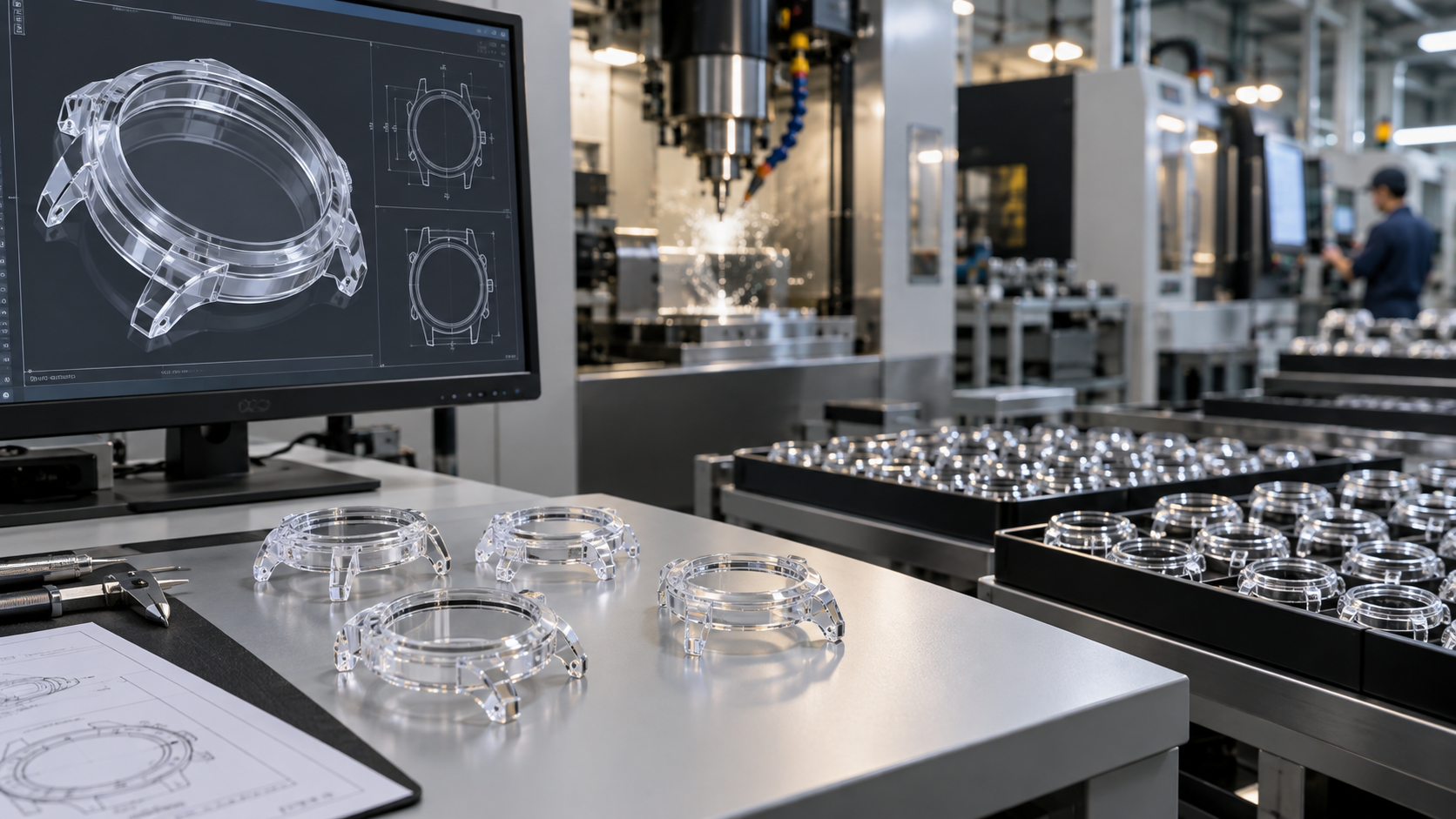
Developing a custom sapphire watch case is very different from ordering a conventional metal watch case.
A CAD model may look complete on screen, but sapphire introduces a different set of manufacturing challenges. Complex cavities, thin walls, drilled holes, polished internal surfaces, sharp transitions and tight assembly tolerances can all affect whether a design is practical to manufacture repeatedly.
For this reason, most serious custom sapphire watch case projects should not move directly from drawing to mass production.
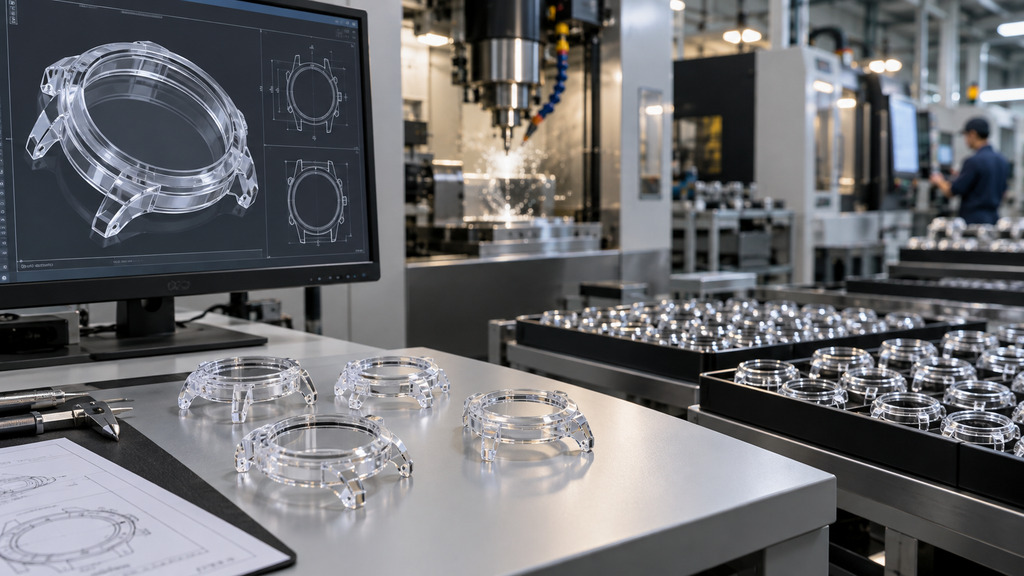
A more controlled route is:
Engineering Review → DFM → Prototype → Qualification → Pilot Batch → Mass Production
For luxury watch brands, independent watchmakers and design studios, an initial batch of 1–5 prototype cases can provide essential information before larger quantities are released.
This article explains how a sapphire watch case project can scale from the first samples to controlled production batches.
Why Start with 1–5 Sapphire Watch Case Prototypes?
The objective of a prototype is not simply to prove that the part can be machined.
A successful prototype should answer several important questions:
- Does the movement fit correctly?
- Are the crown and pushers aligned?
- Are gasket grooves and sealing areas correct?
- Can all important surfaces be polished?
- Are the walls thick enough for safe processing?
- Are holes too close to an edge?
- Does the final transparent appearance match the design intent?
- Are the tolerances realistic?
- Can the component be inspected consistently?
- Can the design be manufactured repeatedly?
For relatively simple sapphire components, one sample may be sufficient for an initial dimensional review.
For a completely new transparent watch case architecture, producing several samples can be more useful because it allows the customer and manufacturer to evaluate repeatability rather than judging a single exceptionally good part.
A typical prototype quantity may therefore be:
1 piece – basic feasibility or dimensional verification
2–3 pieces – assembly, cosmetic and process comparison
3–5 pieces – more complete engineering validation before a larger batch
The correct quantity depends on geometry, material cost, inspection requirements and the purpose of the prototype.
Stage 1: Start with Complete Engineering Information
Before machining begins, the manufacturer needs more than the overall dimensions of the watch case.
For a custom sapphire case, the preferred RFQ package normally includes:
- 3D STEP model
- Controlled 2D drawing
- Overall dimensions
- Movement dimensions or movement envelope
- Crown and stem position
- Case-back interface
- Bezel interface
- Screw or fastening positions
- Gasket locations
- Critical tolerances
- Sapphire color
- Crystal orientation if specified
- Surface finish requirements
- Cosmetic surfaces
- Prototype quantity
- Expected production quantity
If available, information about the complete watch assembly is also valuable.
Sapphire should not be treated as an isolated decorative component. The case must ultimately work with the movement, crown, case back, bezel, gaskets, screws and other mating components.
The more complete the information is at the beginning, the easier it becomes to identify manufacturing risks before material is consumed.
Stage 2: DFM Review Before Prototype Machining
DFM means Design for Manufacturing.
This stage is particularly important for sapphire because a feature that is easy to produce in titanium or stainless steel may be significantly more difficult in single-crystal sapphire.
During DFM review, the manufacturer may evaluate areas such as:
Wall Thickness
Extremely thin sapphire walls can increase the risk of damage during grinding, polishing, assembly or service.
The required thickness depends on geometry rather than one universal minimum value.
Internal Corners
Very sharp internal corners can create machining and stress-concentration problems.
Introducing an appropriate radius may improve both manufacturability and mechanical reliability.
Hole-to-Edge Distance
Screw holes, crown holes and other openings require sufficient surrounding material.
A hole positioned too close to the outer edge may create an increased chipping or cracking risk.
Deep Cavities
A cavity may be possible to machine but difficult to polish.
For a transparent case, this distinction is important because an unpolished internal surface remains visually obvious.
Narrow Slots
Tool access becomes increasingly difficult as slots become deeper and narrower.
This can affect both machining and polishing.
Tolerance Stack-Up
Not every dimension needs the same tolerance.
Critical assembly dimensions may require tight control, while non-functional dimensions can sometimes use a more practical tolerance.
Defining this distinction can reduce unnecessary processing cost.
Stage 3: Select the Sapphire Material Route
After the geometry has been reviewed, the next step is to confirm the sapphire material.
Important variables may include:
- Clear or colored sapphire
- Raw material size
- Crystal growth method
- Crystal orientation
- Material homogeneity
- Internal defect requirements
- Final optical expectations
For clear transparent watch cases, optical appearance is usually one of the primary concerns.
For colored sapphire cases, the project may also need to consider color consistency between different parts and production batches.
This becomes particularly important when the watch uses multiple sapphire components such as:
- Sapphire bezel
- Sapphire case middle
- Sapphire case back
- Sapphire pushers
- Sapphire crown components
A color description alone may not be sufficient.
Whenever appearance is critical, an approved physical sample or agreed visual reference can help establish the production target.
Stage 4: Machine the First Prototype
Once the drawing and material route are approved, prototype manufacturing begins.
A complex sapphire watch case may pass through multiple processes, including:
- Raw sapphire blank preparation
- Cutting
- CNC shaping
- Rough grinding
- Precision grinding
- Hole machining
- Internal cavity machining
- Fine grinding
- Lapping
- Edge finishing
- Multi-stage polishing
- Cleaning
- Dimensional inspection
- Cosmetic inspection
Unlike metal machining, the process cannot focus only on dimensions.
Surface damage introduced during an earlier stage may affect later polishing or even cause the component to fail near the end of production.
For this reason, sapphire manufacturing should be treated as a controlled sequence rather than simply a final CNC operation.
Stage 5: Evaluate the Prototype as Part of the Complete Watch
One of the most common mistakes in prototype evaluation is inspecting only the loose sapphire component.
A case may pass dimensional inspection individually but still create problems during watch assembly.
Whenever possible, the prototype should be assembled with the intended:
- Movement
- Movement holder
- Crown
- Stem
- Pushers
- Gaskets
- Bezel
- Case back
- Screws
- Strap or bracelet interface
This makes it possible to identify assembly problems before production.
Movement Clearance
The movement should fit without interference while maintaining the intended locating features.
Transparent sapphire cases make internal spacing particularly important because unexpected gaps or contact areas may also be visually noticeable.
Crown Alignment
The crown tube, stem and movement axis must align correctly.
Small geometric errors can become significant during final assembly.
Gasket and Sealing Interfaces
If water resistance is required, gasket grooves and sealing surfaces must be reviewed as part of the complete case architecture.
Prototype evaluation should confirm that the physical geometry matches the intended sealing system.
Screw and Fastener Loading
Sapphire does not deform like a metal watch case.
Fastening forces therefore require careful consideration.
Screws, washers, metal inserts and mating components should be designed so excessive localized loading is not transferred into vulnerable sapphire edges.
Visual Alignment
For a transparent watch case, assembly is not only mechanical.
Customers can often see internal structures through the sapphire.
Movement position, screw alignment, gasket appearance, internal steps and surface transitions can all affect the perceived quality of the finished watch.
Stage 6: Review Cosmetic Quality
Luxury sapphire watch cases are both structural components and highly visible cosmetic components.
This means dimensional inspection alone is insufficient.
The prototype should also establish the expected cosmetic standard.
Typical inspection items may include:
- Scratches
- Chips
- Edge defects
- Pits
- Polishing marks
- Cloudiness
- Uneven polish
- Internal surface appearance
- Local distortion
- Color consistency
- Contamination
- Visible machining traces
It is useful to classify surfaces according to their cosmetic importance.
For example:
Class A: Primary visible exterior surfaces
Class B: Visible internal or secondary surfaces
Class C: Hidden assembly surfaces
This helps prevent ambiguity during future production inspection.
A defect that is unacceptable on the top polished surface may be irrelevant on a hidden internal mounting face.
Stage 7: Modify the Design if Necessary
Prototype modification is normal.
It does not necessarily mean that the original design was incorrect.
The purpose of prototyping is to discover how the digital design behaves as a physical sapphire component.
Typical modifications may include:
- Increasing a corner radius
- Increasing local wall thickness
- Moving a hole farther from an edge
- Enlarging a polishing access area
- Adjusting a gasket groove
- Changing a tolerance
- Modifying a chamfer
- Improving assembly clearance
- Changing a fastening interface
These relatively small changes can sometimes provide a major improvement in manufacturability.
The goal is to finalize the design before production quantities are committed.
Stage 8: Freeze the Approved Drawing
Once the prototype has passed engineering, assembly and cosmetic evaluation, the project should move toward a controlled production specification.
This normally requires a final approved drawing.
The controlled drawing should define the features that matter for production, such as:
- Dimensions
- Critical tolerances
- Datum references
- Hole locations
- Surface finish
- Polished zones
- Cosmetic requirements
- Material
- Color
- Crystal orientation if required
- Inspection requirements
Production should not rely solely on informal messages or photographs.
The drawing should become the primary technical reference.
Stage 9: Establish a Golden Sample
For high-end cosmetic sapphire parts, an approved physical sample can be particularly useful.
This is often referred to as a Golden Sample.
The Golden Sample can help define appearance requirements that may be difficult to communicate through numerical specifications alone.
For example:
- Overall transparency
- Edge appearance
- Polishing character
- Color
- Surface consistency
- Visual quality under lighting
The most effective production reference is usually a combination of:
Controlled Drawing + Inspection Criteria + Approved Physical Sample
The drawing controls dimensions.
The inspection criteria define acceptance rules.
The approved sample helps communicate cosmetic expectations.
Stage 10: Move to a Pilot Batch
Moving directly from one successful prototype to hundreds of components can create unnecessary risk.
For complex sapphire structures, an intermediate pilot batch can be useful.
For example, the progression might be:
1–5 prototypes → small pilot batch → regular production batch
The exact quantities depend on the project.
The purpose of a pilot batch is different from the prototype.
A prototype asks:
Can we make this design correctly?
A pilot batch asks:
Can we make this design consistently?
That difference is extremely important.
What Should Be Checked During a Pilot Batch?
A pilot batch can reveal variation that may not appear in a single prototype.
Important areas include:
Dimensional Repeatability
Are critical dimensions staying within tolerance from piece to piece?
Polishing Repeatability
Are all cases achieving a consistent level of transparency and surface finish?
Edge Quality
Are certain holes, corners or thin sections repeatedly showing chipping?
Color Consistency
For colored sapphire, do parts match the approved visual target?
Assembly Fit
Do multiple production parts fit the same movement and mating components consistently?
Production Yield
Which process steps create the highest manufacturing risk?
The answers help determine whether further process optimization is needed before larger batches begin.
Stage 11: Establish Production Inspection
When the design moves into repeat production, inspection requirements should already be clear.
Depending on the project, inspection may include:
- Overall dimensions
- Critical functional dimensions
- Hole diameter
- Hole position
- Flatness
- Parallelism
- Wall thickness
- Surface finish
- Edge integrity
- Cosmetic appearance
- Color
- Assembly fit
Not every dimension necessarily requires the same inspection frequency.
Critical-to-function dimensions can receive higher inspection priority.
A clear inspection plan makes production more efficient while maintaining control over the features that actually affect watch assembly and appearance.
Stage 12: Scale to Production Batches
Once the design, material, manufacturing route and inspection criteria have been validated, the project can move into production.
At this point, scaling is no longer simply a matter of machining more pieces.
Production control should maintain consistency in:
- Raw material
- Machining sequence
- Grinding parameters
- Polishing route
- Cleaning
- Inspection
- Handling
- Packaging
For complex transparent sapphire parts, handling is especially important.
A component that has completed many manufacturing steps still needs protection from impact, contamination and surface damage before final assembly.
Individual protective packaging may therefore be required for finished sapphire cases.
Prototype Production vs Mass Production
| Item | Prototype Stage | Production Stage |
|---|---|---|
| Primary objective | Validate design | Maintain repeatability |
| Typical focus | Feasibility | Process control |
| Quantity | Often 1–5 pcs | Project dependent |
| Drawing status | May still change | Frozen revision |
| DFM changes | Expected | Controlled |
| Assembly testing | Essential | Confirmed |
| Cosmetic standard | Being established | Already defined |
| Inspection | Comprehensive evaluation | Controlled production QC |
| Physical reference | Candidate sample | Approved Golden Sample |
| Process | Development | Repeatable manufacturing |
Understanding this distinction helps avoid a common purchasing mistake: evaluating prototype pricing as if it were simply a smaller version of mass-production pricing.
Prototype production contains engineering and development work that may not be repeated in the same way once the design has been finalized.
Why Prototype Pricing Is Different from Production Pricing
A quantity of one sapphire watch case cannot usually be priced by simply dividing the price of 100 pieces by 100.
Prototype projects may require:
- Engineering review
- CAM programming
- Special tooling preparation
- Raw sapphire blank preparation
- Machine setup
- Individual process development
- Multiple polishing trials
- Dimensional inspection
- Cosmetic evaluation
- Design feedback
These costs are distributed across very few pieces.
During repeat production, some setup and engineering work has already been completed, allowing the manufacturing process to become more efficient.
This is why customers should request separate quotations for:
Prototype quantity
and
Expected production quantities
For example:
- 1 pc
- 3 pcs
- 5 pcs
- 20 pcs
- 50 pcs
- 100 pcs
This provides a much clearer picture of the project’s cost structure.
Should You Produce One Prototype or Five?
There is no universal answer.
Choose 1 Prototype When:
- The design is relatively simple
- The first objective is basic feasibility
- Material cost is very high
- The design is expected to change
- Only dimensional confirmation is required initially
Consider 3–5 Prototypes When:
- Multiple engineering teams need samples
- Assembly testing is required
- Destructive testing may be performed
- Cosmetic consistency needs evaluation
- Different configurations need comparison
- The design is close to production release
For highly customized luxury watch projects, several prototypes can provide more reliable information than one sample alone.
Information to Provide When Requesting a Quote
To evaluate a custom sapphire watch case project efficiently, send as much of the following information as possible:
Required
- 3D STEP file
- 2D drawing
- Required quantity
- Sapphire color
- Key dimensions
- Critical tolerances
Recommended
- Movement model or dimensions
- Assembly drawing
- Cosmetic surface definition
- Polishing requirements
- Crystal orientation
- Gasket information
- Required inspection documents
- Prototype quantity
- Estimated annual volume
- Delivery destination
A complete RFQ package allows engineering risks to be identified earlier and makes the quotation more meaningful.
A Practical Development Route
For a new custom sapphire watch case, a practical project structure can look like this:
Phase 1 — Engineering Review
Submit the drawing, STEP model and assembly information.
Phase 2 — DFM Feedback
Review wall thickness, radii, holes, polishing access, tolerances and assembly risks.
Phase 3 — Prototype
Manufacture approximately 1–5 samples according to the agreed engineering specification.
Phase 4 — Qualification
Inspect dimensions, surface quality, optical appearance and complete watch assembly.
Phase 5 — Revision
Modify the design where necessary and release the final drawing revision.
Phase 6 — Golden Sample
Approve the physical appearance and final configuration.
Phase 7 — Pilot Batch
Verify process repeatability across multiple parts.
Phase 8 — Mass Production
Manufacture controlled batches according to the approved drawing and quality criteria.
Scaling Sapphire Watch Cases Successfully
The most important transition in a sapphire watch case project is not from five pieces to fifty pieces.
It is the transition from an experimental process to a controlled process.
Before production release, the manufacturer and customer should agree on:
- What dimensions are critical
- What surfaces are cosmetic
- What appearance is acceptable
- How assembly will be evaluated
- Which sample represents the target
- Which drawing revision controls production
- How inspection will be performed
Once these points are clearly defined, scaling becomes significantly more predictable.
Custom Sapphire Watch Case Prototype and Production Manufacturing
At Sapphire-Watchcase.com, we support custom sapphire watch case projects from initial engineering review through prototype validation and production manufacturing.
Our project scope can include:
- Clear sapphire watch cases
- Colored sapphire watch cases
- Monobloc sapphire structures
- Multi-part sapphire cases
- Sapphire bezels
- Sapphire case backs
- Complex CNC-machined sapphire components
- Prototype development
- Small-batch production
- Repeat production
For new projects, we recommend starting with the complete engineering package rather than only an external case dimension.
Send us your:
2D Drawing + 3D STEP File + Sapphire Color + Prototype Quantity + Expected Production Quantity
Our team can review the geometry, machining access, polishing requirements, edge risks, critical tolerances and assembly considerations before quotation.
Start Your Custom Sapphire Watch Case Project
Whether you need 1–5 engineering prototypes, a limited series or a larger production batch, early engineering validation can reduce the risk of expensive changes later in the project.
Contact Sapphire-Watchcase.com to request a DFM review and quotation for your custom sapphire watch case.