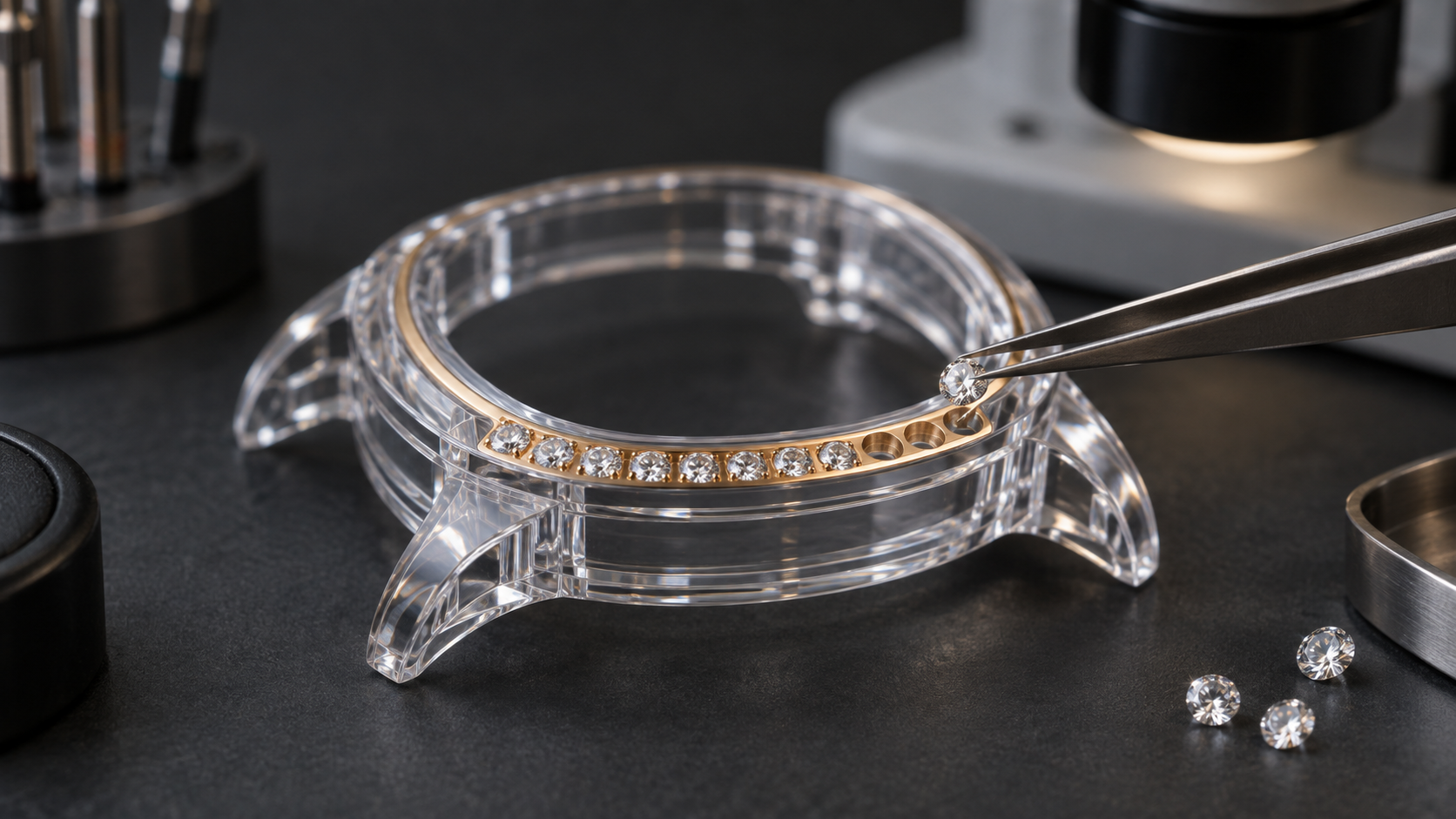
For years, sapphire watch cases were valued mainly for their transparency, scratch resistance and ability to expose a mechanical movement from multiple angles. In 2026, the material entered a more demanding stage: the sapphire itself became part of the gem-setting architecture.
At Watches and Wonders Geneva in April 2026, Hublot introduced a diamond-set sapphire case featuring 145 fancy-cut diamonds. According to the brand’s official announcement, the stones were placed in laser-machined mounts and supported by polished gold channels and framing strips. The limited-edition project illustrates an important shift for the industry. A sapphire case is no longer only a transparent enclosure; it can also become a precisely machined structural platform for jewellery components.
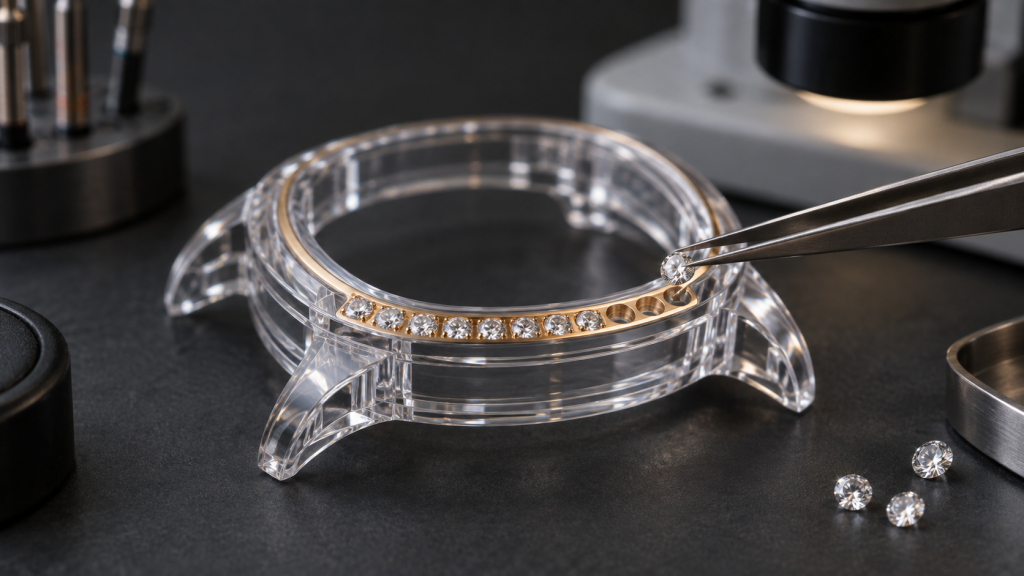
That shift brings substantial engineering challenges. Every stone seat removes material from a brittle crystal. Every sharp internal corner can concentrate stress. Every chip, tool mark or particle remains visible through the finished case. Successful production therefore requires the case designer, sapphire machinist, gem setter and watch assembler to work from a shared tolerance and inspection strategy.
Why Setting Diamonds in Sapphire Is Different from Setting Them in Metal
Traditional gem setting often takes advantage of the controlled plastic deformation of gold, platinum or another metal. A setter can form, tighten or burnish a metal prong, bead or channel around a gemstone. Sapphire does not behave this way.
Synthetic sapphire is single-crystal aluminium oxide. Its Mohs hardness of 9 provides excellent resistance to everyday scratching, but hardness should not be confused with toughness. Sapphire is a brittle material: it does not yield around a diamond in the manner of a precious metal. If excessive local force is applied, damage may begin at an edge flaw, a machining mark or a sharp corner and then propagate as a crack.
For this reason, “diamonds set directly into sapphire” should not be interpreted as ordinary metal-setting practice transferred unchanged to a transparent case. The complete retention system may require accurately machined sapphire seats together with separate metal channels, frames or other engineered retaining components. The geometry must locate the stones without forcing the sapphire to act like a deformable metal.
The transparency of the case creates another difficulty. On an opaque metal bezel, some hidden interfaces are covered by the setting. In a clear sapphire structure, seat walls, adhesive residue where an adhesive is specified, uneven gaps, polishing shadows and trapped particles may remain visible from the front, side or back. Structural quality and cosmetic quality become inseparable.
The Stone Map Must Be Part of the Case Design
A diamond-set sapphire case should be designed from a verified stone map, not merely from a decorative rendering.
Fancy-cut diamonds are particularly demanding because their outlines, facet junctions and depth can vary. A nominal CAD model may not describe every production stone accurately enough for a close-fitting seat. Depending on the project, individual stone measurements or grouped dimensional classes may be required before the final toolpaths are released.
The design team should define:
- The position, rotation and depth of every stone
- The functional contact surfaces within each seat
- The clearance needed to prevent uncontrolled point contact
- The thickness of sapphire remaining below and between adjacent seats
- The distance from stone seats to screw holes, gasket grooves, crown openings and case edges
- The relationship between the sapphire seats and any gold or titanium retaining parts
- The polishing allowance on all visible and functional surfaces
- The datum system used by the sapphire machinist, gem setter and final assembler
This information is especially important when a pattern crosses from the bezel toward the dial or case middle. Small coordinate errors can accumulate across a long decorative layout. A visually continuous pattern may therefore require tighter positional control than an isolated stone.
Before machining begins, the design should also be reviewed for stress concentration. Finite-element analysis can help identify vulnerable ligaments and corners under setting loads, screw preload, wrist impact and pressure testing. Simulation does not replace physical testing, but it can reveal high-risk areas before an expensive sapphire blank is committed.
Laser-Machined Stone Seats: Precision Without a Universal Recipe
Laser processing offers clear advantages for small, irregular features that are difficult to reach with conventional grinding tools. It can generate localized recesses, narrow channels and individually adapted profiles without applying the same mechanical cutting force as a rotating tool.
However, the word “laser-machined” does not automatically mean “damage-free.” Sapphire’s response depends on the laser wavelength, pulse duration, energy density, pulse overlap, scanning direction, focal position and material orientation. Poorly controlled parameters can produce rough sidewalls, redeposited material, subsurface modification, heat-related damage or microcracks around the seat.
Recent research into ultrafast laser processing of sapphire continues to focus on controlling these effects. Picosecond- and femtosecond-scale processes can reduce the thermal influence compared with longer-pulse machining, but the final result still depends on the complete parameter window and subsequent finishing route.
A practical development sequence may include:
- Machining representative test coupons from the intended sapphire grade and orientation.
- Producing the basic case geometry with controlled stock remaining around critical surfaces.
- Registering the laser process to stable mechanical datums.
- Machining the stone seats using a validated scan strategy.
- Cleaning and inspecting the seats before further material is removed.
- Applying localized lapping or polishing where required without rounding critical locating features.
- Re-measuring the finished seat geometry before gem setting.
The order of laser machining and final polishing must be selected deliberately. Machining before final polishing may allow some affected material to be removed, but polishing can change seat edges and depth. Machining after polishing preserves the established external geometry, but it places a finished high-value component at risk. There is no single sequence suitable for every case; representative trials should determine the route.
Stress Control Begins with Geometry
The most reliable way to control cracking is to prevent excessive stress from developing around the seats.
Avoid Sharp Internal Transitions
Decorative diamond patterns often contain acute angles. Reproducing those angles as perfectly sharp internal corners in sapphire can create severe stress concentration. Small engineered radii or relief features may be necessary, even when the visible stone arrangement appears sharp from the outside.
Maintain Sufficient Ligament Thickness
The remaining sapphire between adjacent seats must carry setting, assembly and service loads. Closely spaced stones can leave thin bridges that are difficult to machine, polish and inspect. Minimum ligament dimensions should be established from the actual case geometry and validation results rather than from a general cosmetic rule.
Separate Critical Features Where Possible
A stone seat placed too close to a screw hole, gasket groove or outer edge can cause several stress fields to overlap. The surrounding wall may also become too thin to survive polishing or final assembly. Early design review can often move a seat slightly without changing the overall visual concept.
Control the Retention Load
The diamonds should not be pressed into undersized sapphire recesses. Retaining strips, channels or frames must distribute load predictably and avoid high point pressure against the crystal. If an adhesive is part of the approved construction, its bond line, cure behaviour, ageing and visibility must also be considered. Adhesive should not be treated as a substitute for poor mechanical alignment.
Include Final Watch Assembly Loads
Case screws, gaskets and clamping components can distort the assembly or introduce preload around the gem-set area. Torque values and tightening sequences therefore belong in the engineering plan. A sapphire component that passes inspection as an individual part may still fail if the assembled stack applies uneven force.
Controlling Edge Chipping During Manufacturing
Edge chipping can occur during rough machining, laser processing, polishing, cleaning, transportation or gem setting. Small chips may remain cosmetic defects; others can act as crack origins or interfere with stone position and retention.
Risk reduction normally combines several measures:
- Provide adequate machining stock during early operations.
- Use supported fixtures that distribute clamping force away from thin transparent walls.
- Optimize tool entry and exit paths near exposed edges.
- Avoid abrupt changes in cut depth or unsupported breakout at the end of a feature.
- Progress through controlled abrasive sizes rather than attempting to remove deep damage during final polishing.
- Protect completed surfaces during later seat machining and assembly.
- Clean components between operations so loose diamond abrasive or sapphire debris cannot create new scratches.
- Inspect immediately after every irreversible high-risk step.
Edge design is also important. A perfectly sharp visual edge may be attractive in a rendering, but a small controlled bevel or radius can improve handling strength and reduce chipping. The designer and manufacturer should identify which edges must appear sharp and which can receive a protective transition.
Final polishing cannot be expected to rescue every defect. Removing a deep chip may change the case profile, seat position or wall thickness beyond tolerance. Early detection is usually less expensive than corrective polishing late in production.
Inspection Must Continue Through the Entire Process
Final visual inspection alone is not sufficient for a diamond-set sapphire case. Inspection should be divided into stages so that the source of a defect can be identified before additional value is added.
Incoming Sapphire Inspection
The blank should be checked for material identity, crystal orientation, dimensions, internal inclusions, colour uniformity when coloured sapphire is used, and visible residual stress or strain patterns. Material traceability should remain linked to the finished case.
Inspection After Basic Case Machining
Critical wall thicknesses, hole locations, sealing surfaces and case datums should be verified before laser machining begins. Non-contact optical measurement is particularly useful for visible surfaces and delicate edges.
Inspection After Laser Machining
Each seat should be checked for position, depth, profile and surface condition. High-magnification bright-field, dark-field and transmitted-light inspection can reveal chips, debris and cracks that are difficult to see under ordinary room lighting. Three-dimensional optical profiling or confocal measurement may be used when seat depth and local topography are critical.
Cross-polarized inspection can help identify stress-related optical patterns in transparent sapphire, although interpretation requires an agreed method and qualified reference samples. No single optical test should be assumed to detect every possible subsurface defect.
Inspection After Polishing
Polishing can improve optical clarity while also changing edges and critical dimensions. The finished part should therefore be rechecked for seat geometry, surface quality, edge condition, flatness or profile where applicable, and polishing-induced distortion.
Finishing quality is not merely decorative. NIST strength-characterization work has demonstrated that sapphire strength can vary substantially with processing and surface preparation, even when blanks originate from the same material source. This is why scratch and chip criteria should be linked to structural location, not only to overall appearance.
Inspection After Gem Setting
The completed assembly should be examined from all intended viewing directions. Inspection criteria may include stone position, tilt, gap consistency, retention, contact with the metal channel, particles, residue, new edge damage and changes in case geometry.
After the watch case is fully assembled, the project may also require pressure or water-resistance testing, shock and vibration evaluation, thermal cycling, and confirmation that the movement, crown and pushers operate correctly. Test levels should be defined by the watch specification rather than assumed from the sapphire material alone.
Define Acceptance Criteria Before Production
Terms such as “no chips,” “perfectly transparent” or “high polish” are too subjective for an expensive limited-production case. The drawing and quality agreement should define how the part will actually be judged.
Useful acceptance details include:
- Cosmetic zones and their viewing importance
- Inspection lighting, background, magnification and viewing distance
- Maximum permitted scratch, pit or chip dimensions by location
- Areas in which no edge defect is acceptable
- Stone position, rotation, height and gap tolerances
- Requirements for visible channels, retainers or bond lines
- Dimensional inspection methods and datum references
- Pressure, retention, shock or environmental tests
- Sampling plans and traceability records
A small defect beside a non-functional hidden surface is not equivalent to the same defect beside a stone seat or sealing edge. Location-based criteria make inspection more meaningful and reduce disputes between the case supplier, gem setter and watch brand.
Prototype Validation Is Essential, Even for a Small Limited Edition
Limited quantity does not eliminate the need for a controlled process. In fact, low production volume leaves fewer parts over which development losses can be distributed.
A sensible qualification plan may begin with laser-machined sapphire coupons and representative seat geometries. It can then progress to a partial bezel or case section before a complete case is produced. Sacrificial samples may be used for controlled retention, impact or environmental testing. The final prototype should use production-representative sapphire, diamonds, retaining components, surface finishes and assembly conditions.
The first complete case should undergo a documented first-article inspection. Any change to the laser program, sapphire orientation, stone dimensions, polishing process or retention hardware should be reviewed before it is introduced into the production lot.
This staged approach may appear slower at the beginning, but it protects the most expensive blanks and reduces the chance of discovering a systemic defect after polishing and gem setting.
What to Include in an RFQ for a Diamond-Set Sapphire Watch Case
For an effective manufacturability review, the RFQ should contain more than an exterior rendering. Ideally, it should include:
- Native 3D CAD files and controlled 2D drawings
- Sapphire type, colour, orientation and optical requirements
- Complete stone map and diamond-cut information
- Individual stone measurements or agreed size classes where available
- Retention concept, including all metal channels, strips or frames
- Critical wall thicknesses and minimum distances between features
- Defined polished, frosted and hidden surfaces
- Caseback, movement ring, gasket, crown and screw interfaces
- Assembly sequence and specified torque values
- Water-resistance, impact and environmental requirements
- Cosmetic inspection standard and dimensional report requirements
- Prototype quantity, production quantity and acceptable development samples
- Responsibility for sapphire machining, gem setting, final assembly and testing
Sapphire machining, gem setting and watch assembly may be performed by different specialists. Their interfaces should be established before production begins. The case supplier needs to understand how the stones will be retained, while the setting partner needs verified seat geometry and limits on allowable force.
Conclusion
Diamond-set sapphire watch cases represent one of the clearest material developments in haute horlogerie in 2026. They combine optical transparency, jewellery design and precision structural engineering in a single component. The result can be visually exceptional, but the manufacturing margin is narrow.
The most successful projects begin with a measured stone map, realistic wall thicknesses, a validated laser process, controlled polishing allowances and stage-by-stage inspection. Stress control cannot be added after the seats have been machined, and cosmetic inspection cannot replace structural validation.
For a custom project, share the sapphire case drawing, 3D model, stone layout, target quantity and assembly concept at the RFQ stage. An early manufacturability review can identify risks around stone-seat geometry, polishing access, remaining wall thickness and inspection before production blanks are committed.