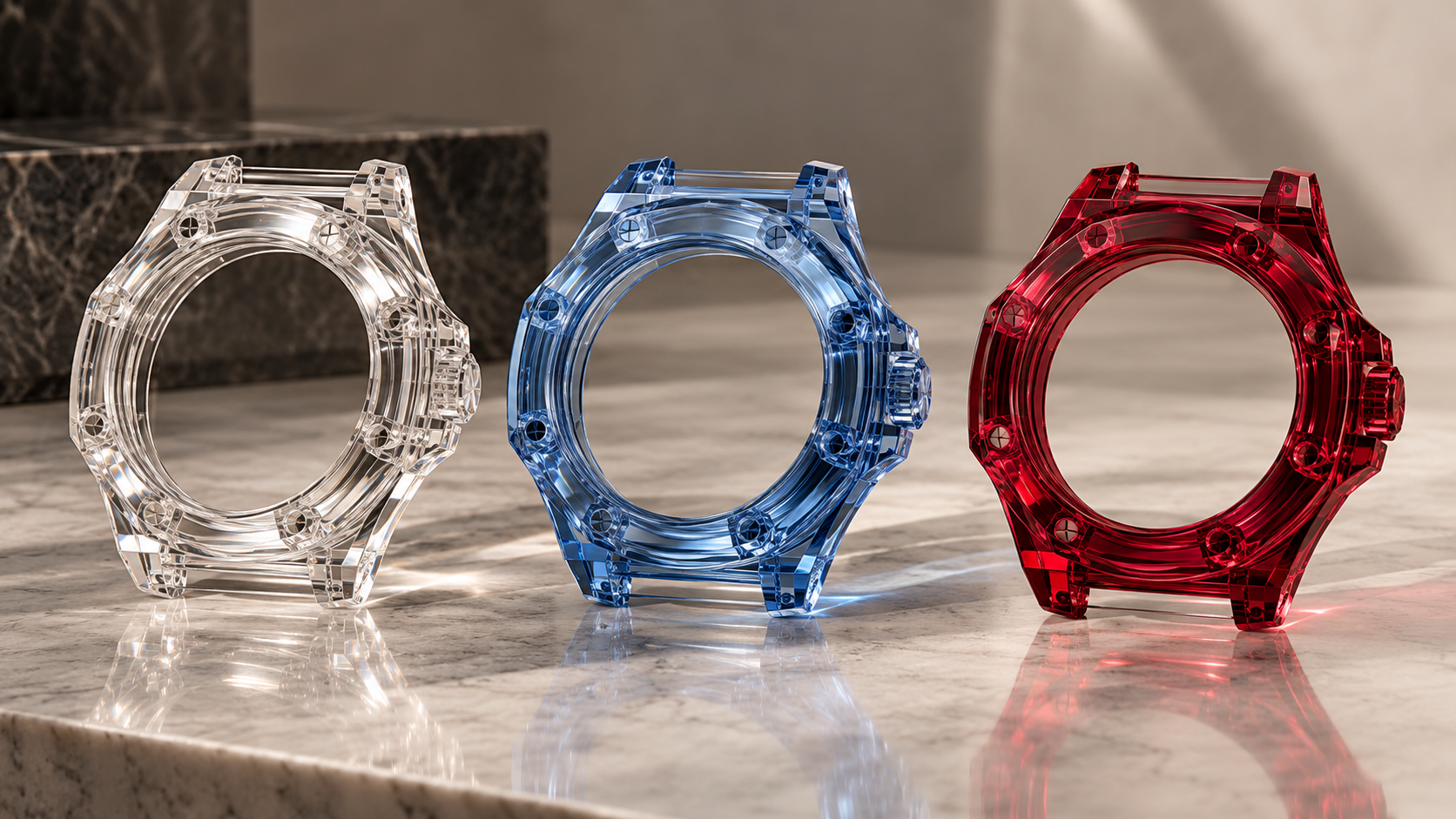
Transparent sapphire watch cases were once mainly associated with completely clear cases.
That is changing.
In 2026, color is becoming an increasingly important part of sapphire-case design.
Instead of applying a conventional surface coating, watch brands can use colored synthetic crystal to make the entire case body part of the visual identity.
Recent launches illustrate the trend.
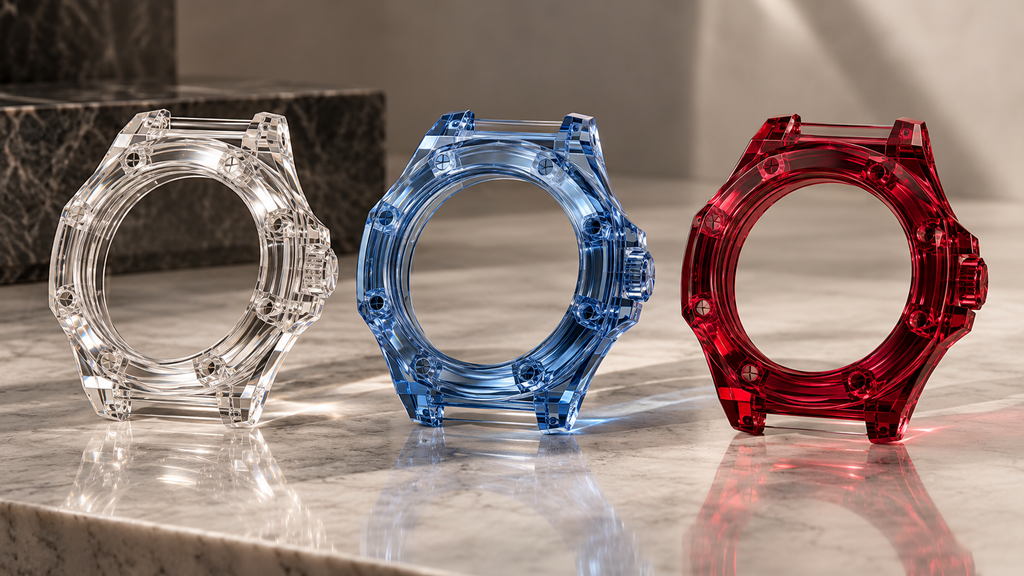
In July 2026, Hublot introduced the Big Bang Sapphire Sky Blue, using a transparent sky-blue sapphire case in a limited run of 100 pieces.
At Watches & Wonders 2026, ArtyA also presented its Complexity architecture in transparent sapphire and a deep transparent synthetic ruby version described as Pigeon’s Blood Ruby.
The important development is not simply that sapphire is available in more colors.
Color is becoming part of the case engineering.
Colored Sapphire Is Not a Painted Surface
A colored sapphire watch case should not be understood as clear sapphire with ordinary paint applied to the outside.
The visual color is produced within the crystal material.
This provides an important aesthetic advantage.
When properly manufactured, the color remains visible through:
- side walls;
- lugs;
- bevels;
- polished edges;
- internal cavities.
This creates visual depth that a thin surface coating cannot easily reproduce.
Wall Thickness Changes the Appearance
A colored sapphire sample may look very different from a finished case.
Why?
The optical path length changes.
A thin polished coupon may appear relatively light.
A thick case wall can appear much darker because light travels through more colored crystal.
The final appearance is also influenced by:
- local wall thickness;
- curvature;
- internal reflections;
- polishing;
- lighting;
- background;
- adjacent metal components.
This means color approval should ideally be performed on a representative geometry rather than only on a small flat sample.
Sky Blue and Royal Blue Are Different Design Directions
A light sky-blue case is intended to preserve a high level of transparency.
The movement remains clearly visible.
The color creates atmosphere rather than dominating the watch.
A deeper royal-blue case behaves differently.
Greater optical density can make thick regions look significantly darker.
This may create more dramatic contrast but can reduce movement visibility in certain lighting.
The correct specification therefore depends on whether the design priority is:
maximum transparency or stronger color identity.
Synthetic Ruby Creates Another Optical Effect
Synthetic ruby is based on the same Al₂O₃ crystal family as sapphire, with chromium responsible for its characteristic red coloration.
The resulting material can combine:
- high hardness;
- transparent red color;
- strong internal reflection;
- the structural capability needed for selected watch-case geometries.
ArtyA’s 2026 Complexity demonstrates how deep-red transparent crystal can be integrated with an extremely complex high-complication movement rather than being used only as a decorative insert.
Color Uniformity Is a Manufacturing Specification
For production, “blue” is not precise enough.
A brand developing a colored sapphire watch case should establish an approved visual reference.
Important factors can include:
- hue;
- saturation;
- transparency;
- acceptable batch variation;
- inspection lighting;
- reference wall thickness.
A color that appears acceptable under warm showroom lighting may appear different under daylight or cool LED lighting.
Therefore, visual inspection conditions should be defined.
Polishing Changes the Perceived Color
A ground or frosted sapphire surface scatters light.
A fully polished surface transmits and reflects light much more strongly.
The same colored crystal can therefore produce dramatically different visual effects depending on surface finish.
Highly polished blue sapphire may look clear and luminous.
A frosted blue surface may appear softer and more opaque.
This gives designers another way to control the appearance without changing the bulk crystal color.
Case Geometry and Color Should Be Designed Together
In clear sapphire, a thick wall primarily affects optical depth.
In colored sapphire, the same wall also affects color density.
This means wall thickness can become an aesthetic variable.
A designer can intentionally use:
- thicker regions to create deeper color;
- thinner regions for transparency;
- polished bevels for bright highlights;
- curved walls for changing optical depth.
But this should be designed deliberately.
Unplanned thickness variation can create unwanted color patches.
The 2026 Direction Is Clear
Luxury watchmaking is increasingly treating laboratory-grown crystal as a design material rather than simply a substitute for transparent glass.
Industry coverage of Watches & Wonders 2026 identified lab-grown crystal and experimentation with materials as one of the year’s visible watchmaking trends.
Sapphire-watch-case development is therefore moving from:
clear transparent enclosure
toward:
engineered color + structural transparency + movement display.
For custom watch projects, color should be defined at the same stage as geometry—not after the case design has already been frozen.