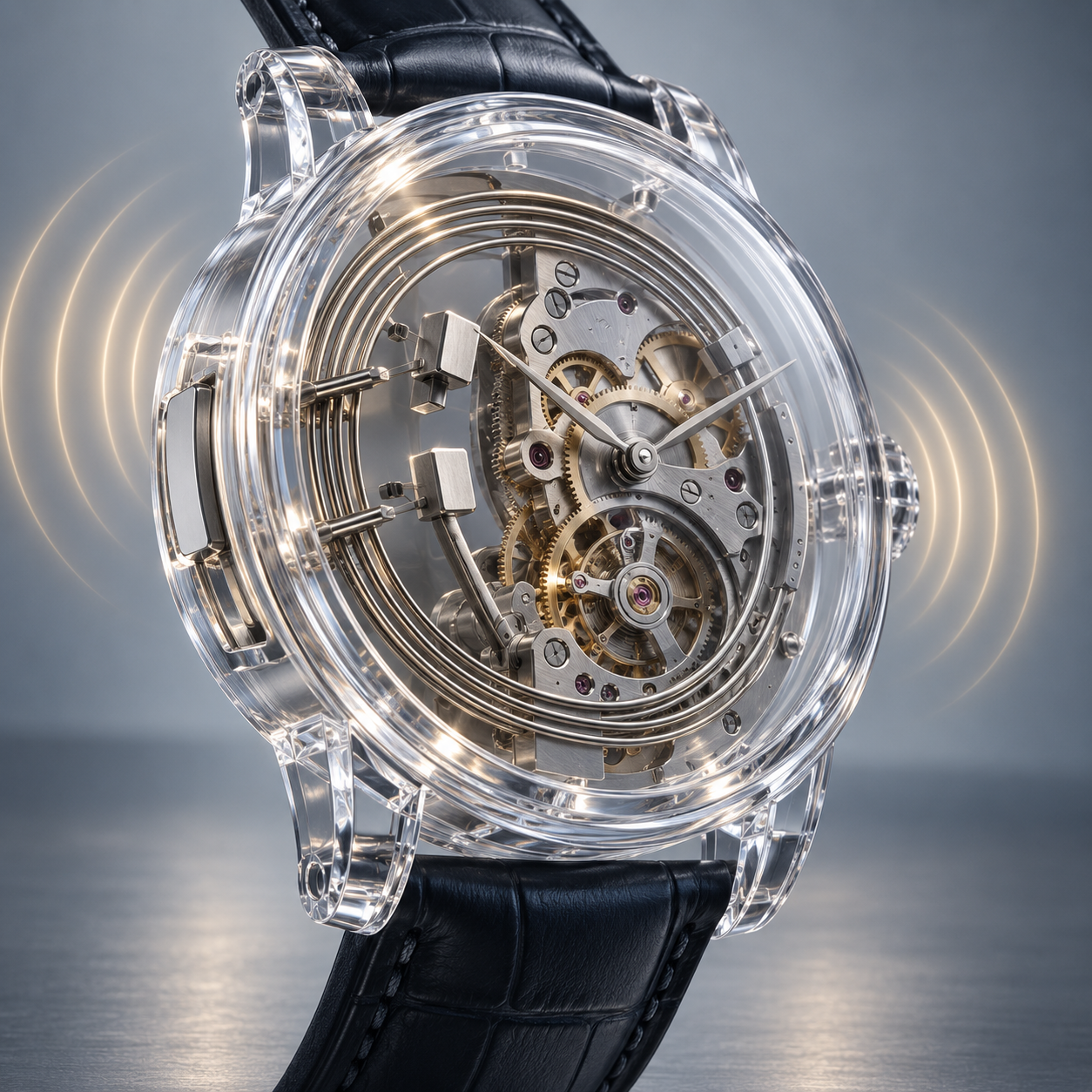
Minute repeaters present an unusual engineering challenge in mechanical watchmaking.
Most watch-case design focuses on protecting the movement from water, dust, impact and daily wear. A minute repeater must accomplish all of these functions while also allowing extremely small mechanical components to generate an audible and musically pleasing sound.
That changes the role of the watch case.
The case is no longer only a protective enclosure.
It becomes part of an acoustic system.
Sapphire is particularly interesting in this context because it combines high stiffness, low material damping, excellent scratch resistance and optical transparency. More importantly, sapphire can potentially become part of the sound-generating structure itself rather than simply surrounding it.
Chopard’s L.U.C Full Strike provides one of the clearest examples. In its patented architecture, the minute-repeater gongs and sapphire crystal are manufactured as a single monobloc structure rather than connected through conventional joints. Chopard states that this eliminates welding, screws and adhesive between the crystal and gongs and contributes to the intensity and consistency of the sound.
The engineering lesson is important for sapphire component manufacturers:
Sapphire does not automatically improve the sound of a minute repeater.
Its acoustic potential depends on how the sapphire component is designed, machined, supported and integrated into the complete watch.
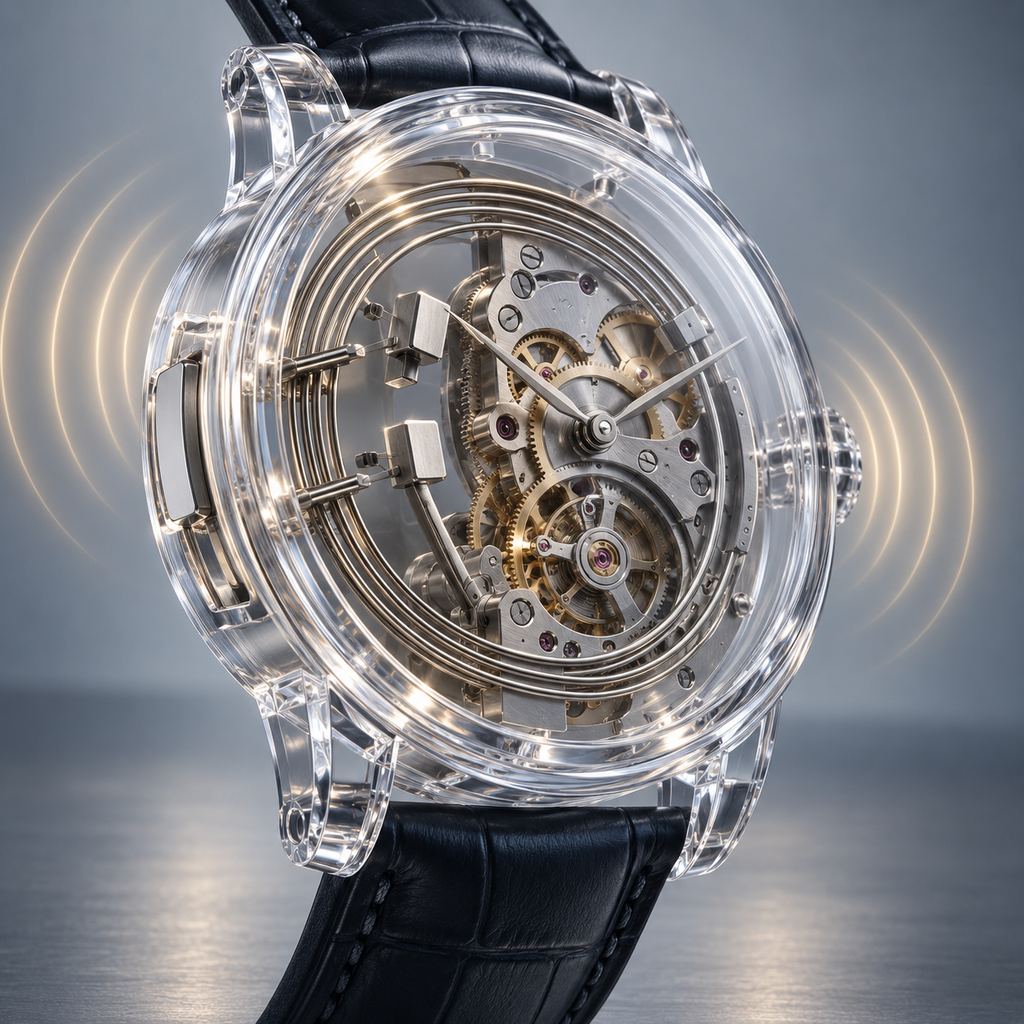
How Does a Minute Repeater Produce Sound?
A traditional minute repeater contains several important acoustic components.
When the repeater mechanism is activated, small hammers strike metal gongs.
Different sequences indicate:
- Hours
- Quarter-hours
- Minutes
The vibration generated by the hammer strike travels through the gong and into the surrounding watch structure.
Eventually, part of this mechanical vibration is transferred into the air and becomes audible sound.
The complete path can be simplified as:
Hammer → Gong → Gong Mount → Movement/Case Structure → Watch Case → Air
Every interface along this path can influence the result.
Energy may be:
- Transmitted
- Reflected
- Absorbed
- Scattered
- Damped
This is why two watches using similar movements may sound very different when installed in different cases.
Why Traditional Gong Attachment Matters
In conventional minute-repeaters, the gong must be attached somewhere.
Historically, gongs have often been fixed to the movement or a supporting block.
From an acoustic perspective, every mechanical interface represents a potential impedance change.
The vibration generated in the gong must pass through:
- The gong itself
- Its fixing point
- Screws or other connections
- Supporting components
- The case structure
Each connection can potentially dissipate some vibrational energy.
Tiny variations in assembly can also change the resulting sound.
This is one reason minute repeaters are extremely sensitive to manufacturing and adjustment.
The Monobloc Sapphire Concept
An alternative approach is to reduce the number of interfaces between the sound-generating structure and the radiating surface.
This is the principle behind the sapphire monobloc architecture used by Chopard.
In the L.U.C Full Strike, the sapphire crystal protecting the dial and the sapphire gongs form a single component.
Rather than manufacturing a gong separately and then fastening it to another part, the acoustic structure is integrated directly with the crystal.
The manufacturer describes the component as being machined from a single sapphire block without welding, screws or glue between the gong and crystal.
From an engineering perspective, this can change the vibration path from:
Hammer → Gong → Mechanical Connection → Crystal
to something closer to:
Hammer → Integrated Sapphire Gong → Sapphire Crystal
The number of mechanical interfaces is reduced.
That can potentially reduce energy loss and improve repeatability.
Why Fewer Mechanical Interfaces Can Matter
Whenever two separate parts are assembled, their connection introduces variables.
These may include:
- Contact pressure
- Screw preload
- Surface roughness
- Adhesive thickness
- Local deformation
- Microscopic gaps
- Position error
For a structural component, these variations may be acceptable.
For an acoustic component, small differences can influence vibrational transmission.
A monolithic structure eliminates some of these variables.
This does not guarantee better sound automatically, but it can make the energy-transfer path more predictable.
That distinction is important.
The advantage comes from the architecture, not simply from replacing metal with sapphire.
Sapphire as an Acoustic Radiator
The front crystal of a watch has a relatively large surface area compared with the tiny gong.
That makes it potentially useful as a sound-radiating structure.
When vibration reaches the crystal, the crystal can move microscopic amounts and transfer acoustic energy into the surrounding air.
The principle has similarities to other resonating structures.
A musical instrument does not rely only on the vibrating string.
The body of the instrument helps convert vibration into audible sound.
Likewise, in a chiming watch, the geometry and mechanical coupling of the case and crystal can influence the sound that reaches the listener.
The sapphire crystal can therefore perform multiple functions simultaneously:
- Optical window
- Protective component
- Structural member
- Acoustic transmission element
- Resonating surface
This multifunctional role makes sapphire particularly interesting in high-complication watch design.
Does a Full Sapphire Case Automatically Sound Better?
No.
This is an important distinction.
A complete sapphire case and a sapphire acoustic monobloc are two different engineering concepts.
Chopard itself currently uses the same monobloc sapphire acoustic principle in watches with different external case materials. Its Full Strike family includes sapphire, steel and titanium case executions, while the core striking architecture continues to use sapphire gongs integrated with the sapphire crystal.
Chopard’s current Strike One Titanium documentation goes even further, stating that its patented monobloc sapphire construction allows the acoustic quality to remain independent of whether the surrounding case is titanium or another metal.
This illustrates an important principle:
The acoustic performance of sapphire depends more strongly on where it is located in the vibration path than on simply using more sapphire.
A transparent sapphire case may provide visual benefits, but the acoustic system still needs to be deliberately engineered.
Resonance Frequency Matters
Every mechanical structure has natural vibration modes.
When excited near one of these modes, vibration amplitude can increase.
For a sapphire acoustic structure, resonant behavior depends on parameters such as:
- Gong length
- Gong cross-section
- Crystal diameter
- Crystal thickness
- Local stiffness
- Mounting position
- Boundary conditions
- Geometry around the gong connection
Changing any of these parameters may change the resulting frequency response.
This is why sapphire acoustic components cannot be designed only according to cosmetic requirements.
Their geometry needs to be considered dynamically.
Gong Geometry
A minute-repeater gong may appear simple, but its geometry directly influences its acoustic behavior.
Important parameters can include:
- Length
- Width
- Thickness
- Curvature
- Cross-sectional consistency
- Radius at transitions
- Distance from surrounding components
Very small dimensional changes can shift resonance frequencies.
For a sapphire gong integrated into a sapphire crystal, the transition between the gong and the crystal becomes particularly important.
If the transition is too rigid, too thin or geometrically inconsistent, vibration behavior may differ from the intended design.
Crystal Thickness
The sapphire crystal itself also influences the system.
A thicker crystal is generally stiffer.
A thinner crystal may respond more strongly to vibration but may also create different mechanical modes.
Therefore, simply making the crystal thinner to increase sound transmission would be an oversimplification.
The correct thickness must balance:
- Acoustic response
- Mechanical strength
- Water resistance
- Impact resistance
- Optical requirements
- Case architecture
A minute-repeater crystal should therefore be regarded as a tuned structural component rather than only a transparent cover.
Case Diameter and Internal Volume
The surrounding case also affects acoustic behavior.
Several geometric parameters can influence how sound propagates:
- Case diameter
- Case thickness
- Internal cavity volume
- Movement-to-case clearance
- Open versus closed architecture
- Case-back construction
- Crystal surface area
A larger internal cavity does not automatically produce louder sound.
Likewise, a thinner case does not automatically improve resonance.
The interaction between the movement, crystal and case needs to be evaluated as a complete system.
The Importance of Air Volume
Mechanical vibration must ultimately generate pressure waves in air.
The space surrounding the movement therefore becomes part of the acoustic environment.
Changes in internal volume can alter:
- Acoustic impedance
- Resonance behavior
- Sound radiation
- Frequency balance
For extremely compact watch cases, the air volume between the movement and case surfaces may be quite small.
Designers therefore need to consider mechanical and acoustic spaces simultaneously.
Sapphire Case Openings
Crown openings, pushers, repeater sliders and other features can influence structural behavior.
Minute repeaters frequently require a dedicated actuator in the case.
Machining this opening into sapphire creates several challenges:
- Local stress concentration
- Reduced wall thickness
- Increased fracture risk
- Changes in stiffness
- Potential influence on vibration modes
Therefore, the repeater-actuation area should not be treated simply as a cosmetic opening.
Its geometry may need to be considered during both structural and acoustic design.
Monobloc Components Demand Extreme Machining Accuracy
Manufacturing several separate components provides one advantage: an individual part can sometimes be replaced if it is out of tolerance.
A monobloc sapphire structure offers less flexibility.
If the gong, crystal and transition structure are all manufactured from one sapphire component, an error in one area may make the entire component unusable.
This raises the importance of process control.
Critical dimensions can include:
- Gong thickness
- Gong width
- Gong length
- Crystal thickness
- Gong-to-crystal transition geometry
- Flatness
- Parallelism
- Mounting dimensions
- Hole positions
The manufacturing process must preserve both mechanical and acoustic geometry.
Sapphire Is Difficult to Machine
Synthetic sapphire has a Mohs hardness of approximately 9.
This provides exceptional scratch resistance but makes precision manufacturing difficult.
Unlike ductile metals, sapphire is brittle.
During machining, uncontrolled loading can produce:
- Microcracks
- Edge chipping
- Subsurface damage
- Pitting
- Local fractures
For an ordinary cosmetic sapphire component, a small defect may primarily affect appearance.
For a vibrating acoustic component, defects located in highly stressed regions may also affect reliability.
This makes edge quality and subsurface damage particularly important around thin gong-like structures.
Why Transition Radii Matter
Imagine a thin sapphire gong emerging from a much larger sapphire crystal.
The connection between these two sections experiences a dramatic change in geometry.
A sharp corner at this location could create high stress concentration.
Therefore, transition radii should be carefully controlled.
The correct geometry needs to balance two competing objectives:
Mechanical reliability
A larger, smoother radius can reduce stress concentration.
Acoustic behavior
Changing the geometry also changes local stiffness and therefore vibration characteristics.
This is a classic example of why acoustic sapphire components require cooperation between acoustic engineering and precision manufacturing.
Machining Tolerance Can Affect Pitch
For an ordinary sapphire case, a dimensional variation of several microns may have little practical effect in some non-critical areas.
For a resonating feature, thickness variation may matter much more.
If a sapphire gong is designed around a specific geometry, variation in its cross-section can change its stiffness and mass.
That can influence natural frequency.
The relationship means manufacturers should clearly distinguish between:
- Cosmetic tolerances
- Assembly tolerances
- Acoustic-critical tolerances
Not every surface needs extreme accuracy.
But dimensions that control the resonating structure may require much tighter process control.
Symmetry and Repeatability
Minute repeaters typically generate more than one tone.
The relationship between those tones matters.
If two sapphire resonating elements are manufactured independently, dimensional variation between them may affect their frequency relationship.
This means relative tolerance can sometimes matter more than absolute tolerance.
For example, maintaining consistent geometry between two acoustic features may be critical even if both remain technically within their individual dimensional limits.
For production, process capability therefore becomes extremely important.
Polishing Creates Another Challenge
Sapphire acoustic components still require excellent surface quality.
But polishing removes material.
This creates a problem.
Suppose a resonating section has already been machined close to its target thickness.
Aggressive polishing can change:
- Local thickness
- Cross-section
- Edge radius
- Mass
- Stiffness
All of these can influence vibration.
Therefore, polishing allowance must be considered during the original machining process.
The operator cannot treat an acoustic-critical sapphire surface in the same way as a purely cosmetic sapphire component.
Surface Finish and Microcracks
Fine surface finish is useful not only for appearance.
Grinding damage can leave microcracks beneath the sapphire surface.
These defects are particularly undesirable in thin structures exposed to repeated vibration.
Fine grinding and controlled polishing can reduce damaged surface layers and improve reliability.
Critical areas may require microscopic inspection after machining and polishing.
Mounting Conditions Change Resonance
Even a perfectly manufactured sapphire acoustic component may behave differently once installed.
The mounting system changes its boundary conditions.
Relevant factors include:
- Gasket stiffness
- Gasket compression
- Clamping force
- Screw torque
- Contact area
- Metal retaining rings
- Adhesive layers
- Contact with the case
A crystal that vibrates freely under laboratory conditions may behave differently when compressed inside a water-resistant watch case.
This is why final acoustic testing should be performed on the assembled watch architecture rather than only on the loose sapphire component.
Water Resistance Versus Acoustic Freedom
This creates one of the most interesting engineering conflicts.
Water resistance generally requires controlled compression of seals.
Acoustic performance may benefit from allowing selected components to vibrate with minimal damping.
Excessive gasket compression could potentially alter the boundary condition of a vibrating sapphire component.
Too little compression, however, may compromise sealing.
The design therefore needs a controlled balance between:
Sealing
and
Acoustic isolation.
For this reason, O-ring material, hardness, cross-section and compression percentage may all become relevant to acoustic development.
Screw Torque Should Be Controlled
Similar considerations apply to screws.
If a sapphire acoustic structure is retained by a metal ring or screw system, changing screw torque can change contact pressure.
Uneven torque may result in asymmetric boundary conditions.
A production assembly process should therefore specify:
- Screw sequence
- Torque value
- Torque tolerance
- Lubrication condition
- Reassembly procedure
For very high-end chiming watches, assembly consistency can be just as important as machining consistency.
Case Material Still Plays a Role
Although monobloc sapphire architecture can reduce dependence on the external case material, this does not mean the rest of the case is acoustically irrelevant in every possible design.
Titanium, gold, steel and sapphire differ in:
- Density
- Elastic modulus
- Damping
- Geometry achievable in manufacturing
- Mass distribution
They may interact differently with vibration depending on how the acoustic structure is mounted.
Therefore, statements about one patented watch architecture should not automatically be generalized to every minute-repeater design.
For a new watch project, acoustic behavior should be evaluated experimentally.
Full Sapphire Cases Introduce Additional Possibilities
A full sapphire watch case creates another interesting design space.
Because the complete case is transparent, designers can visually expose:
- Gongs
- Hammers
- Acoustic bridges
- Repeater mechanisms
- Movement architecture
This gives the customer the opportunity not only to hear the minute repeater but also to watch the striking sequence operate.
From a product-design perspective, this combination is powerful.
The complication becomes simultaneously:
- Mechanical
- Acoustic
- Visual
This is one reason sapphire and high complications can work particularly well together in luxury watchmaking.
Acoustic Simulation
For advanced projects, finite-element analysis can help predict structural vibration.
A simulation may evaluate:
- Natural frequencies
- Mode shapes
- Local stress
- Crystal deformation
- Gong vibration
- Interface behavior
Acoustic models can then study how structural vibration couples with the surrounding air.
However, simulation should not completely replace prototypes.
Minute repeater sound quality includes subjective characteristics such as:
- Clarity
- Loudness
- Sustain
- Harmonic richness
- Balance between notes
Some of these are difficult to predict perfectly in a digital model.
Simulation is therefore most useful for narrowing the design space before physical prototypes are produced.
Acoustic Measurement During Development
Prototype testing can move beyond simply listening to the watch.
Possible measurements include:
- Sound pressure level
- Fundamental frequency
- Harmonic spectrum
- Decay time
- Frequency stability
- Signal consistency between strikes
A microphone in a controlled test environment can capture repeatable acoustic data.
Laser vibrometry may also be used in advanced development to study how the sapphire surface itself vibrates.
This type of measurement can help engineers correlate:
Machining geometry → structural vibration → audible sound.
Temperature Can Influence the System
A wristwatch operates across changing temperatures.
Temperature can influence:
- Material dimensions
- Gasket stiffness
- Lubricants
- Component clearances
- Mechanical preload
The changes are small, but high-precision acoustic systems can be sensitive to them.
For this reason, acoustic validation may include more than one environmental condition if the application demands very high consistency.
What Should Be Specified on a Sapphire Acoustic Component Drawing?
A conventional sapphire drawing may include:
- Diameter
- Thickness
- Surface quality
- Flatness
- Parallelism
A sapphire acoustic component requires additional information.
Potential specifications include:
Resonating Geometry
Gong length
Gong width
Gong thickness
Curvature
Cross-section
Transition Geometry
Fillet radius
Local thickness
Blend profile
Crystal Geometry
Outer diameter
Crystal thickness
Profile
Edge geometry
Mounting Features
Datum surfaces
Contact areas
Hole locations
Gasket surfaces
Surface Requirements
Polished areas
Fine-ground areas
Edge quality
Maximum chips
Critical defect zones
Dimensional Control
Profile tolerance
Thickness tolerance
True position
Flatness
Parallelism
Clearly identifying acoustic-critical characteristics is particularly useful for the manufacturer.
Inspection Before Acoustic Testing
Before the component is installed, dimensional inspection can verify whether the manufactured sapphire matches the design.
Depending on geometry, suitable equipment may include:
- CMM
- Optical measuring systems
- 3D profilometry
- Laser scanning
- Microscopy
- Custom gauges
Critical thin structures should also be inspected for edge defects and local chips.
The inspection process should ideally occur at multiple manufacturing stages.
Waiting until final polishing to discover an unacceptable geometry can result in significant loss because sapphire components accumulate substantial value throughout processing.
Prototype Development Is Essential
Minute-repeater acoustics are too complex to rely only on nominal dimensions.
A practical development process may involve:
- Acoustic concept
- Mechanical design
- Sapphire DFM review
- Finite-element simulation
- Prototype machining
- Dimensional inspection
- Polishing
- Assembly
- Acoustic measurement
- Geometry adjustment
- Second prototype
- Final production specification
Even when the first prototype is functional, acoustic tuning may continue.
A change of only a small amount in a resonating structure can sometimes produce a measurable difference.
Manufacturing Consistency Matters More Than One Excellent Prototype
Producing one successful high-complication watch is different from producing a repeatable series.
For production, the manufacturer must control:
- Sapphire blank quality
- Crystal orientation
- Machining process
- Tool condition
- Material removal
- Polishing allowance
- Final dimensions
- Assembly conditions
If acoustic performance depends on a narrow geometric window, statistical consistency becomes important.
The objective is not merely:
Can this component make a good sound?
The more relevant production question is:
Can every qualified component reproduce the intended acoustic behavior within an acceptable range?
What Should Be Included in an RFQ?
For custom sapphire components intended for chiming watches or minute repeaters, an RFQ should ideally provide:
Sapphire Information
Synthetic sapphire grade
Crystal orientation if required
Blank dimensions
Optical requirements
3D Geometry
STEP model
Gong geometry
Crystal geometry
Transition surfaces
Critical Dimensions
Gong thickness
Gong width
Profile tolerance
Crystal thickness
Mounting dimensions
Surface Requirements
Optical polish
Fine grinding
Edge quality
Cosmetic acceptance criteria
Acoustic Requirements
Target frequencies if available
Acceptable frequency tolerance
Measurement conditions
Sound-pressure requirements if applicable
Assembly Information
Case material
Gasket design
Clamping method
Screw torque
Contact surfaces
Environmental Requirements
Water-resistance target
Operating temperature
Impact requirement
These details allow the sapphire manufacturer to evaluate whether the component can be produced consistently before prototype machining begins.
Sapphire Is Not an Automatic Acoustic Upgrade
So, can sapphire improve minute-repeater acoustics?
The most accurate answer is:
It can — when sapphire is deliberately engineered into the sound-generation and transmission path.
Simply replacing a conventional metal watch case with a transparent sapphire case does not guarantee louder, clearer or more musical sound.
The real opportunity appears when sapphire performs several functions simultaneously.
It can act as:
- A resonating element
- A gong structure
- A crystal
- A vibration transmission path
- A structural component
- An optical window
The monobloc sapphire concept demonstrates how eliminating intermediate mechanical connections can create a fundamentally different acoustic architecture.
Current Chopard Full Strike models use sapphire gongs and the sapphire crystal as one integrated structure, while the broader Full Strike family demonstrates that this acoustic system can coexist with sapphire, steel and titanium external cases.
For sapphire manufacturers, the important opportunity is therefore larger than producing transparent watch cases.
Future high-complication projects may require sapphire parts in which optical quality, structural strength and acoustic performance must all be controlled at the same time.
That demands a different level of manufacturing discipline.
Crystal orientation, machining tolerance, transition radius, polishing allowance, mounting condition and final assembly can all become part of the acoustic design.
When these variables are considered together from the earliest DFM stage, sapphire can move beyond being a transparent enclosure and become an active functional material within the mechanical watch itself.