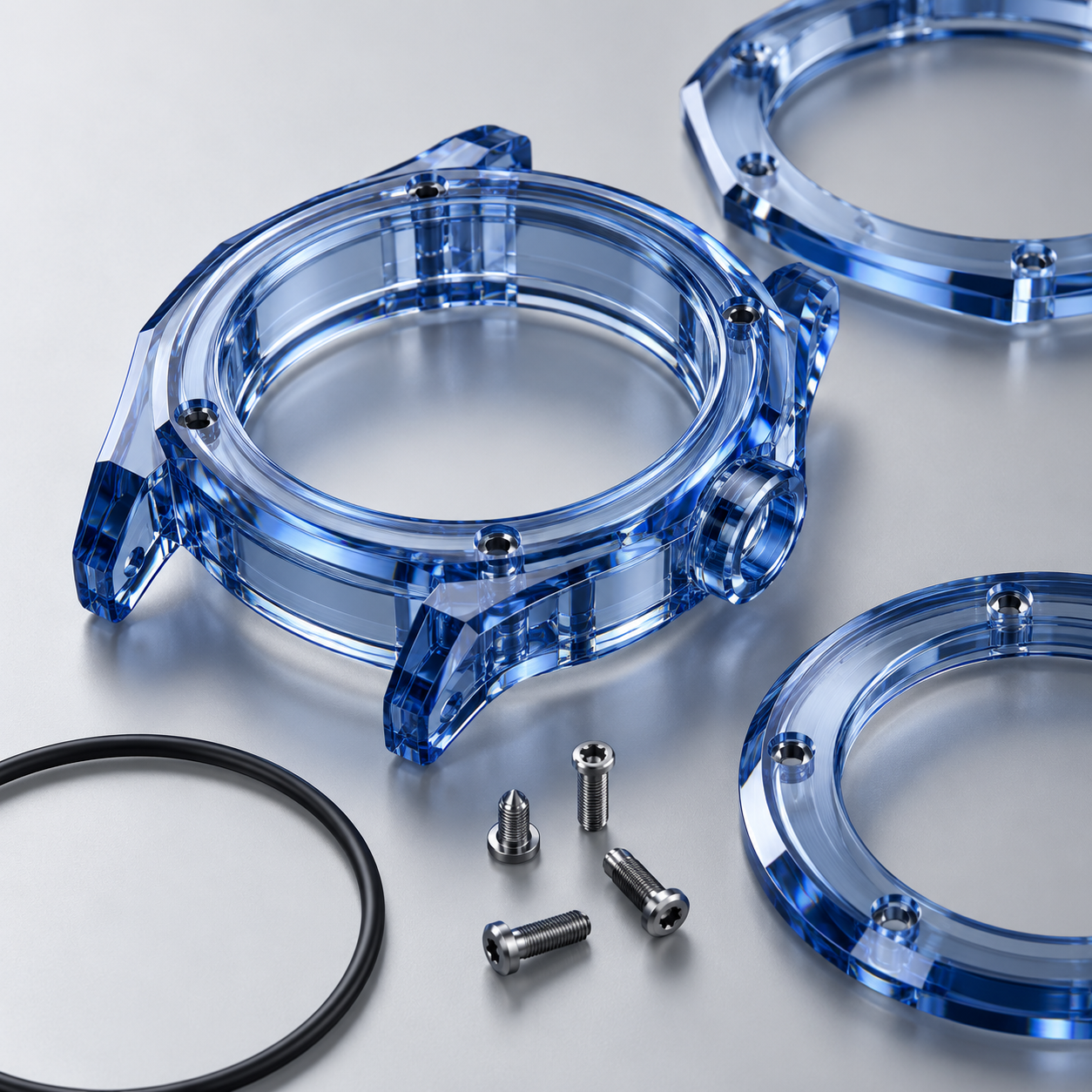
Transparent sapphire has long been associated with high-end mechanical watches, skeleton movements and tourbillons. In 2026, however, the role of sapphire in watchmaking is continuing to expand.
One of the most interesting developments is the growing use of colored sapphire as a functional structural material, rather than simply as a decorative transparent shell.
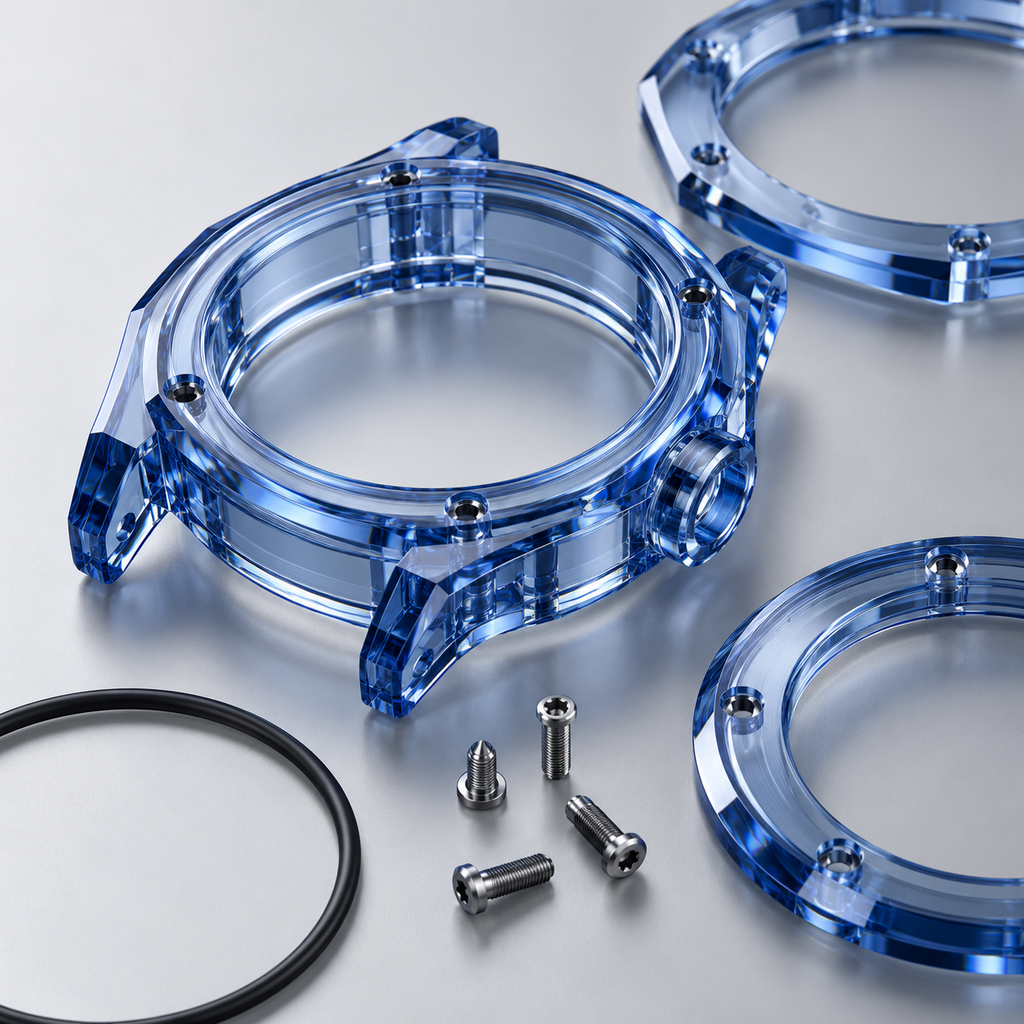
Blue sapphire is a particularly strong example.
In October 2026, Casio introduced the limited-edition MRG-D5000, using blue sapphire crystal in a multi-component shock-resistant architecture. Instead of treating sapphire only as a visual luxury material, the design addresses one of the biggest engineering challenges of sapphire watch cases: how to manage impact and localized stress without causing cracks or edge damage.
For watch brands developing their own colored sapphire cases, this development highlights an important shift.
The next generation of sapphire cases will not be defined only by color.
They will increasingly be defined by the relationship between material, geometry, assembly and mechanical performance.
Why Blue Sapphire Is Attracting More Attention
Clear sapphire remains the most recognizable option for transparent watch cases because it exposes the movement from almost every direction.
Colored sapphire creates a different effect.
Rather than making the case visually disappear, color turns the case itself into an important part of the watch’s identity.
Blue sapphire can provide:
- high visual recognition
- transparent or semi-transparent appearance
- strong contrast with skeleton movements
- distinctive reflections along polished edges
- compatibility with both modern and traditional watch designs
- differentiation from conventional steel, titanium and ceramic cases
Depending on the sapphire material, crystal thickness, geometry and lighting conditions, the finished color may appear light blue, deep blue, blue-black or almost colorless around very thin sections.
This variation is important during product development.
A blue sapphire raw blank does not guarantee that every section of the finished watch case will look exactly the same.
Color and Geometry Work Together
With metal watch cases, the color of the material is generally visible on the surface.
Sapphire behaves differently because light travels through the material.
The final appearance depends on several factors:
- sapphire color concentration
- case wall thickness
- curvature
- polishing quality
- surface orientation
- internal reflections
- surrounding components
- dial and movement colors
- strap and caseback materials
A thick sapphire side wall may appear considerably darker than a thin bezel section made from the same crystal.
Similarly, polished chamfers can produce bright highlights while deeper internal sections appear more saturated.
For this reason, colored sapphire watch-case development should include both material selection and optical evaluation.
Why Shock Resistance Is More Difficult With Sapphire
Sapphire has excellent surface hardness and scratch resistance.
It is approximately 9 on the Mohs hardness scale, making it significantly harder than most conventional watch-case materials.
But hardness is not the same as toughness.
A steel or titanium case can tolerate some deformation around screw holes or impact areas.
Sapphire is much less forgiving.
Because it is a hard and brittle single-crystal material, excessive localized stress can lead to:
- small edge chips
- cracks around holes
- fractures near sharp internal corners
- damage around screw seats
- failure during assembly
- failure after impact
The design of the case therefore becomes extremely important.
Simply converting a metal watch-case drawing into sapphire without structural modification is rarely the best approach.
Screw Holes Are Critical Areas
Screw holes are among the most sensitive features in a sapphire component.
Each hole introduces an interruption into the material.
The surrounding sapphire must withstand both machining forces and assembly loads.
Risk increases when a hole is:
- too close to an outer edge
- located in a thin wall
- combined with a sharp internal corner
- subjected to excessive screw preload
- drilled at a difficult angle
- surrounded by insufficient material
This is why modern sapphire-case architecture increasingly focuses on controlling how mechanical loads enter the crystal.
A screw should not simply be tightened against sapphire in the same way that it might be tightened against steel.
Multi-Part Construction Can Improve Structural Design
One-piece sapphire cases offer exceptional visual continuity, but a monobloc structure is not always the best solution for every watch.
A multi-part architecture can provide several advantages.
Different components can be optimized independently for:
- impact management
- movement installation
- sealing
- polishing
- assembly
- crown integration
- strap attachment
Instead of allowing one large sapphire component to receive all external forces, the structure can distribute loads through several carefully designed interfaces.
Metal inserts, polymer cushions, gaskets or structural frames can also be incorporated where appropriate.
The objective is not necessarily to eliminate metal.
It is to place each material where it performs best.
Avoid Sharp Internal Corners
Sharp corners are particularly problematic in brittle materials.
A visually attractive 90-degree internal corner in a CAD model can create a significant stress concentration in the physical sapphire component.
Whenever possible, designers should consider controlled internal radii.
Larger radii can improve:
- grinding stability
- structural strength
- polishing access
- manufacturing yield
The exact radius depends on the overall geometry and available space, but in general, smoother transitions are preferable to abrupt changes in section.
Wall Thickness Should Not Be Uniform Everywhere
Designers sometimes begin a sapphire case project by specifying one wall thickness for the entire component.
In reality, different areas perform different functions.
The area around a crown opening may require more supporting material than a decorative side wall.
A lug containing a strap hole may require a different local thickness from a bezel section.
Therefore, wall thickness should be engineered according to structural requirements rather than visual symmetry alone.
A carefully designed case may include thicker sections around:
- screw interfaces
- crown openings
- strap attachment areas
- caseback interfaces
- sealing grooves
and thinner sections where structural loads are relatively low.
Colored Sapphire Makes Edge Quality More Visible
With transparent sapphire, polishing quality is always important.
Colored sapphire can make certain defects even more visible.
Small edge chips, polishing marks or uneven transitions may catch light differently from surrounding areas.
This can be especially noticeable on:
- blue sapphire
- pink sapphire
- orange sapphire
- purple sapphire
- other strongly colored transparent materials
For a luxury watch case, edge finishing is therefore not a secondary cosmetic operation.
It is part of the final optical design.
Material Selection Should Begin Before Final CAD
One common development mistake is to finish the entire case design first and select sapphire material afterward.
A better process is to evaluate the intended material during the early design stage.
Questions should include:
- Clear sapphire or colored sapphire?
- What shade or transparency level is required?
- What is the largest required raw blank?
- Which areas of the finished case will be thickest?
- Are all visible surfaces expected to be optically polished?
- Are integrated lugs required?
- How will the movement be installed?
- Where will external impact loads enter the case?
- Are screws positioned directly in sapphire?
- What level of color consistency is required between production pieces?
These questions can significantly influence both manufacturing feasibility and cost.
Prototype Testing Becomes More Important
A colored sapphire case should be evaluated physically rather than only through computer rendering.
A prototype reveals things that CAD cannot fully predict.
These include:
- actual color saturation
- optical depth
- reflections
- movement visibility
- local distortion
- edge brilliance
- wrist appearance
- assembly behavior
For structural designs, additional testing may include:
- pressure testing
- assembly testing
- controlled impact testing
- dimensional inspection
- repeated installation and removal of components
A prototype is therefore not just a cosmetic sample.
It is an engineering validation tool.
Colored Sapphire Is Moving Beyond Decoration
The significance of recent blue-sapphire watch developments is not simply that another blue watch has entered the market.
The more important trend is that colored sapphire is increasingly being treated as a genuine engineering material.
Watchmakers are exploring how to combine:
- distinctive color
- transparent architecture
- mechanical protection
- complex geometry
- precision assembly
This creates new opportunities for independent watch brands and luxury watch designers.
A colored sapphire case can become one of the defining features of a watch rather than simply a container for the movement.
What Watch Brands Should Provide for a Custom Sapphire Case
For a new sapphire watch-case project, the most useful starting information usually includes:
- 2D drawing
- STEP or other 3D CAD file
- movement dimensions
- movement installation direction
- target case dimensions
- required sapphire color
- crown position
- strap or bracelet connection
- required water resistance
- target quantity
If final CAD is not yet available, a reference watch, concept rendering or movement specification can also be used for an initial feasibility discussion.
Early engineering review is especially valuable for colored sapphire because material availability and finished optical appearance need to be considered together with geometry.
Conclusion
Blue sapphire watch cases demonstrate how quickly transparent watch architecture is evolving.
The challenge is no longer simply to machine a transparent case.
Modern sapphire watch-case development requires the simultaneous control of color, geometry, stress, polishing and assembly.
As colored sapphire continues to move into more technically demanding watch designs, successful projects will increasingly depend on engineering the complete case system rather than treating sapphire as a direct replacement for metal.
For watch brands developing clear, blue, orange, pink or other custom sapphire watch cases, early material and structural review can reduce development risk and help transform an ambitious design into a manufacturable product.