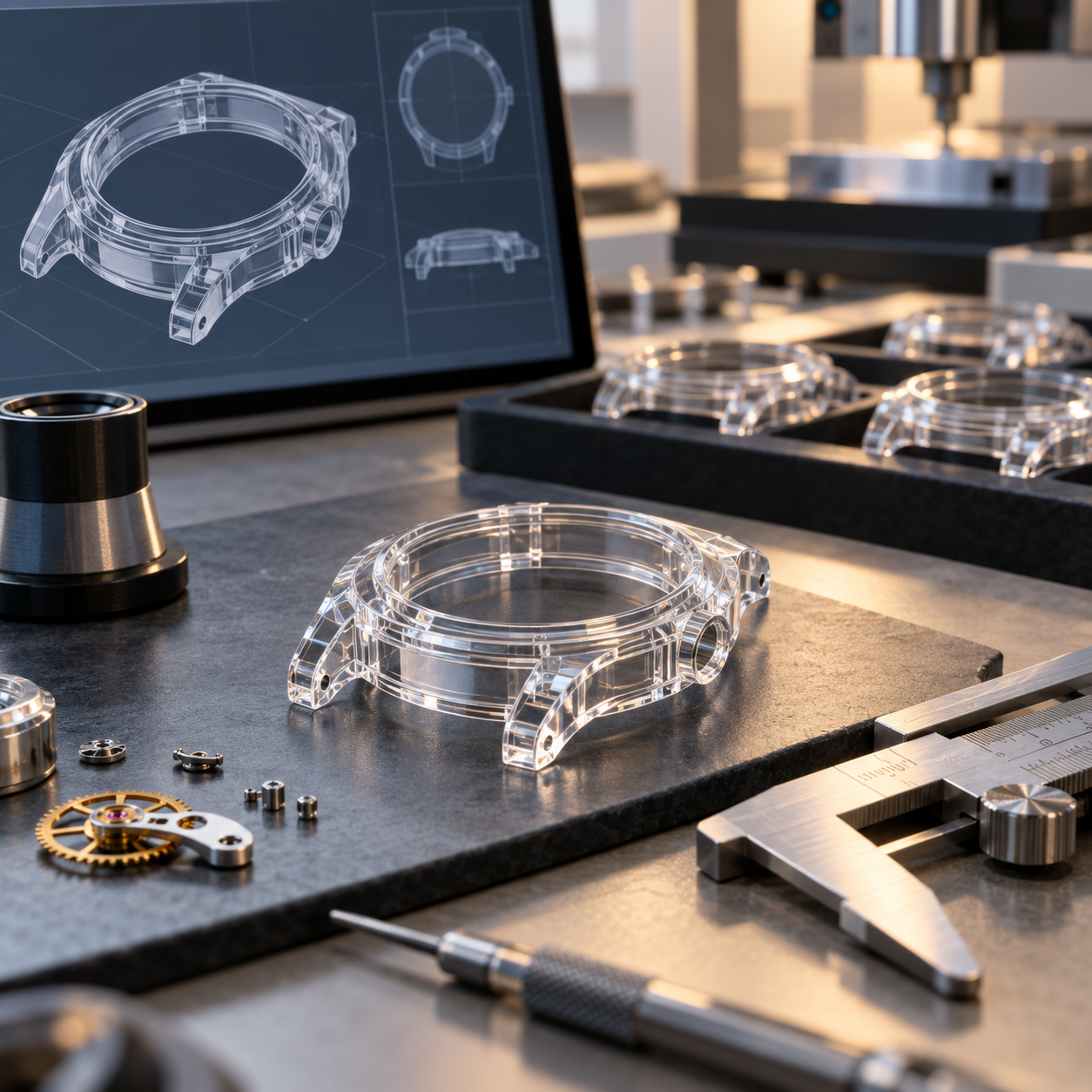
Designing a custom sapphire watch case is very different from ordering a standard metal case from a catalog.
Most sapphire watch-case projects begin with a specific movement, an industrial design concept or an existing watch architecture.
The manufacturer then needs to determine whether that concept can actually be produced in sapphire.
For independent watch brands, design studios and luxury watch companies, understanding this development process can save considerable time and cost.
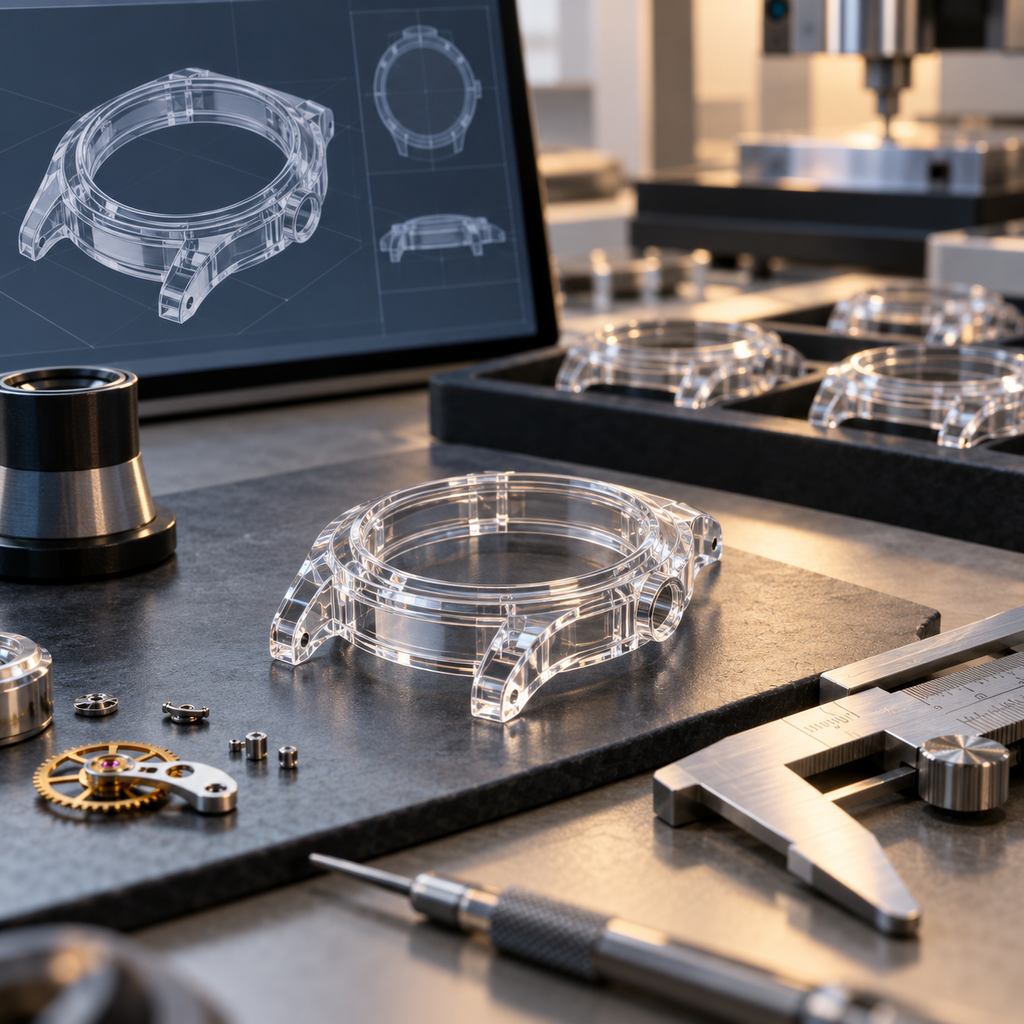
A successful sapphire case project normally moves through several stages:
concept → engineering review → material planning → prototype → assembly validation → revision → small-batch production.
Each stage solves a different problem.
Stage 1: Start With the Movement
The movement should normally be considered before the final sapphire case geometry is locked.
Important movement information includes:
- movement diameter
- movement height
- stem height
- crown position
- movement holder structure
- dial diameter
- hand clearance
- movement installation direction
For complicated mechanical movements, additional information may be needed regarding:
- tourbillon position
- pushers
- chronograph controls
- power-reserve displays
- peripheral components
Transparent cases make these relationships even more important because internal components remain visible through the sapphire.
The movement holder is therefore not only functional.
It can become part of the visual design.
Stage 2: Provide CAD or Reference Information
The most efficient starting point is usually a STEP file together with a dimensioned 2D drawing.
However, early-stage watch projects do not always have final CAD.
Manufacturing discussions can also begin from:
- concept renderings
- movement drawings
- existing watch samples
- rough 3D models
- industrial design sketches
The objective of the first review is not necessarily to calculate the final price immediately.
It is to determine whether the concept is compatible with sapphire manufacturing.
Stage 3: Review the Geometry for Sapphire
A design originally created for steel or titanium often requires modification before it can be manufactured reliably from sapphire.
Critical areas include:
Wall Thickness
Very thin sections can increase the risk of damage during grinding, polishing, assembly or impact.
Internal Corners
Sharp internal corners can create stress concentrations.
Screw Holes
Holes need sufficient surrounding material.
Crown Opening
The crown area usually contains several interacting dimensions and can become structurally sensitive.
Lugs
Integrated sapphire lugs require enough material around strap or screw holes.
Deep Cavities
A cavity may be machinable but extremely difficult to polish.
Undercuts
Severe undercuts may require alternative machining strategies or a multi-part case.
A small geometry change at this stage can greatly improve production yield later.
Stage 4: Decide Between Monobloc and Multi-Part Construction
One of the most important decisions is whether the case should be machined as one major sapphire body or divided into several components.
A monobloc case provides:
- exceptional visual continuity
- minimal visible interfaces
- strong transparent appearance
- distinctive high-end aesthetics
However, it may also create:
- difficult internal machining
- difficult polishing access
- complicated movement installation
- higher risk if one area fails late in production
A multi-part structure provides greater flexibility.
For example, the project may use:
- sapphire middle case
- separate sapphire bezel
- sapphire caseback
- titanium caseback
- metal movement holder
- separate sapphire lugs or decorative parts
The correct architecture depends on the movement and design objectives.
Stage 5: Select Clear or Colored Sapphire
Material selection should take place before final manufacturing drawings are released.
Common options include:
- clear sapphire
- blue sapphire
- pink sapphire
- yellow sapphire
- orange sapphire
- other customized transparent colors
For colored sapphire, the manufacturer should evaluate both availability and the optical effect of the finished geometry.
A thick colored case will usually appear more saturated than a thin component.
Large colored crystal blanks can also be more difficult to source than small parts.
Material size therefore needs to be confirmed early.
Stage 6: Define the Visible Surfaces
Not every surface requires the same finish.
A good drawing should distinguish between:
- external optical surfaces
- internal visible surfaces
- sealing surfaces
- hidden assembly surfaces
- datum surfaces
This is important because polishing sapphire is time-consuming.
Applying the highest optical polish to every hidden surface can unnecessarily increase manufacturing cost.
On the other hand, an internal wall visible through the complete case may require a much better finish than a conventional hidden internal surface.
Transparent architecture changes the definition of a “cosmetic surface.”
Stage 7: Prototype Machining
Once the design is reviewed, the first physical prototype can be manufactured.
Typical stages include:
- raw sapphire preparation
- rough shaping
- precision grinding
- hole machining
- fine grinding
- polishing
- dimensional inspection
- cleaning
- assembly evaluation
Sapphire machining relies primarily on diamond tools and abrasives because conventional cutting tools cannot process the material efficiently.
The prototype stage can therefore require substantially more time than a comparable machined aluminum or steel prototype.
Stage 8: Inspect Critical Dimensions
After polishing, the part should be measured again.
This is important because polishing removes material.
Dimensions that may require particular attention include:
- case diameter
- movement cavity
- case thickness
- bezel interface
- caseback interface
- gasket grooves
- crown hole
- screw holes
- lug spacing
For precision watch assemblies, a small dimensional difference can affect sealing or movement installation.
This is why tolerances should be assigned according to function.
Applying an extremely tight tolerance to every cosmetic dimension is rarely necessary.
Stage 9: Check Optical Quality
Dimensional inspection alone is not sufficient.
Sapphire is also an optical material.
Inspection should evaluate:
- transparency
- scratches
- chips
- polishing haze
- edge quality
- internal marks
- distortion
- color consistency for colored sapphire
A case can meet its dimensions and still fail a luxury-watch cosmetic requirement.
For visible sapphire structures, optical quality should therefore be included in the acceptance criteria.
Stage 10: Assemble the Complete Prototype
The sapphire component should be tested as part of the real watch architecture.
This stage may reveal issues that cannot be identified from the sapphire part alone.
Typical checks include:
- movement installation
- dial clearance
- stem alignment
- crown operation
- gasket compression
- caseback assembly
- screw loading
- strap installation
If water resistance is required, pressure testing can also be performed after assembly.
Stage 11: Expect One Engineering Revision
For a new custom sapphire case, it is reasonable to expect that the first physical prototype may reveal opportunities for improvement.
Possible changes include:
- increasing an internal radius
- adjusting a gasket groove
- increasing local wall thickness
- changing screw position
- modifying the movement holder
- reducing an undercut
- changing a chamfer
- improving polishing access
This does not mean the prototype has failed.
Prototype development exists specifically to identify these issues before batch production.
Stage 12: Freeze the Production Drawing
Once the prototype has been assembled and approved, the production configuration should be frozen.
The final documentation should clearly define:
- revision number
- dimensions
- tolerances
- material
- color
- surface finish
- polishing requirements
- inspection criteria
This prevents different versions of the drawing from being used during manufacturing.
For repeat orders, the approved sample and final drawing can serve as the reference standard.
Moving From One Prototype to 10–100 Pieces
Producing one successful sapphire case is different from producing a consistent batch.
Small-batch production requires additional attention to:
- raw material availability
- batch color consistency
- machining fixtures
- tool wear
- polishing repeatability
- inspection standards
- packaging
The manufacturing process should therefore be stabilized before quantities increase.
For a new brand, a practical development sequence may be:
1–2 engineering prototypes → 5–10 pilot pieces → 20–100 piece production batch.
The exact quantity depends on project cost, movement availability and market strategy.
Why Pilot Production Is Useful
A pilot batch provides information that a single prototype cannot.
It can reveal variation in:
- dimensions
- polishing
- edge quality
- color
- assembly
The watch brand can also use pilot pieces for:
- internal testing
- photography
- exhibitions
- sales samples
- media samples
- early customer evaluation
Only after the process is stable does it make sense to move toward a larger production quantity.
What Determines the Price of a Custom Sapphire Case?
There is no universal price per millimeter for a sapphire watch case.
Cost depends on several factors.
Raw Material
Large or colored sapphire blanks usually cost more than small clear components.
Geometry
Free-form surfaces, deep cavities and integrated lugs increase machining difficulty.
Machining Time
Sapphire material removal is slow compared with conventional metals.
Polishing
Large numbers of visible optical surfaces increase finishing time.
Tolerances
Tighter functional tolerances require more process control.
Quantity
Prototype cost and production-unit cost can be very different.
Yield
Complex designs carry a higher risk of loss during manufacturing.
This is why a detailed CAD review is normally required before an accurate quotation can be prepared.
What Should You Send for a Quotation?
To receive a useful engineering evaluation, provide as much of the following information as possible:
- STEP/IGES/3D CAD
- 2D drawing
- overall case size
- movement model
- movement dimensions
- sapphire color
- required quantity
- polishing requirements
- target water resistance
- reference images
- desired delivery schedule
If some information is not available yet, it is still possible to begin with a concept drawing or movement specification.
Common Mistakes to Avoid
Copying a Metal Case Directly
Metal geometry may contain features unsuitable for sapphire.
Making Walls Too Thin
Thin transparent walls look attractive in rendering but may reduce manufacturing reliability.
Placing Holes Too Close to Edges
Sufficient supporting material should remain around drilled features.
Ignoring Polishing Access
A surface that cannot be reached efficiently may never achieve the desired optical finish.
Ordering a Batch Before Testing Assembly
Prototype assembly should be completed before production quantities are released.
Selecting Color Too Late
Colored sapphire availability can affect both design and schedule.
A Better Development Strategy
The best sapphire watch-case projects begin with collaboration between:
- watch designer
- movement engineer
- case engineer
- sapphire manufacturer
- assembly team
Manufacturability should be considered while the design is still flexible.
This usually creates a better result than completing an ambitious CAD model first and asking the manufacturer to reproduce it exactly afterward.
Sapphire rewards designs created specifically around its properties.
Conclusion
Developing a custom sapphire watch case is not simply a machining project.
It is a combined process involving:
material science, mechanical design, precision grinding, optical polishing, dimensional inspection and watch assembly.
The most successful development path moves gradually from engineering review to physical prototype and then to controlled small-batch production.
For luxury watch brands and independent watchmakers, this approach reduces risk while preserving the visual freedom that makes sapphire one of the most exciting materials in modern watchmaking.
If you are developing a custom sapphire watch case, providing the movement information, CAD drawing, target material and expected quantity is usually enough to begin an initial manufacturing review.