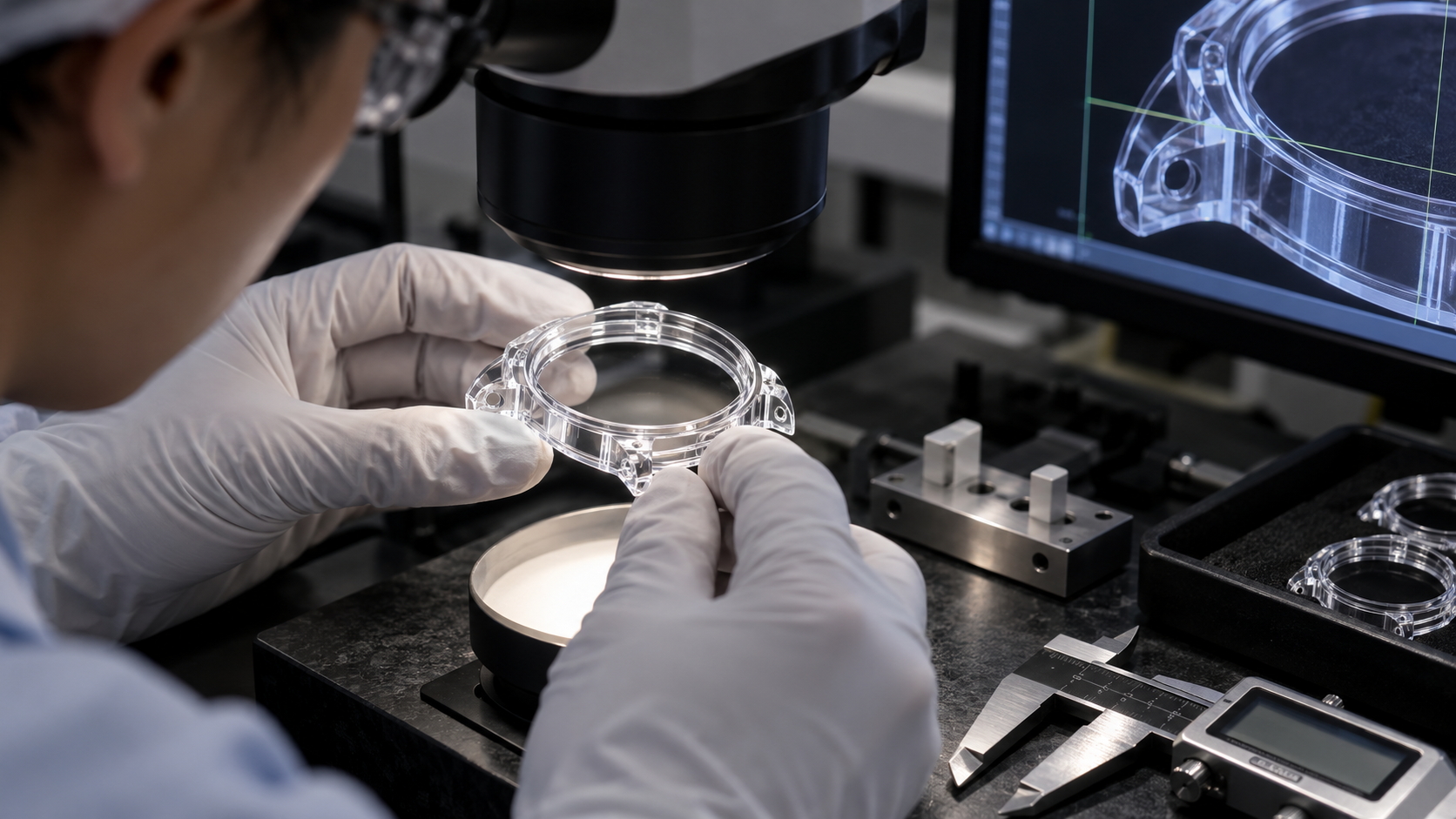
A sapphire watch case can look simple when viewed as a finished product.
In manufacturing, however, it is a complex precision component combining optical surfaces, cosmetic surfaces, mechanical interfaces, thin edges, drilled holes, sealing areas and highly polished three-dimensional geometry.
For this reason, quality inspection for a sapphire watch case cannot rely on a simple statement such as:
“The surface must be perfect.”
A professional quality specification should define exactly what must be measured, what defects are acceptable, which surfaces are most important and under what conditions cosmetic inspection should be performed.
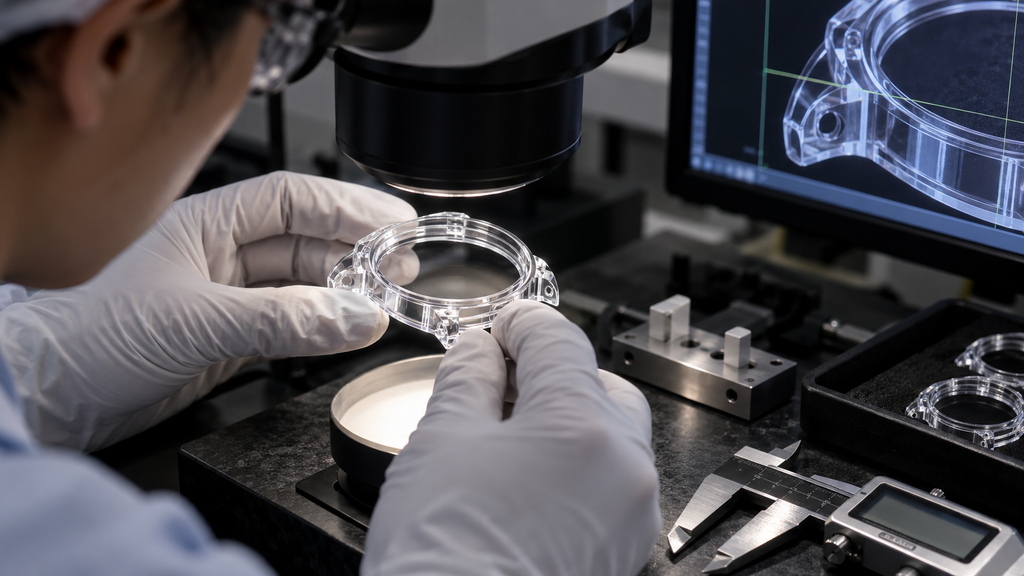
For custom sapphire watch cases, the most important inspection categories normally include:
- Dimensional tolerance
- Geometric accuracy
- Hole and feature position
- Wall thickness
- Surface defects
- Edge chipping
- Polishing quality
- Transparency
- Cosmetic appearance
- Color consistency
- Assembly fit
- Cleanliness and packaging
This article explains how these factors can be controlled from prototype development through production inspection.
Why Sapphire Watch Case Inspection Is Different
Sapphire is not a conventional metal watch-case material.
It is extremely hard and highly scratch resistant, but it is also a brittle crystalline material.
This creates a different quality-control problem.
A stainless-steel component may tolerate a small dent or local deformation without immediately becoming unusable.
With sapphire, small edge damage or a microchip in a critical location can be much more important.
At the same time, the transparency of sapphire means that surfaces normally hidden inside a metal watch case may remain visible.
A customer may see:
- Internal cavity walls
- Polishing transitions
- Screw holes
- Lug holes
- Gasket interfaces
- Internal shoulders
- Edge geometry
- Small particles or residue
As a result, a sapphire watch case must often satisfy both:
Mechanical inspection requirements
and
Luxury cosmetic inspection requirements.
1. Dimensional Inspection
Dimensional inspection confirms whether the manufactured sapphire case matches the approved engineering drawing.
Typical dimensions may include:
- Overall diameter
- Overall length and width
- Case height
- Internal cavity diameter
- Movement cavity dimensions
- Wall thickness
- Lug dimensions
- Lug spacing
- Hole diameter
- Hole position
- Crown opening
- Pusher opening
- Step height
- Groove dimensions
- Chamfer size
- Case-back interface
- Bezel interface
The inspection method should be selected according to the geometry and tolerance.
Possible equipment includes:
- Digital micrometers
- Height gauges
- Optical measuring systems
- Tool microscopes
- Vision measurement systems
- Coordinate measuring machines
- Profile measuring equipment
- Dedicated inspection fixtures
For delicate polished sapphire surfaces, non-contact inspection can be particularly useful because it reduces the possibility of damaging vulnerable edges or cosmetic surfaces during measurement.
Not Every Dimension Needs the Same Tolerance
One common mistake in custom sapphire projects is applying unnecessarily tight tolerances to every dimension.
This can increase manufacturing cost without improving the performance of the finished watch.
Instead, the drawing should distinguish between:
Critical-to-Fit Dimensions
These directly control assembly.
Examples include:
- Movement locating dimensions
- Crown position
- Screw-hole position
- Case-back fit
- Bezel fit
- Gasket groove geometry
Critical-to-Appearance Dimensions
These affect visual alignment.
Examples include:
- Bezel symmetry
- Lug geometry
- Visible wall thickness
- Chamfer consistency
- Decorative transitions
Non-Critical Dimensions
These may tolerate a wider manufacturing range without affecting function or appearance.
A good engineering drawing places the tightest tolerance only where it is justified.
2. Geometric Tolerance
A dimension can be within tolerance while the complete geometry is still incorrect.
This is why geometric inspection may also be necessary.
Depending on the design, important characteristics may include:
- Flatness
- Parallelism
- Perpendicularity
- Concentricity
- Roundness
- Profile
- True position
- Symmetry
For example, a case-back sealing surface may require controlled flatness even if its diameter is correct.
Similarly, a crown hole may have the correct diameter but still create an assembly problem if its position relative to the movement centerline is incorrect.
The datum system on the technical drawing should therefore be clearly defined.
3. Wall Thickness Inspection
Wall thickness is particularly important for transparent sapphire cases.
The design may contain:
- Thin side walls
- Narrow lug regions
- Material surrounding drilled holes
- Thin sections near crown openings
- Curved transitions
A single minimum-thickness measurement may not be sufficient for a complicated case.
Critical regions can be mapped to confirm that enough material remains after grinding and polishing.
This is important because polishing removes material.
A wall that meets the target after rough machining may become thinner after the final optical polishing process.
For thin-wall designs, inspection planning should therefore consider the complete manufacturing sequence.
4. Hole Diameter and Position
Holes are among the most sensitive features of a sapphire watch case.
Typical examples include:
- Crown holes
- Pusher holes
- Screw holes
- Spring-bar holes
- Strap attachment holes
- Decorative openings
Inspection should not consider only diameter.
It may also need to check:
- Hole location
- Hole axis
- Roundness
- Entry-edge condition
- Exit-edge condition
- Chamfer
- Distance to the nearest outer edge
A hole may be dimensionally correct but still unacceptable if chipping around its edge exceeds the agreed limit.
5. Edge Chipping
Edge integrity is one of the most important quality categories for machined sapphire.
Potential problem areas include:
- External corners
- Lug tips
- Hole edges
- Internal cavity transitions
- Chamfer intersections
- Thin-wall regions
- Sharp decorative features
Chipping can occur during:
- Cutting
- Grinding
- Drilling
- Polishing
- Cleaning
- Handling
- Assembly
The drawing should define where edge chips are completely prohibited and where a limited edge exclusion may be acceptable.
Not All Edge Chips Have the Same Importance
Consider two defects of identical size.
One is located on a hidden internal surface.
The other is located on the top edge of a transparent luxury watch case.
Technically they may have similar dimensions, but cosmetically they are very different.
This is why sapphire watch-case specifications should classify surfaces according to their function and visibility.
6. Cosmetic Zones
A practical quality specification can divide a watch case into different cosmetic zones.
For example:
Zone A — Primary Cosmetic Surface
These are the surfaces the customer sees immediately.
Examples:
- Top surface
- Exterior side wall
- Bezel area
- Visible lug surfaces
- Highly polished transparent faces
These areas normally require the strictest cosmetic control.
Zone B — Secondary Visible Surface
These surfaces are visible but less prominent.
Examples:
- Internal case walls
- Underside edges
- Inner lug areas
- Secondary chamfers
A slightly different acceptance standard may be appropriate.
Zone C — Hidden Functional Surface
These surfaces are normally hidden after assembly.
Examples:
- Movement interfaces
- Covered gasket areas
- Certain mounting surfaces
- Hidden internal steps
The priority in these areas may be dimensional function rather than premium cosmetic appearance.
This approach is often more practical than applying one extremely strict optical standard to the entire component.
7. Surface Scratches
Even though sapphire itself is highly scratch resistant, scratches can still appear during manufacturing.
Possible causes include:
- Grinding processes
- Incomplete polishing
- Contaminated polishing media
- Diamond particles
- Improper handling
- Contact with other sapphire parts
The location, length, depth and visibility of a scratch should all be considered.
A faint polishing mark under magnification is not necessarily equivalent to a visible scratch on the main external viewing surface.
This is why visual inspection conditions should be agreed in advance.
8. Pits, Digs and Local Surface Defects
Localized defects can include:
- Pits
- Digs
- Pinpoints
- Polishing defects
- Material imperfections
- Local haze
For optical sapphire components, scratch-dig specifications such as:
60-40
40-20
20-10
may be used to define optical surface quality.
Lower numbers generally represent stricter surface-quality requirements.
However, a complete sapphire watch case is not simply a flat optical window.
It contains multiple curved, angled and decorative surfaces.
For this reason, applying an optical scratch-dig specification should be done only where appropriate and should be combined with a practical cosmetic inspection standard.
Scratch-Dig Is Not the Same as Surface Roughness
These two requirements are sometimes confused.
They measure different things.
Scratch-Dig
Evaluates localized visible surface imperfections such as scratches and pits.
Surface Roughness
Evaluates microscopic texture across a surface.
A surface can have extremely low roughness and still contain one visible scratch.
Conversely, a surface may appear free from large scratches but still have insufficient polishing quality at a microscopic scale.
For demanding projects, both parameters may need to be considered separately.
9. Polishing Quality
Polishing is especially important for transparent sapphire watch cases.
The finished component may include:
- Flat polished surfaces
- Curved polished surfaces
- Internal polished walls
- Chamfers
- Lug surfaces
- Deep cavity surfaces
A quality inspection should evaluate whether the polishing is uniform across all specified areas.
Possible problems include:
- Local haze
- Polishing marks
- Uneven gloss
- Incomplete polishing
- Optical distortion
- Transition marks
- Residue
Complex three-dimensional surfaces are generally more difficult to polish consistently than flat sapphire windows.
This is one reason cosmetic requirements should be discussed during DFM rather than only after the first part has been manufactured.
10. Transparency Inspection
When customers purchase a transparent sapphire watch case, they naturally expect high clarity.
But the term “transparent” needs to be interpreted carefully.
The visual appearance of a finished case is affected by:
- Sapphire material quality
- Surface polish
- Wall thickness
- Internal reflections
- Viewing angle
- Curved geometry
- Crystal orientation
- Coatings
- Lighting conditions
A complete three-dimensional sapphire case may therefore show reflections or optical effects that would not appear in a simple flat sapphire window.
These should not automatically be treated as material defects.
Haze vs Normal Optical Reflection
The quality inspector should distinguish between actual surface or material problems and normal optical behavior.
Possible Defects
- Local cloudy region
- Poorly polished surface
- Residue
- Surface contamination
- Internal visible inclusion
- Severe polishing distortion
Normal Optical Effects
- Edge brightness
- Internal reflection
- Refraction through curved walls
- Changes in appearance with viewing angle
Prototype approval is useful because the customer can establish the expected appearance using the real component rather than relying only on a written description.
11. Color Inspection for Colored Sapphire Cases
Colored sapphire introduces additional quality-control requirements.
Possible colors include:
- Blue
- Red
- Pink
- Purple
- Green
- Smoked or dark tones
- Other customized colors
For colored sapphire, inspection may need to evaluate:
- Hue
- Saturation
- Shade
- Uniformity
- Part-to-part matching
- Batch-to-batch matching
A written color name alone is rarely sufficient.
For example, two suppliers may interpret “dark blue sapphire” very differently.
For high-end projects, it is better to establish:
Approved physical color sample + defined lighting conditions + approved production range
This becomes especially important when one watch uses several colored sapphire components.
12. Cosmetic Inspection Conditions
A statement such as:
“No visible defects.”
is difficult to enforce unless the inspection conditions are defined.
Visual inspection can be influenced by:
- Lighting intensity
- Light direction
- Viewing distance
- Viewing angle
- Background color
- Magnification
- Inspection time
A defect that is invisible during normal use may become obvious under 20× magnification.
The customer and manufacturer should therefore agree on how cosmetic inspection will be performed.
A specification might define:
- Inspection under controlled white light
- Dark or neutral background
- Defined viewing distance
- Defined viewing angles
- Defined observation time
- Magnification only for specific defect categories
The exact conditions should match the real quality requirement of the product.
13. Why “Perfect” Is Not an Inspection Standard
Words frequently used in luxury-product RFQs include:
- Perfect
- Flawless
- Optical quality
- Premium quality
- No defects
- Jewelry quality
These phrases communicate an expectation but do not provide a measurable acceptance standard.
A better specification defines:
- Where defects are prohibited
- What type of defects are controlled
- Maximum defect size
- Inspection conditions
- Cosmetic-zone classification
- Whether magnification is used
This reduces disputes between supplier and customer.
14. Inspection Under Magnification
Magnification can be useful for identifying:
- Edge chips
- Small scratches
- Hole damage
- Polishing defects
- Local pits
- Microdamage
However, magnification should not automatically become the cosmetic acceptance condition for every surface.
A luxury watch is usually viewed by the wearer with the naked eye.
If every microscopic feature were treated as a cosmetic failure regardless of visibility, manufacturing cost could increase dramatically without improving the user’s actual experience.
Magnification is most useful when applied to defined engineering risks.
15. Inspection of Hole and Edge Damage
One area where magnification is particularly valuable is hole-edge inspection.
Under controlled lighting, inspectors can check:
- Entry edge
- Exit edge
- Local microchips
- Chamfer continuity
- Surface cracks
- Damage near thin walls
Hole-edge quality is particularly important when the feature will experience mechanical loading during assembly.
16. Cracks vs Cosmetic Chips
A crack should not be treated in the same way as a minor cosmetic imperfection.
Visible cracks in critical sapphire structures are generally unacceptable because they can propagate under mechanical stress.
A localized edge chip, however, needs to be evaluated based on:
- Size
- Depth
- Location
- Distance from a critical feature
- Cosmetic visibility
- Structural importance
The acceptance standard should therefore distinguish between cracking and limited edge imperfections.
17. Assembly-Fit Inspection
A sapphire case can pass dimensional inspection and still fail during final watch assembly.
This is why prototype and production inspection should include fit verification where practical.
Potential checks include:
- Movement installation
- Crown alignment
- Stem alignment
- Case-back fit
- Bezel fit
- Gasket interface
- Screw alignment
- Strap or bracelet interface
If mating components are available, actual fit checks can identify problems that dimensional reports alone may not reveal.
18. Gasket and Sealing Surfaces
For watches requiring water resistance, sealing surfaces require particular attention.
Inspection may include:
- Surface flatness
- Groove geometry
- Surface damage
- Gasket contact area
- Assembly clearance
The finished watch should ultimately be validated as a complete assembly when water resistance is a functional requirement.
A loose sapphire component cannot prove the final water-resistance performance by itself.
19. Optical Inspection Equipment
Depending on the quality requirement, sapphire inspection may use equipment such as:
- Stereo microscopes
- Optical comparators
- Vision measurement systems
- CMM systems
- Surface profilometers
- Interferometers
- Roughness measurement equipment
- Controlled inspection lights
Not every watch case requires every measurement technique.
The inspection method should be selected according to the actual specification.
20. Incoming Material Inspection
Quality control should not begin only after machining.
Raw sapphire material can also be checked before production.
Depending on the project, incoming inspection may consider:
- Material type
- Color
- Crystal orientation
- Internal visible defects
- Blank dimensions
- Material documentation
Controlling the input material helps reduce variability later in production.
21. In-Process Inspection
Waiting until final polishing to discover a dimensional problem can be expensive.
A better strategy uses inspection during several stages.
For example:
Incoming Material
↓
Rough Machining Inspection
↓
Critical Hole and Geometry Check
↓
Pre-Polish Inspection
↓
Final Dimensional Inspection
↓
Cosmetic Inspection
↓
Assembly/Fit Verification
↓
Cleaning and Packaging
This makes it possible to detect problems before additional high-cost processing is performed.
22. Final Dimensional Inspection
After final polishing, critical dimensions should be confirmed again.
This is important because polishing removes material.
The final inspection should therefore be performed on the finished part rather than relying exclusively on measurements taken during rough machining.
Critical dimensions can be listed on an inspection report when required.
23. Final Cosmetic Inspection
Before packaging, each component should be clean enough to distinguish genuine defects from removable contamination.
The inspector may check for:
- Scratches
- Pits
- Edge chips
- Haze
- Polishing marks
- Stains
- Fingerprints
- Residue
- Foreign particles
- Color variation
For transparent sapphire, both reflected-light and transmitted-light inspection may be useful depending on the component geometry.
24. Cleaning Is Part of Quality Control
Transparent sapphire easily reveals contamination.
A perfectly manufactured surface can appear defective if it contains:
- Fingerprints
- Polishing compound
- Dust
- Oil
- Cleaning residue
Final cleaning should therefore be treated as part of the production process rather than merely cosmetic preparation.
After cleaning, parts should be handled with appropriate gloves and protected from unnecessary contact.
25. Packaging Is Also Part of Quality
A sapphire watch case may require many hours of machining and polishing.
Poor packaging can damage it during the final stage.
Finished sapphire parts should normally be separated so that polished components cannot strike or rub against one another.
Packaging can include:
- Individual protective bags
- Separated foam cavities
- Custom trays
- Protective film where appropriate
- Dust protection
- Lot identification
For premium polished components, packaging standards should be agreed before mass production.
26. What Should Be Included in a Sapphire Watch Case Quality Drawing?
For a professional custom project, the drawing or quality specification should ideally identify:
Dimensional Requirements
- Critical dimensions
- Tolerances
- Datums
- Hole position
- Wall thickness
- Flatness and other geometric requirements
Surface Requirements
- Polished surfaces
- Ground surfaces
- Frosted surfaces
- Surface roughness where required
- Optical surface quality where applicable
Edge Requirements
- Chamfer
- Radius
- Permitted edge chips
- Critical chip-free areas
Cosmetic Requirements
- Primary cosmetic surfaces
- Secondary surfaces
- Hidden surfaces
- Scratch limits
- Pit limits
- Haze requirements
Appearance Requirements
- Transparency
- Color
- Shade matching
Inspection Requirements
- Inspection equipment where relevant
- Sampling method
- Inspection report
- Viewing conditions
27. Prototype Quality vs Mass-Production Quality
Prototype and mass-production quality control have different objectives.
Prototype Stage
The objective is to determine whether the design and manufacturing route work.
Inspection may identify:
- Design risks
- Difficult polishing areas
- Fragile edges
- Tolerance conflicts
- Optical appearance issues
- Assembly problems
Design changes are expected.
Mass-Production Stage
The design should already be frozen.
The objective becomes:
repeatability.
The manufacturer must reproduce the approved geometry and cosmetic target consistently across production batches.
28. Establish a Golden Sample
For cosmetic sapphire products, an approved physical sample can be extremely valuable.
The Golden Sample establishes a visual reference for:
- Transparency
- Polishing
- Edge quality
- Color
- Overall appearance
A Golden Sample should not replace the technical drawing.
Instead, the strongest quality system combines:
Approved Drawing + Written Inspection Standard + Golden Sample
The drawing controls dimensions.
The quality standard defines measurable acceptance criteria.
The Golden Sample helps establish the visual target.
29. Recommended Quality-Control Workflow
A practical sapphire watch-case inspection workflow can follow:
Step 1 — Review the Drawing
Identify critical dimensions, cosmetic surfaces and edge-risk areas.
Step 2 — Approve Raw Material
Confirm sapphire material, orientation and color where required.
Step 3 — In-Process Inspection
Check critical geometry before expensive finishing operations.
Step 4 — Pre-Polish Review
Confirm that the component is suitable to continue to final polishing.
Step 5 — Final Dimensional Inspection
Measure critical dimensions after finishing.
Step 6 — Edge Inspection
Check holes, lugs, corners and thin-wall areas for damage.
Step 7 — Cosmetic Inspection
Evaluate scratches, pits, haze, polishing quality and transparency.
Step 8 — Assembly Check
Verify important mating interfaces when required.
Step 9 — Final Cleaning
Remove contamination before release.
Step 10 — Protected Packaging
Separate finished components and protect vulnerable surfaces.
30. Quality Questions Buyers Should Ask Before Ordering
When sourcing custom sapphire watch cases, buyers should consider asking:
- Which dimensions will be inspected?
- How are critical dimensions identified?
- How are cosmetic surfaces classified?
- What is the edge-chip acceptance standard?
- How are scratches and pits evaluated?
- Is surface roughness specified separately from cosmetic quality?
- How is transparency evaluated?
- How is colored sapphire matched?
- Can dimensional reports be supplied?
- Can a Golden Sample be retained for future production?
- How are finished parts protected during packaging?
- Can prototype fit be checked against mating components?
These questions help convert general quality expectations into a controlled manufacturing specification.
Quality Inspection for Custom Sapphire Watch Cases
At Sapphire-Watchcase.com, quality planning for custom sapphire watch components begins with the engineering drawing.
Depending on project requirements, inspection can cover:
- Overall dimensions
- Critical tolerances
- Hole dimensions and location
- Wall thickness
- Geometric accuracy
- Surface finish
- Edge integrity
- Scratches and pits
- Polishing quality
- Transparency
- Color consistency
- Cosmetic appearance
- Assembly interfaces
- Protected packaging
For complex projects, we recommend defining cosmetic zones and critical-to-function dimensions before prototype machining begins.
This makes both prototype evaluation and production acceptance more objective.
Send Us Your Sapphire Watch Case Quality Requirements
If you are developing a custom sapphire watch case, please provide:
2D Drawing + 3D STEP File + Sapphire Color + Quantity + Critical Tolerances + Cosmetic Requirements
If you already have an inspection standard or approved sample, include it with your RFQ.
For projects without an established quality standard, the component geometry can first be reviewed to identify:
- Critical dimensions
- Vulnerable edges
- Important cosmetic surfaces
- Polishing requirements
- Assembly interfaces
A clear inspection specification established before manufacturing can significantly reduce uncertainty during prototype approval and mass production.
Contact Sapphire-Watchcase.com for custom sapphire watch case manufacturing, prototype evaluation and quality inspection support.