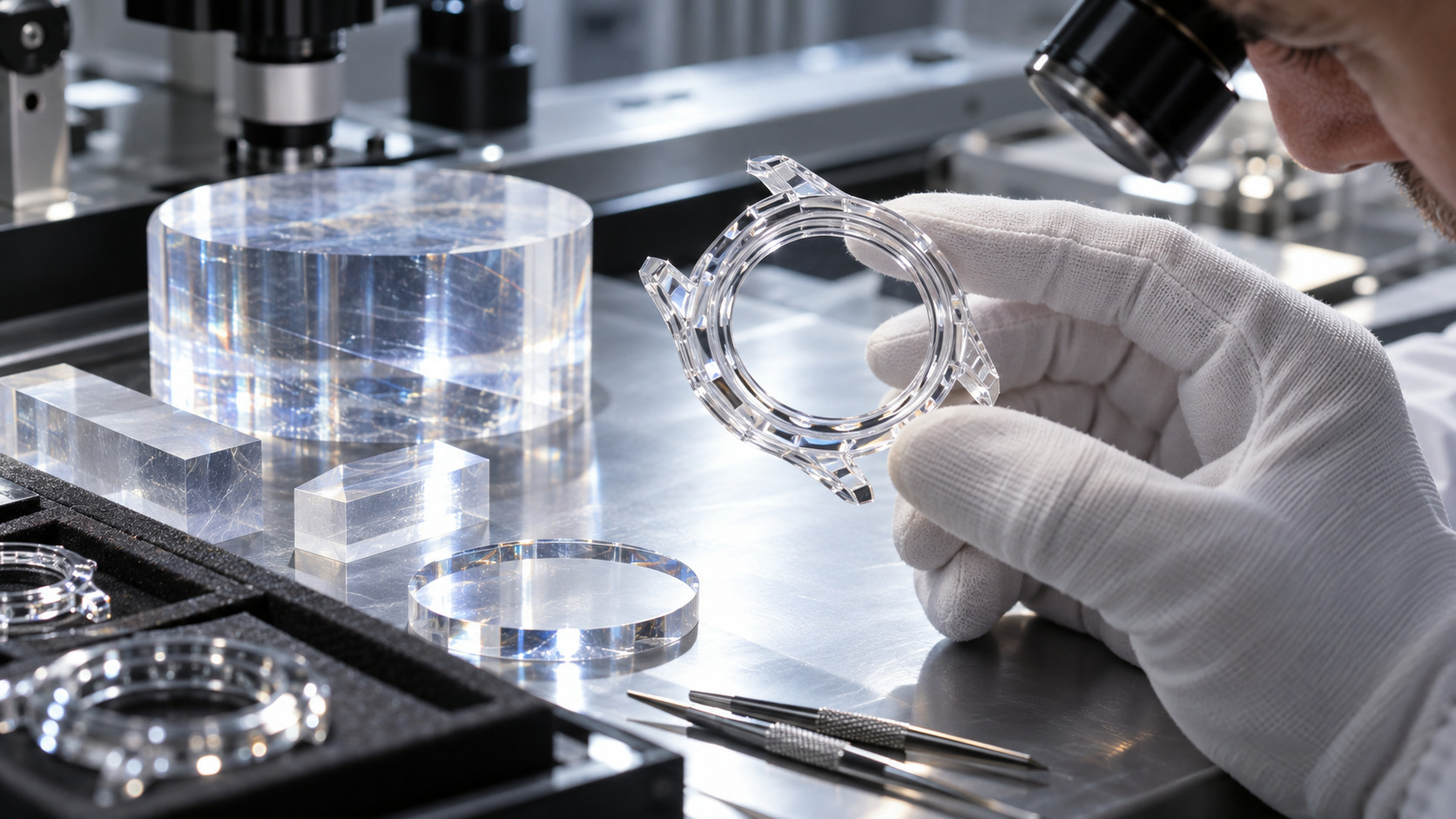
Sapphire watch cases are often selected for their exceptional hardness, scratch resistance, transparency and premium appearance. However, sapphire is not simply a transparent material that behaves identically in every direction.
Single-crystal sapphire has a defined crystallographic structure, and its optical, mechanical and thermal properties vary with crystal orientation.
For conventional sapphire watch crystals, orientation may primarily affect optical performance. For a complete sapphire watch case, the situation is more complicated because the component contains multiple surfaces, holes, shoulders, curves, threads and thin-wall features.
Understanding C-axis sapphire, A-axis sapphire and other crystal orientations therefore becomes important when designing and manufacturing high-end sapphire watch cases.
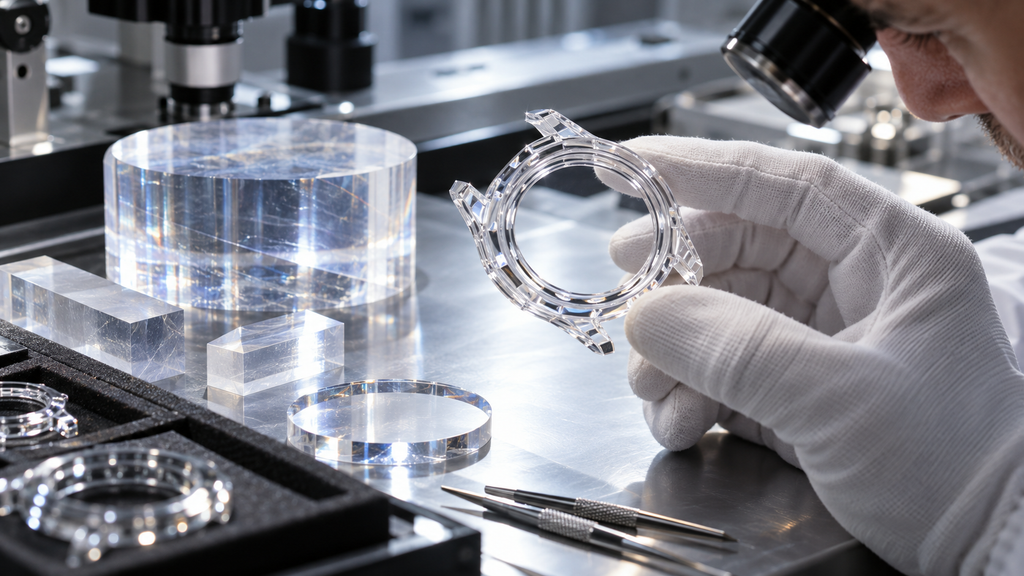
What Is Crystal Orientation in Sapphire?
Synthetic sapphire is single-crystal aluminum oxide, or Al₂O₃.
Unlike ordinary glass, which is essentially isotropic, sapphire has an ordered crystal lattice. Its properties can therefore vary depending on the direction in which the material is cut, machined or viewed.
Common sapphire orientations include:
- C-plane / C-axis
- A-plane
- M-plane
- R-plane
For a flat sapphire component, the specified orientation usually describes how the crystal lattice is positioned relative to the major surface.
For example, in a C-plane sapphire window, the C-axis is typically perpendicular to the main optical surface.
For a three-dimensional sapphire watch case, however, orientation must be considered relative to the overall geometry rather than just one flat surface.
C-Axis Sapphire
C-axis sapphire is one of the most commonly specified orientations for optical sapphire components.
The C-axis corresponds to the optical axis of the sapphire crystal. When light propagates in a suitable direction relative to this axis, birefringence can be minimized.
This makes C-axis orientation especially useful for components where optical clarity and predictable light transmission are important.
For sapphire watch cases, C-axis orientation may be selected when large transparent surfaces form an important part of the visual design.
Examples include:
- Fully transparent sapphire watch cases
- Large sapphire case backs
- Integrated transparent case structures
- Sapphire components surrounding a skeleton movement
- Watch designs requiring highly consistent optical appearance
The orientation does not automatically determine whether a watch case will look perfectly transparent. Surface polishing, internal geometry, wall thickness and reflections between different surfaces also have a major influence.
What Is A-Axis Sapphire?
A-axis or A-plane sapphire represents a different crystallographic orientation.
Because sapphire is anisotropic, changing the orientation changes how certain mechanical, optical and thermal characteristics relate to the component geometry.
A-axis material can therefore be useful when the mechanical design, available crystal blank or machining strategy makes it more suitable than C-axis material.
The choice between C-axis and A-axis should not be made solely according to a statement such as “one orientation is stronger.”
For complex sapphire components, the actual result depends on several factors:
- Part geometry
- Wall thickness
- Hole location
- Corner radius
- Surface finish
- Residual machining damage
- Polishing process
- Assembly load
- Crystal orientation
- Impact direction
This is particularly important for sapphire watch cases because they contain many stress-concentration areas that simple optical windows do not have.
Does Crystal Orientation Affect Sapphire Strength?
Yes, but the relationship is more complicated than comparing two simple strength numbers.
Single-crystal sapphire is anisotropic. Properties such as elastic behavior and thermal expansion vary with crystallographic direction.
However, the practical strength of a finished sapphire watch case is also strongly influenced by microscopic surface defects.
Grinding marks, edge chips, sharp internal corners or subsurface damage can become stress concentration points.
For this reason, a well-designed and carefully polished sapphire component with an appropriate orientation may perform better than a theoretically favorable crystal orientation that has poor edge quality or excessive machining damage.
When evaluating sapphire watch case strength, crystal orientation should therefore be considered together with:
Material quality + geometry + machining + polishing + edge design + assembly conditions.
Why Edge Design Matters
Sapphire is extremely hard but relatively brittle compared with metals.
A transparent sapphire case may contain:
- Lug holes
- Crown openings
- Screw holes
- Case-back interfaces
- Stepped internal cavities
- Thin transparent walls
- Sharp decorative transitions
These areas frequently determine the real mechanical reliability of the component.
Sharp corners can increase local stress, while controlled radii can distribute loading more effectively.
For this reason, DFM — Design for Manufacturing — is especially important for sapphire cases.
During prototype evaluation, engineers may recommend increasing a radius, changing a hole-to-edge distance or slightly increasing wall thickness even if the original CAD model is technically machinable.
The objective is not simply to machine the shape, but to produce a component that can survive polishing, assembly and practical use.
Crystal Orientation and Optical Appearance
One of the reasons sapphire is so attractive in luxury watches is its unique transparent appearance.
A properly polished sapphire case can reveal:
- Movement architecture
- Bridges and gears
- Internal case construction
- Decorative components
- Light reflections through multiple surfaces
Crystal orientation can influence the optical behavior of sapphire because the refractive index is direction-dependent.
This phenomenon is associated with birefringence.
For a simple optical window, crystal orientation can be controlled so that the optical path is optimized.
A sapphire watch case is much more complicated.
Light may travel through:
- The front face
- Side walls
- Curved surfaces
- Chamfers
- Internal shoulders
Each surface may intersect the crystal lattice at a different angle.
As a result, the visual performance of a sapphire watch case depends on both crystallography and component geometry.
Why a Sapphire Case May Look Different from Sapphire Glass
Customers sometimes expect a complete sapphire case to have exactly the same appearance as a flat sapphire watch crystal.
In practice, a three-dimensional sapphire case creates far more optical interfaces.
Even with excellent material quality, the viewer may see:
- Internal reflections
- Light refraction
- Edge brightness
- Slight optical distortion around curves
- Different apparent transparency at different viewing angles
These effects do not necessarily indicate poor material quality.
They are often caused by the geometry of the sapphire itself.
For highly transparent designs, the relationship between wall thickness, polishing quality, geometry and crystal orientation should therefore be evaluated during the prototype stage.
Crystal Orientation and Machining
Sapphire is significantly more difficult to machine than conventional metals or engineering plastics.
Typical sapphire watch case manufacturing may involve:
- Crystal blank selection
- Orientation verification
- Cutting
- CNC grinding
- Hole machining
- Contour machining
- Fine grinding
- Lapping
- Multiple polishing operations
- Dimensional inspection
- Cosmetic inspection
The crystal orientation can influence machining behavior because material removal does not behave identically in every crystallographic direction.
The effect becomes particularly important when producing:
- Thin walls
- Deep cavities
- Small holes
- Narrow slots
- Sharp transitions
- Complex curved surfaces
- High-polish decorative edges
The optimal machining direction and process parameters may therefore vary according to the component geometry.
C-Axis vs A-Axis for Sapphire Watch Cases
There is no universal rule stating that every sapphire watch case must use one specific orientation.
The appropriate choice depends on the design.
| Factor | C-Axis Consideration | A-Axis Consideration |
|---|---|---|
| Optical applications | Frequently preferred | Can be used depending on design |
| Birefringence control | Advantageous for certain optical paths | Depends on viewing direction |
| Complex 3D case | Must be evaluated with geometry | Must be evaluated with geometry |
| Machining | Direction-sensitive | Direction-sensitive |
| Mechanical design | Geometry remains critical | Geometry remains critical |
| Custom case development | Common option | Available for specific requirements |
For many watch projects, the correct approach is to review the complete CAD drawing rather than selecting orientation independently.
Crystal Orientation Should Be Defined Early
Crystal orientation is best considered before prototype machining begins.
Changing orientation after the geometry, blank size and machining process have already been established may increase cost or require a new raw material blank.
A professional sapphire watch case development process should normally review:
- Overall dimensions
- Crystal orientation
- Wall thickness
- Hole diameter
- Hole-to-edge distance
- Internal corner radius
- Lug geometry
- Crown opening
- Case-back structure
- Surface finish
- Optical requirements
- Dimensional tolerances
- Assembly method
This allows material selection and machining strategy to be optimized together.
How Is Sapphire Orientation Verified?
For demanding sapphire components, crystallographic orientation can be measured using specialized inspection equipment such as X-ray diffraction systems.
Orientation control is particularly important when the drawing specifies a defined crystal plane or axis.
For custom watch components, orientation requirements should ideally be included directly on the technical drawing.
For example, the drawing can specify:
- Required crystal orientation
- Reference surface
- Orientation tolerance
- Optical surface
- Polished surfaces
- Critical dimensions
This reduces ambiguity between the watch designer and sapphire manufacturer.
Should Every Sapphire Watch Case Specify Crystal Orientation?
Not necessarily.
For some decorative parts, orientation may not significantly affect the customer’s functional requirement.
For premium transparent sapphire watch cases, however, specifying or at least discussing crystal orientation is recommended.
Orientation becomes increasingly important when the project includes:
- Large transparent areas
- Optical performance requirements
- Very thin walls
- High dimensional precision
- Complex machining
- Tight cosmetic standards
- High-value watch movements
- Strict reliability requirements
In these cases, crystal orientation becomes part of the engineering design rather than simply a raw-material specification.
Prototype Evaluation Is Essential
Even when the final target is mass production, sapphire watch case projects normally benefit from prototype validation.
A prototype allows the manufacturer and customer to evaluate:
- Transparency
- Optical appearance
- Edge appearance
- Surface polishing
- Hole quality
- Wall thickness
- Assembly fit
- Dimensional tolerances
- Potential chipping areas
- Structural weak points
If necessary, the CAD design can then be adjusted before production quantities are manufactured.
For complex sapphire cases, relatively small design modifications can significantly improve manufacturability and production yield.
Custom Sapphire Watch Case Manufacturing
Manufacturing a complete sapphire watch case requires more than simply machining transparent Al₂O₃.
Successful development requires coordination between:
Crystal selection → Orientation → Mechanical design → Precision machining → Polishing → Inspection → Assembly validation
For watch brands developing transparent, skeleton or luxury sapphire watches, providing the complete engineering drawing at the beginning of the project allows the manufacturer to review the relationship between crystal orientation and the final geometry.
At Sapphire-Watchcase.com, we support custom sapphire watch case development according to customer drawings and technical requirements.
Available customization can include:
- Custom sapphire case bodies
- Sapphire case backs
- Sapphire bezels
- Transparent sapphire components
- CNC-machined sapphire structures
- Precision holes and cavities
- Complex 3D sapphire parts
- Optical polishing
- Prototype development
- Small-batch and production manufacturing
If you are developing a new sapphire watch case, send us your 2D drawing, 3D STEP file, required quantity and key tolerances.
Our team can evaluate the design, crystal orientation, machining feasibility and polishing requirements before quotation.
Contact us for custom sapphire watch case manufacturing and prototype evaluation.