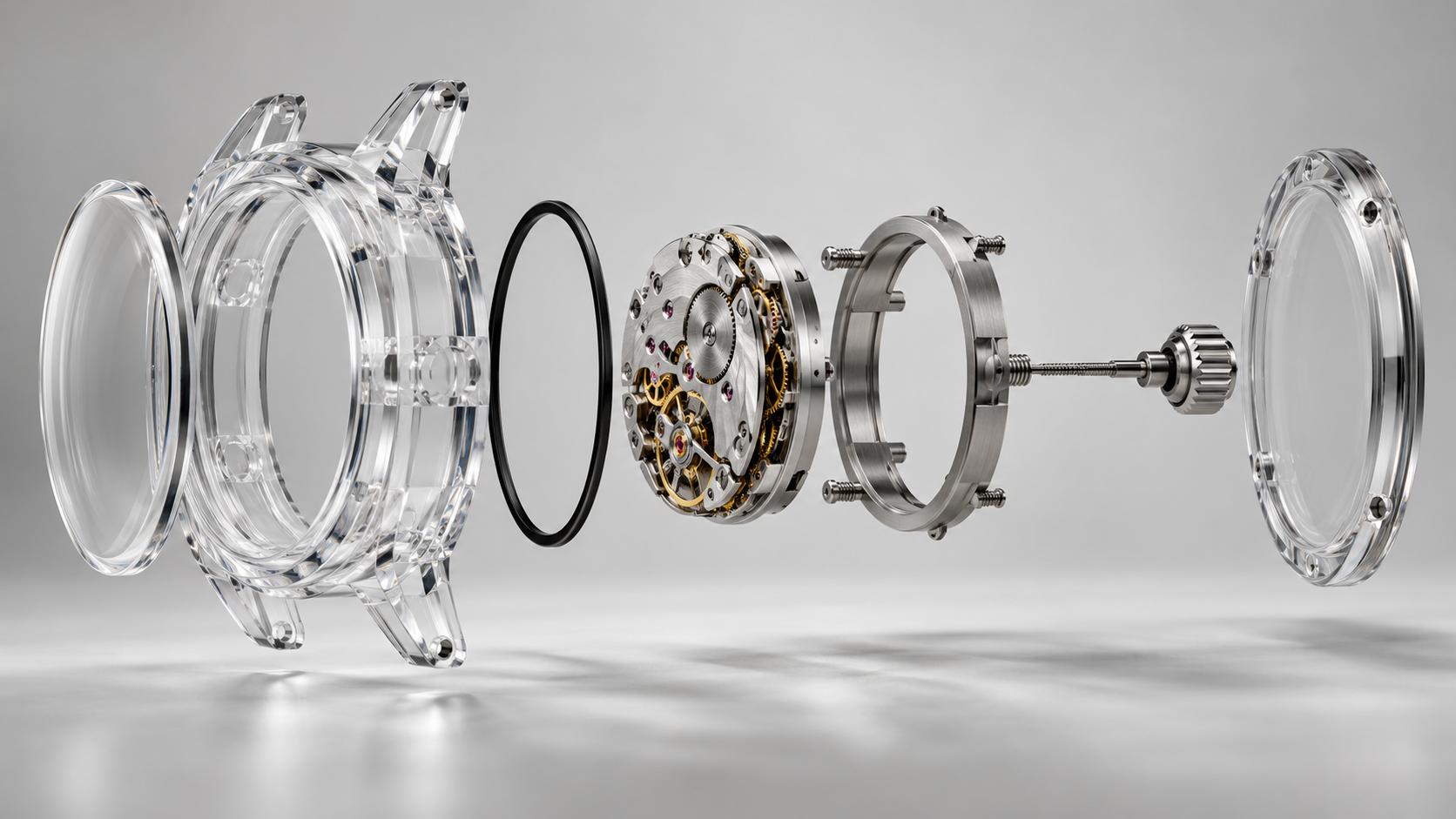
A watch case can look perfect in a rendering and still fail during assembly.
This problem becomes more serious with sapphire.
Metal components provide some flexibility during machining and assembly.
Sapphire is different.
It is extremely hard and dimensionally stable, but also brittle.
This means the complete watch architecture needs to be defined before the expensive sapphire machining process reaches its final stages.
For a custom sapphire watch case, the starting point should not be the external shape alone.
It should be the movement and assembly system.
Start With the Movement Envelope
The first step is to define the maximum physical envelope of the movement.
Important dimensions include:
- movement diameter;
- movement height;
- stem height;
- crown position;
- dial diameter;
- hand-stack clearance;
- rotor clearance for automatic movements.
A nominal movement diameter alone is not enough.
Bridges, screws, rotor edges and setting mechanisms may extend beyond the main movement plate.
Define How the Movement Enters the Case
This is one of the most commonly overlooked questions.
A monobloc sapphire case may have a beautiful external form but no practical assembly path.
Before machining begins, the designer should determine whether the movement enters through:
- front;
- rear;
- removable bezel;
- removable caseback;
- separate middle-case structure.
The movement-holder design depends on this decision.
Our current one-piece sapphire case guidance specifically recommends confirming movement insertion and retention before freezing the geometry.
Crown Position Must Be Coordinated Early
The winding stem needs to connect accurately with the movement.
A small error in crown-hole height can create:
- stem bending;
- increased friction;
- poor winding feel;
- setting problems.
With a metal prototype, the hole may sometimes be modified.
With sapphire, post-machining correction is far less forgiving.
The crown centerline should therefore be defined from the movement datum rather than only from the external case geometry.
Movement Holder vs. Direct Sapphire Contact
It is often preferable not to clamp the movement directly against hard sapphire surfaces.
A separate movement ring can:
- position the movement;
- absorb small tolerance differences;
- simplify assembly;
- reduce localized contact stress;
- provide an interface for dial or caseback structures.
Possible materials include suitable metals or engineered polymers depending on the watch architecture.
The holder should be considered part of the tolerance stack.
Establish Datums Before Tolerances
A drawing may contain dozens of dimensions.
Without a clear datum system, those dimensions can still be difficult to manufacture and inspect.
Typical sapphire watch-case datums may reference:
- caseback sealing plane;
- central movement axis;
- crown axis;
- bezel interface.
Critical features should be dimensioned from stable functional datums.
This allows machining and inspection to reference the same geometry.
Concentricity Is Often More Important Than Absolute Diameter
Consider:
- movement cavity;
- top crystal;
- bezel;
- caseback;
- dial.
Each may individually meet its diameter tolerance.
But if their centers are offset from each other, the finished watch can look visibly misaligned.
For transparent sapphire, this problem becomes particularly obvious because the wearer can see through multiple structural layers.
Therefore, concentricity and positional tolerance deserve specific attention.
Polishing Changes Dimensions
Sapphire polishing removes material.
This is especially important at:
- sealing planes;
- shoulders;
- movement cavity edges;
- bezel interfaces.
If a component is machined directly to final dimension before optical polishing, the finished part may move outside tolerance.
The machining process therefore needs to include a polishing allowance.
Our current integrated sapphire assembly guidance recommends evaluating movement clearance, crown alignment, gasket space and final visual alignment on the complete prototype rather than only inspecting the loose sapphire part.
Tolerance Stack-Up Matters
Imagine an assembly containing:
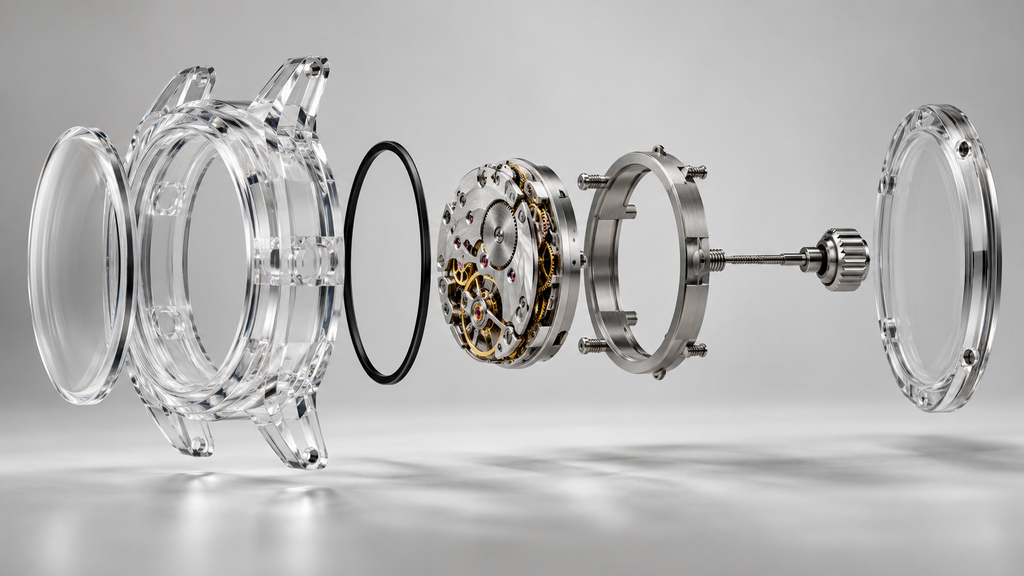
sapphire middle case + movement holder + movement + dial + top crystal + caseback + gasket.
Each component has a manufacturing tolerance.
If all dimensions shift in the same direction, the accumulated error can become much larger than the tolerance of any individual part.
Possible results include:
- movement too loose;
- movement impossible to install;
- crown misalignment;
- compressed gasket;
- dial interference;
- excessive axial play.
A stack-up analysis should therefore be performed before drawings are released.
Do Not Make Every Tolerance Extremely Tight
One common mistake is to specify ±0.01 mm everywhere.
This can dramatically increase sapphire machining and inspection cost without improving the final watch.
Tight tolerances should be reserved for functional interfaces.
Decorative surfaces may allow significantly larger dimensional variation.
A useful drawing separates:
functional dimensions from cosmetic geometry.
Prototype the Entire Assembly
The first prototype should not be approved simply because the sapphire part looks correct.
Assembly validation should check:
- movement installation;
- stem alignment;
- crown operation;
- caseback closure;
- gasket compression;
- screw loading;
- rotor clearance;
- dial position;
- visual centering;
- serviceability.
This is particularly important for transparent watches because internal components are part of the finished appearance.
Think About Servicing
A watch is not assembled only once.
Future servicing may require the movement to be removed and reinstalled.
The engineer should consider:
- which component is removed first;
- where tools contact the case;
- whether gaskets can be replaced;
- whether the movement can be extracted safely.
A design that can be assembled once but cannot be serviced is not a fully engineered watch case.
From CAD Model to Manufacturable Watch
A high-end sapphire case should be designed as an assembly, not as an isolated crystal part.
The correct sequence is:
movement selection → assembly concept → datum structure → tolerance analysis → sapphire geometry → polishing plan → prototype → complete assembly test.
Following this sequence reduces the risk of discovering an expensive dimensional problem after the sapphire component has already undergone many hours of machining and polishing.
For custom sapphire watch projects, the external case shape attracts attention.
But the hidden tolerance architecture is what makes the watch actually work.