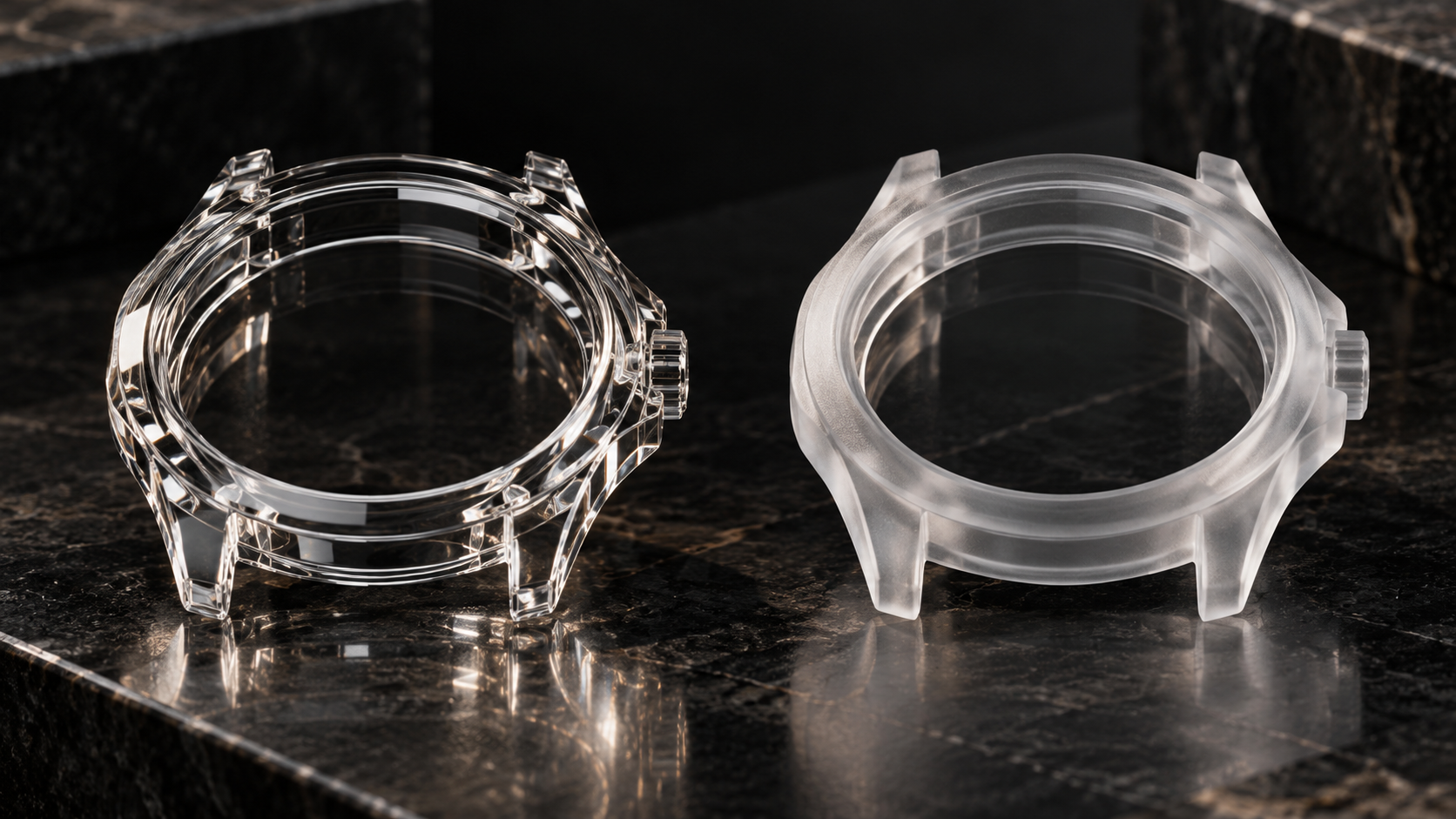
Sapphire watch cases are normally associated with mirror-like optical polishing.
A perfectly polished case allows light to travel through the material and exposes the mechanical movement from multiple directions.
But full transparency is not always the most interesting design choice.
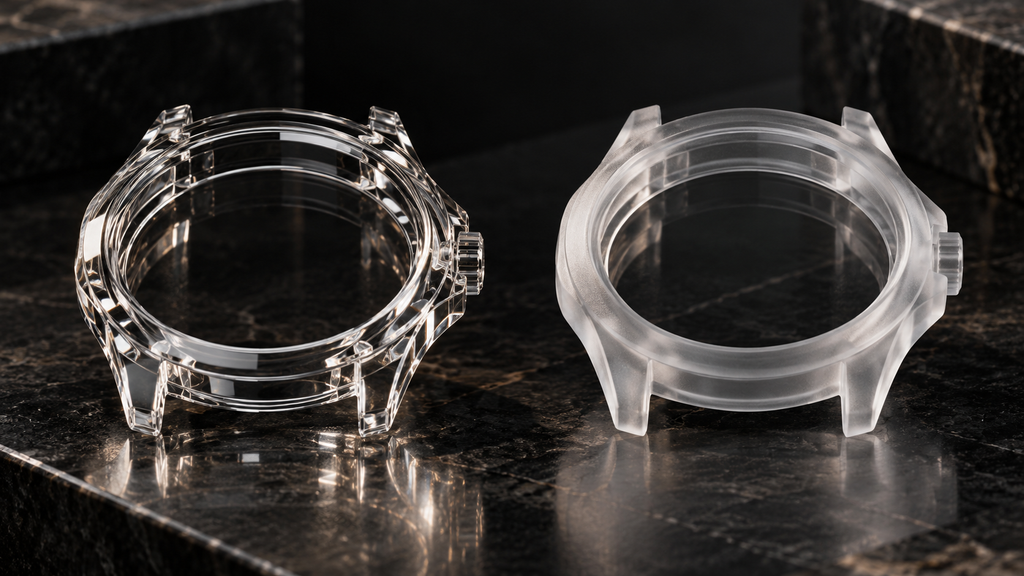
A growing number of custom watch projects use combinations of:
- polished sapphire;
- frosted sapphire;
- matte regions;
- polished bevels;
- functional ground surfaces.
The result can create stronger contrast and more complex visual depth than a fully transparent case.
Why Ground Sapphire Looks Cloudy
Synthetic sapphire is transparent in bulk crystal form.
After grinding, however, microscopic surface irregularities scatter light.
Instead of traveling cleanly through the surface, light is redirected in many directions.
The surface therefore appears:
- frosted;
- matte;
- cloudy;
- translucent.
Optical polishing removes progressively smaller surface defects until light transmission becomes much more orderly.
That is why a sapphire component can change from almost opaque-looking after grinding to highly transparent after polishing.
Frosting Can Be Intentional
The same light-scattering effect can be used deliberately.
A controlled frosted finish can create:
- soft diffusion;
- reduced glare;
- visual contrast;
- reduced visibility of fingerprints;
- separation between functional zones.
For example, a watch case may use polished external walls with a lightly frosted internal structure.
Another design may use a matte case side combined with highly polished bevels.
The material remains sapphire, but the optical character changes completely.
Our existing material platform already supports polished, local-frost and mixed-finish directions where geometry allows processing access.
Full Polish Maximizes Movement Visibility
For skeleton watches and tourbillons, the main reason for choosing sapphire is often movement visibility.
Full optical polishing is therefore appropriate when the design objective is to make the case visually disappear.
A polished surface provides:
- maximum transparency;
- stronger internal reflections;
- crisp edge highlights;
- a more “liquid” crystal appearance.
The disadvantage is that every internal surface becomes visible.
Machining marks or imperfect polishing inside the case can be seen from outside.
Frosting Can Hide Selected Internal Structures
Not every part of the case needs to be optically transparent.
Some internal areas may contain:
- movement holders;
- gasket interfaces;
- metal inserts;
- structural shoulders.
A controlled matte finish can visually soften these areas.
This can be useful when the designer wants the movement to remain the main focal point without exposing every functional interface.
Mixed Finishing Requires Process Planning
Creating one fully polished sapphire surface is already difficult.
Creating a clean boundary between polished and frosted regions can be even harder.
The manufacturer must control:
- masking;
- abrasive access;
- finish transition;
- edge protection;
- polishing sequence.
If a polished region is accidentally exposed during frosting, the optical boundary may become irregular.
If a frosted region is accidentally repolished, the visual contrast can disappear.
For this reason, surface zones should be clearly marked on the engineering drawing.
Geometry Determines What Is Possible
A wide flat side wall is relatively easy to finish selectively.
A deep internal corner is much harder.
Features such as:
- narrow slots;
- deep cavities;
- small radii;
- undercuts;
may not provide sufficient tool access to create a perfectly controlled finish boundary.
Therefore, finish requirements should be reviewed during CAD development rather than after the case is already machined.
Frosted Does Not Mean Rough and Uncontrolled
A decorative frosted finish still needs process control.
An excessively coarse surface can:
- reduce strength locally;
- trap contamination;
- create irregular appearance;
- produce edge chipping.
The objective is a controlled optical texture, not random machining damage.
Functional surfaces such as gasket seats and precision interfaces should also be separated from decorative frosted zones.
Polished Edges Can Transform a Matte Case
One particularly effective design direction is:
frosted main surface + polished chamfer or bevel.
The matte region diffuses light.
The polished edge produces a sharp bright reflection.
This contrast can make the geometry of the sapphire component much more visible.
It works particularly well on:
- tonneau cases;
- angular lugs;
- faceted bezels;
- geometric crown guards.
Colored Sapphire Adds Another Layer
Mixed finishing becomes even more visually powerful with colored sapphire.
A polished blue surface may look luminous and transparent.
A frosted section of the same crystal can appear more saturated because of light scattering.
This means designers can create multiple visual tones from one material without using coatings or paint.
Inspection Must Be Defined Differently
A polished sapphire case is normally inspected for:
- haze;
- scratches;
- polishing marks;
- optical defects.
A frosted case needs additional criteria.
These can include:
- uniform texture;
- no glossy patches;
- consistent transition lines;
- no excessive coarse marks.
Mixed-finish components need both inspection systems simultaneously.
A Surface-Finish Drawing Is Worth Creating
For complex custom cases, we recommend defining each surface directly on a drawing or marked 3D model.
For example:
P1 = optical polish
P2 = decorative polish
F1 = fine frost
G1 = functional ground surface
This avoids ambiguous instructions such as “polish the visible areas.”
With transparent sapphire, almost every surface can become visible from some viewing angle.
Conclusion
Sapphire finishing should not be viewed only as the final cosmetic step.
It is an optical design tool.
Full polishing emphasizes transparency.
Frosting emphasizes form.
Mixed finishing can balance both.
For high-end custom watch cases, the most effective designs often decide surface character at the same time as case geometry.