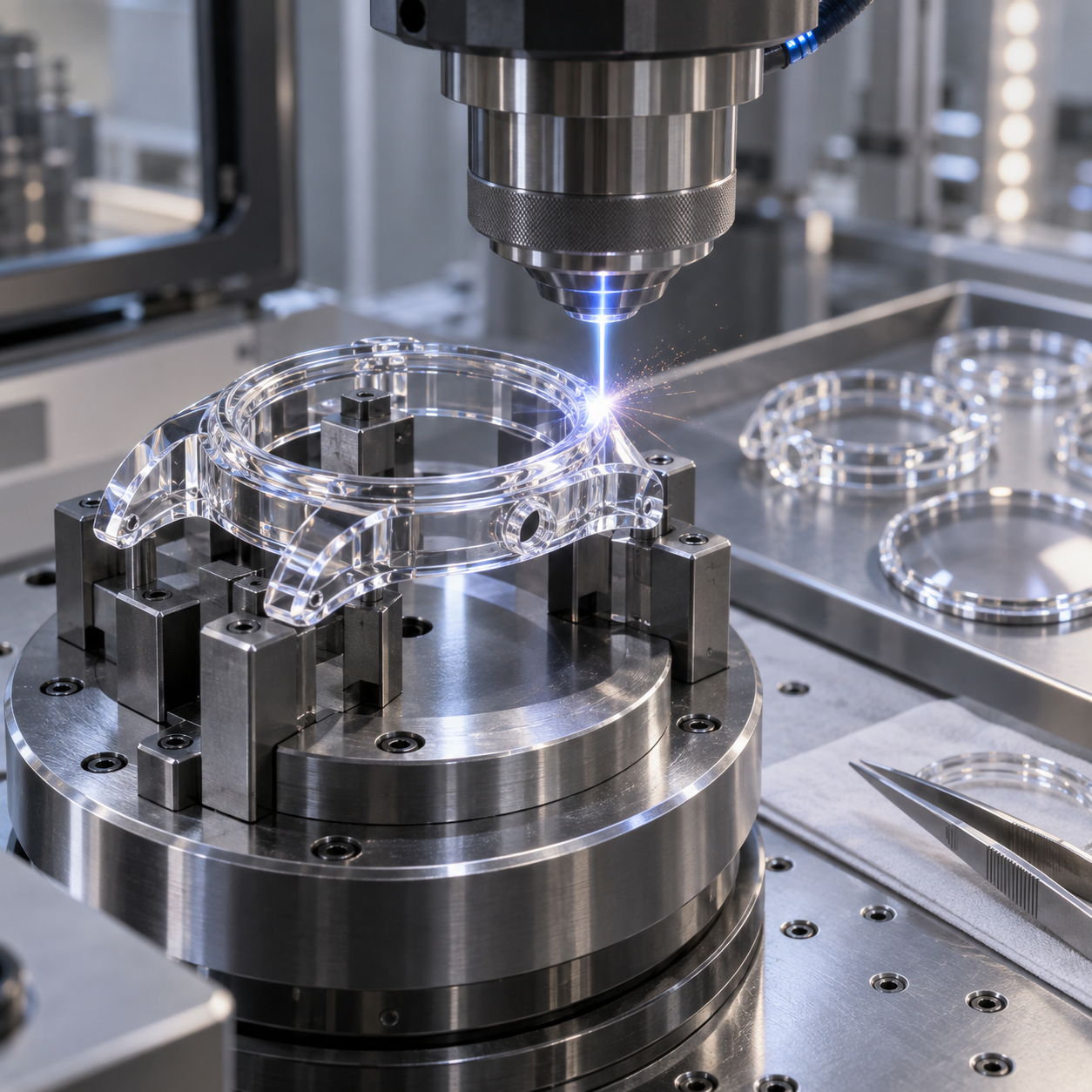
A transparent sapphire watch case creates an unusual manufacturing challenge.
Unlike a conventional titanium, stainless-steel or precious-metal case, almost every machining decision remains visible in the finished product.
Crown openings, pusher holes, screw seats, gasket grooves, internal shoulders and polished cavities cannot simply be hidden beneath a coating or brushed finish. At the same time, synthetic sapphire is extremely hard, brittle and resistant to conventional material removal.
As sapphire watch cases become more complex, the industry is moving beyond the simple question of whether sapphire can be machined.
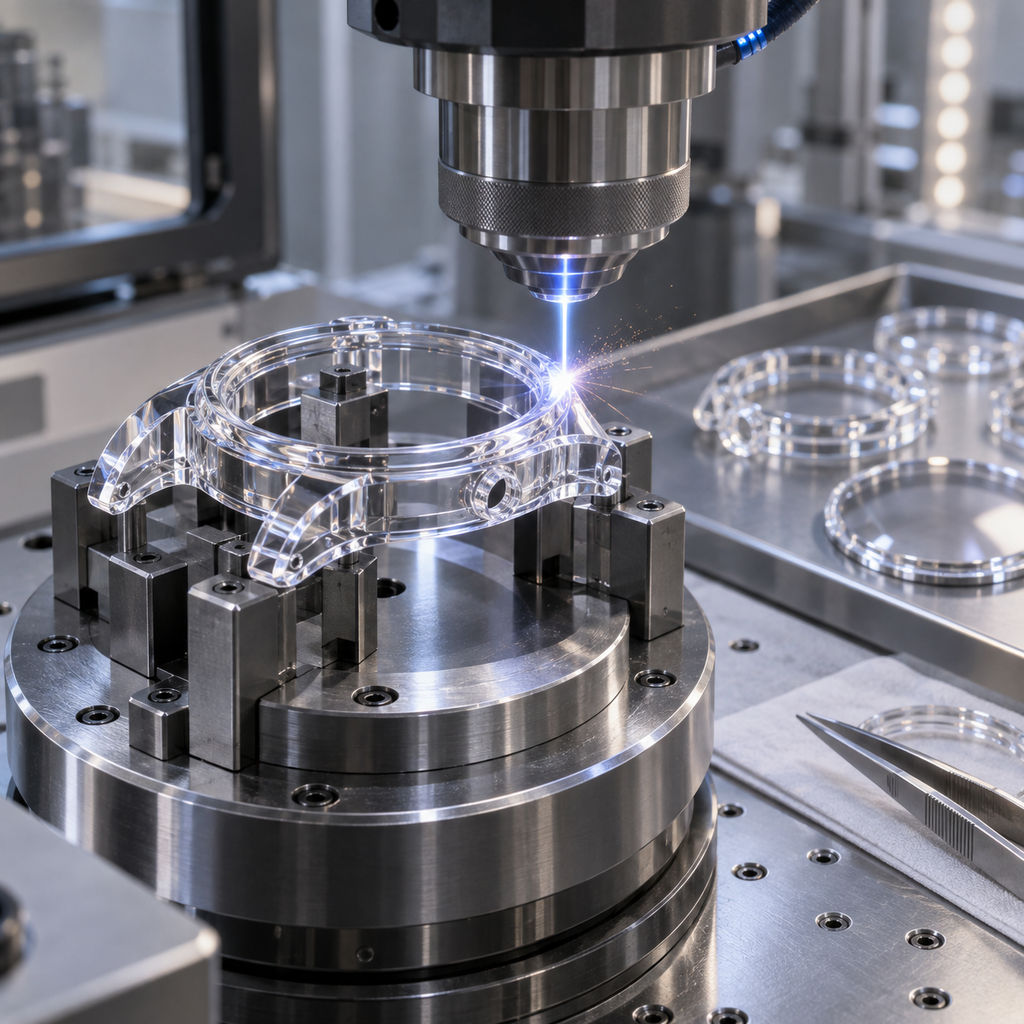
The more important questions are becoming:
How can complex features be produced faster?
How can microcracks and edge chipping be reduced?
How can subsurface damage be controlled before polishing?
And how can increasingly complicated transparent structures be manufactured without sacrificing optical quality or production yield?
Recent developments in ultrafast laser machining and plasma-assisted sapphire finishing provide a glimpse of where ultra-precision sapphire manufacturing may be heading.
Why Sapphire Watch Cases Are Difficult to Machine
Synthetic sapphire is single-crystal aluminum oxide, Al₂O₃.
Its high hardness and chemical stability are major advantages in a finished luxury watch, but those same properties create significant manufacturing difficulties.
Material removal is comparatively slow.
Diamond tools and grinding media experience wear.
Aggressive machining can generate microcracks.
Sharp intersections can chip.
Grinding can leave a subsurface damage layer beneath an apparently acceptable surface.
For a conventional opaque component, some of these defects may remain cosmetically hidden.
A transparent sapphire watch case provides no such advantage.
Light passes through the material and interacts with both external and internal surfaces. Scratches, pits, cloudy grinding zones, microchips and internal damage can therefore affect the appearance of the entire case.
This is why sapphire case manufacturing is not simply conventional CNC machining performed on a harder material.
It is a combination of precision geometry generation, brittle-material damage management and optical finishing.
From Mechanical Removal to Hybrid Manufacturing
Traditional sapphire manufacturing generally relies on a sequence involving diamond cutting, grinding, CNC machining, lapping and polishing.
These processes remain essential.
However, research increasingly focuses on hybrid manufacturing methods that combine different physical mechanisms rather than forcing a single tool to perform every operation.
One emerging approach is to combine ultrashort laser excitation with longer laser pulses.
Another uses plasma-assisted chemical modification to make sapphire easier to finish.
The potential advantage of these methods is not simply higher removal speed.
The real objective is to achieve higher productivity while simultaneously controlling cracks, thermal damage and subsurface integrity.
For watch cases, this could become particularly valuable as designers demand smaller openings, thinner walls and more complex internal geometries.
Femtosecond Lasers Offer Precision but Not Always High Throughput
Femtosecond lasers deliver extremely short pulses.
Because the interaction occurs over a very short timescale, energy can be localized into a small region before substantial heat spreads into the surrounding sapphire.
This makes femtosecond processing attractive for precision features such as microholes and grooves.
However, precision alone does not solve the manufacturing problem.
Removing meaningful volumes of sapphire exclusively with femtosecond pulses can be inefficient.
A 2026 study published in Communications Engineering investigated an alternative strategy in which a single femtosecond pulse and a synchronized microsecond pulse were delivered coaxially.
The researchers reported approximately four orders of magnitude higher micromachining speed compared with the femtosecond percussion-processing condition used in their experiment, while also mitigating cracks in the sapphire base material.
The concept is important.
Instead of asking one laser pulse to provide both precision initiation and high-volume material removal, the process divides these functions between different timescales.
Why Femtosecond–Microsecond Processing Matters
Sapphire is normally difficult for certain laser wavelengths to absorb efficiently.
The femtosecond pulse can first create a highly excited region inside or near the sapphire.
This transient state modifies the material’s interaction with the following microsecond pulse.
The longer pulse can then deposit energy much more efficiently into the pre-excited zone.
In the 2026 research, the authors linked the enhanced machining behavior to changes including bandgap narrowing, thermal ionization and increased laser absorption after the initial femtosecond excitation.
For industrial sapphire processing, the broader implication is significant:
high precision and high removal efficiency may no longer need to be treated as completely opposing requirements.
That could eventually be relevant to watch-case geometries where conventional drilling or grinding becomes increasingly difficult.
Microholes Are Becoming More Important in Sapphire Case Design
A modern luxury watch case can contain many relatively small but highly critical openings.
The crown tube opening must align accurately with the movement.
Chronograph pushers require precisely positioned holes.
Screw holes may need controlled diameter, depth and edge condition.
Some high-complication watches introduce additional corrector openings.
Cases may also contain decorative apertures or complex internal channels.
With metal, these are normal machining operations.
With sapphire, every small opening creates additional fracture risk.
A drill entering or exiting the material can produce edge chipping.
Excessive mechanical force can generate microcracks.
A deep hole can create tool-access and coolant problems.
Very small features can become disproportionately expensive.
Laser-assisted approaches therefore become increasingly interesting as feature sizes decrease.
Crown and Pusher Openings Are Not Just Holes
A crown opening appears simple on a drawing.
In practice, it may involve several interacting requirements:
accurate position,
controlled diameter,
good circularity,
a clean entrance edge,
a clean exit edge,
sufficient surrounding wall thickness,
and a finished surface suitable for assembly.
The area may also sit close to a crown guard or another structural feature.
If machining introduces a small crack in this region, later polishing does not necessarily solve the underlying problem.
The crack may remain beneath the surface.
It can also propagate during subsequent manufacturing or assembly.
This is one reason why the future of precision sapphire machining is closely connected to subsurface damage control, not merely visible surface quality.
What Is Subsurface Damage?
After grinding or abrasive machining, a sapphire surface may appear relatively smooth when inspected from above.
Beneath that surface, however, the crystal can contain microscopic damage.
This can include microcracks, dislocations, amorphous regions and residual stress created during material removal.
The depth and severity depend on the machining method and process parameters.
Subsurface damage matters for two reasons.
First, it influences subsequent polishing.
More damaged material must be removed before a high-quality optical surface can be produced.
Second, defects beneath the surface can act as potential crack-initiation sites.
For a transparent structural component such as a watch case, both issues are important.
Recent atomic-scale sapphire research has demonstrated how significant this distinction can be. A 2026 Nature Communications study observed an approximately 2 nm subsurface damage layer even in a sapphire sample that had already undergone chemical mechanical polishing, before applying its atomic-scale surface-reconstruction approach.
The lesson for watch-case manufacturing is straightforward:
surface roughness alone does not completely describe surface integrity.
Femtosecond Plasma-Assisted Ablation and Microgrooves
Another 2026 study investigated femtosecond laser-induced plasma-assisted ablation for producing microgrooves in sapphire.
The researchers evaluated factors including laser energy, scanning speed, scan count and processing distance.
Cross-sectional SEM and TEM analysis showed limited subsurface damage, a thin recast layer and preservation of the underlying crystalline lattice under optimized conditions.
The study was not specifically about watch cases.
However, the manufacturing principles are relevant to future sapphire components containing narrow grooves and precision microfeatures.
Examples in a watch-case context could include fine gasket structures, decorative grooves, small locating features or geometry that is difficult for conventional grinding tools to access.
This should be viewed as an emerging manufacturing direction rather than a replacement for established CNC sapphire processing.
Complex Microfeatures Require More Than Smaller Tools
One common misconception is that increasingly detailed sapphire parts can be manufactured simply by using smaller diamond tools.
Tool diameter is only one limitation.
As features become smaller, several problems become more severe.
Tool stiffness decreases.
Tool wear becomes more significant relative to feature size.
Coolant access becomes more difficult.
Internal corners become harder to reach.
Small exit edges become easier to chip.
Polishing access may ultimately become more difficult than machining access.
This last point is particularly important.
A geometry that can be successfully machined is not automatically a geometry that can be successfully polished.
Transparent watch-case design therefore requires machining and finishing to be considered together.
Plasma-Assisted Finishing Could Change Sapphire Surface Processing
Finishing sapphire is traditionally slow because of its hardness and chemical stability.
This has encouraged research into methods that first modify the surface chemically and then remove material more efficiently.
One particularly interesting 2026 development is laser-enhanced plasma vaporization machining, or LEP-VM.
Researchers reported a hybrid process combining plasma-assisted chemical reactions with localized laser heating.
Rather than depending primarily on aggressive mechanical abrasion, the process forms a modified surface layer and then selectively removes it.
The reported sapphire experiments achieved a surface roughness of approximately Sa 0.13 nm, while characterization indicated damage-free subsurface integrity without detected amorphization or lattice degradation under the reported conditions.
The study also reported a single-spot removal rate up to approximately 0.25 μm/min.
These results are relevant to the broader future of sapphire finishing.
However, it is important to distinguish laboratory-scale advanced finishing research from established mass-production watch-case processing.
Why Plasma-Assisted Finishing Is Interesting for Watch Cases
Current sapphire watch-case polishing requires considerable time because mechanical and chemical processes must gradually remove grinding marks and damaged material while preserving dimensions.
The challenge becomes greater with:
curved surfaces,
deep cavities,
thin transparent walls,
small internal radii,
multiple surface angles,
and complicated three-dimensional cases.
A nontraditional process capable of removing material with extremely low mechanical force could potentially offer new options for finishing sensitive sapphire structures.
The value would not simply be an extremely low roughness number.
More important would be the ability to preserve crystal integrity while reducing the amount of mechanical damage introduced during finishing.
For transparent sapphire cases, this could eventually contribute to better clarity and greater process consistency.
Internal Sapphire Surfaces Are Becoming More Important
Traditional watch-case finishing focuses heavily on exterior appearance.
Transparent sapphire changes the situation.
The inside of the case can also be seen.
Movement cavities, internal shoulders, crown-hole interiors and structural recesses therefore become part of the visual product.
This creates a major manufacturing problem.
External surfaces are relatively accessible to polishing tools.
Deep internal cavities are not.
As watch brands pursue more dramatic skeletonized and transparent designs, the quality of these internal surfaces becomes increasingly important.
Future hybrid machining and localized finishing processes could therefore have their greatest impact not on simple flat surfaces, but on regions that conventional polishing tools struggle to reach.
Thin Walls Create Another Manufacturing Challenge
Transparent sapphire invites designers to remove visual mass.
Thinner walls can create a lighter, more open appearance and expose more of the movement.
But thin sapphire structures increase manufacturing sensitivity.
Local machining forces become more important.
Small chips represent a larger percentage of total wall thickness.
Residual stresses become less desirable.
Sharp geometry near thin sections can increase stress concentration.
The manufacturer therefore needs to balance appearance, structural requirements and manufacturing yield.
Ultra-precision processes are valuable only when they improve this overall balance.
Creating an extremely precise feature while reducing production yield would not necessarily improve the commercial manufacturing process.
Edge Quality Remains Critical
Laser processing does not eliminate edge-quality requirements.
In fact, small holes and complex microfeatures can introduce new entrance and exit conditions that require careful control.
For sapphire watch cases, the engineering team must consider not only the nominal dimensions of a hole or groove but also:
edge chipping,
microcracks,
taper,
recast material,
thermal influence,
surface roughness,
and the amount of finishing required afterward.
An apparently small edge defect can become highly visible after the surrounding sapphire is optically polished.
This is one reason why inspection must accompany advanced machining development.
Inspection Must Evolve With the Process
Conventional dimensional inspection remains essential.
But next-generation sapphire manufacturing increasingly requires additional attention to material integrity.
Optical microscopy can identify visible chips and surface defects.
High-magnification inspection can reveal finer cracks.
Surface metrology can quantify roughness.
For process development and failure analysis, techniques such as SEM, TEM or Raman characterization can provide information about damage mechanisms and crystalline integrity.
Not every production watch case needs laboratory-level analysis.
The purpose of advanced characterization is to understand the manufacturing process well enough that reliable production inspection criteria can eventually be established.
A Hybrid Process Is More Realistic Than a Single “Future Technology”
It is unlikely that one advanced technology will completely replace conventional sapphire machining.
A more realistic manufacturing route is hybrid.
Diamond grinding or CNC machining may remain the fastest way to generate the basic three-dimensional case geometry.
Ultrafast or combined-pulse laser machining may become useful for selected microfeatures.
Precision lapping may establish intermediate surface quality.
Plasma-assisted or other non-contact finishing methods could eventually improve difficult surfaces or reduce subsurface damage.
Conventional optical polishing may still be required for final cosmetic performance.
The future is therefore less about replacing one process with another and more about assigning each operation to the process that performs it most efficiently.
Production Yield Is the Final Test
The most advanced machining method is commercially valuable only if it contributes to stable production.
Luxury sapphire watch cases already have high material and processing value before final polishing.
If a component develops a crack near the end of the manufacturing sequence, much of that accumulated value is lost.
For this reason, production yield should be considered from the first design review.
Critical areas include thin lugs, crown openings, pusher holes, screw seats, deep cavities and transitions between thick and thin sections.
Design-for-manufacturing analysis can identify these risks before tooling and prototype production begin.
Small modifications to radii, wall thickness or hole position can sometimes improve manufacturing reliability without changing the visible design concept.
The Next Generation of Sapphire Watch Case Manufacturing
Ultra-precision sapphire manufacturing is entering an interesting stage.
Recent research demonstrates that femtosecond and microsecond laser pulses can be combined to dramatically change sapphire micromachining behavior.
Femtosecond plasma-assisted methods are improving understanding of low-damage microgroove fabrication.
Laser-enhanced plasma processing is demonstrating atomic- and near-atomic-scale finishing with extremely low roughness and high subsurface integrity.
These technologies should not yet be interpreted as universal production methods for sapphire watch cases.
Their importance is that they show how sapphire manufacturing could evolve.
The next generation of high-end sapphire cases is likely to demand:
greater geometric complexity,
smaller functional features,
thinner transparent structures,
better internal-surface quality,
lower subsurface damage,
and more consistent production yield.
Meeting those requirements will require manufacturers to combine crystal knowledge, precision machining, laser processing, advanced finishing and inspection into one integrated manufacturing strategy.
For watch brands, the question is therefore changing.
It is no longer simply:
“Can this case be made from sapphire?”
The more relevant question is becoming:
“How can this sapphire geometry be manufactured repeatedly, with controlled damage, optical clarity and acceptable production yield?”
That is where ultra-precision sapphire watch case manufacturing is heading.