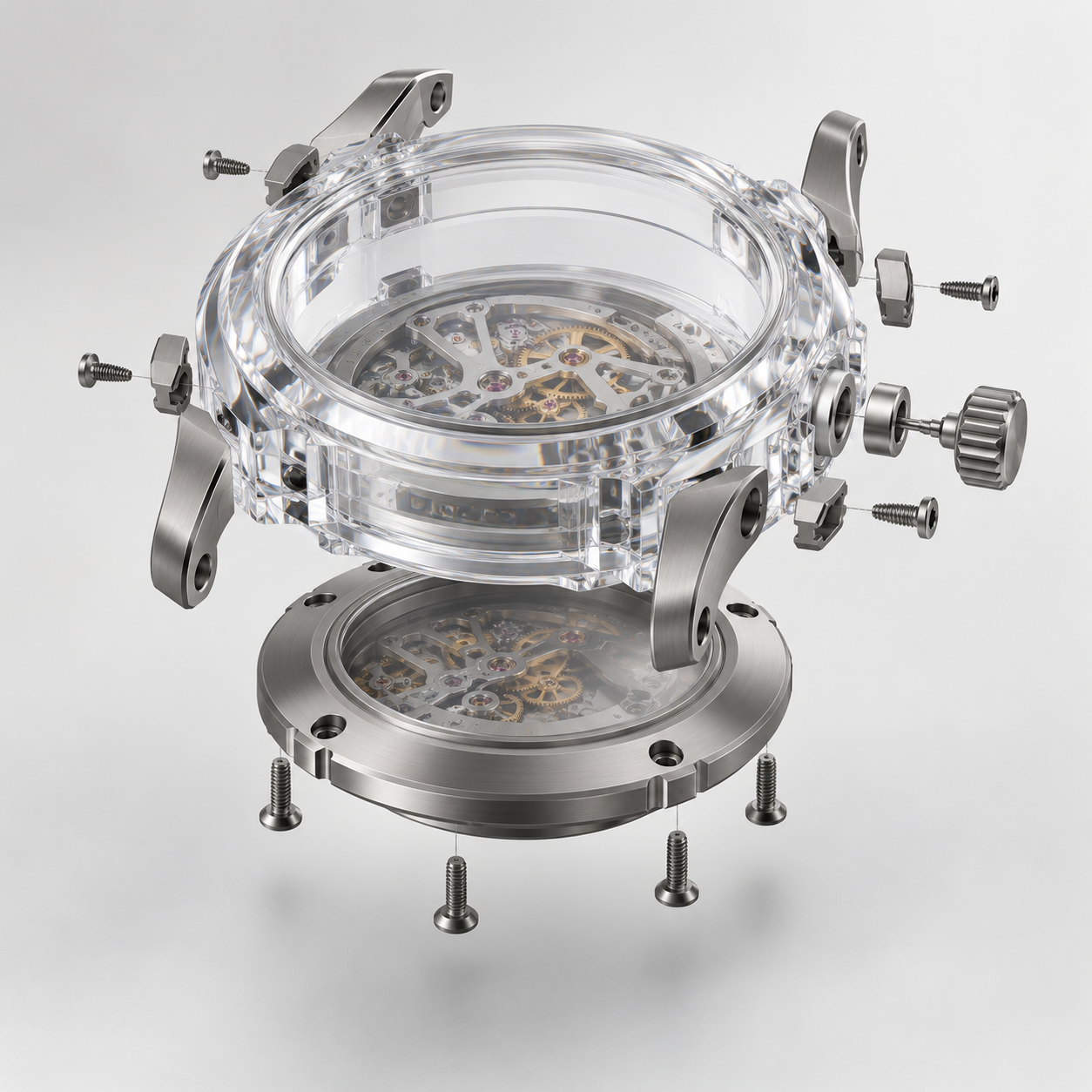
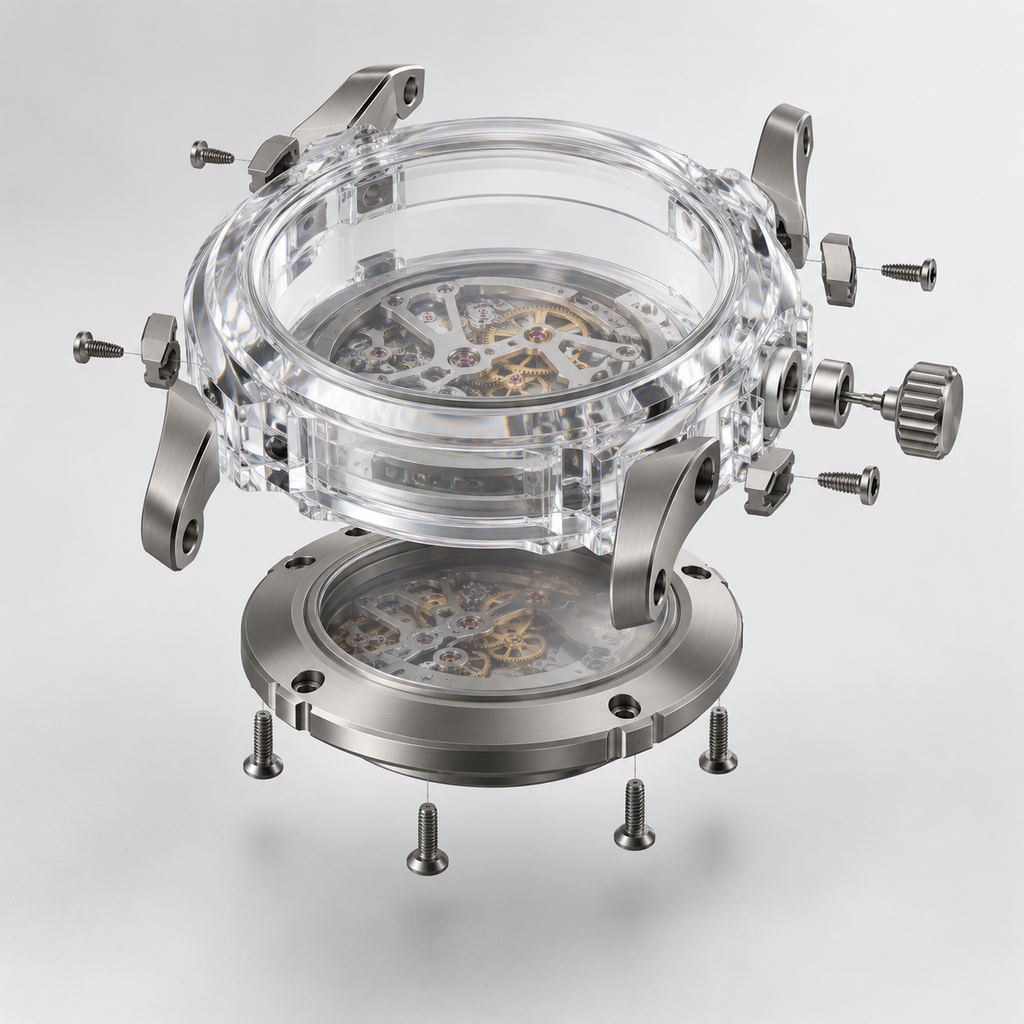
Transparent sapphire watch cases are increasingly moving beyond the traditional concept of a crystal shell surrounding a mechanical movement. In high-complication watches, sapphire is now being integrated with titanium case backs, structural frames, screws, inserts, crowns, bracelet components and movement-supporting elements to create hybrid case architectures.
A recent example appeared on September 16, 2026, when Hublot introduced the MP-14 Origin by Jeff Koons. The watch uses a 44 mm octagonal sapphire-and-titanium architecture, with a sapphire case body assembled with a titanium case back, titanium screws and additional structural components. Hublot states that machining the transparent sapphire case alone requires approximately 534 hours.
For sapphire watch case manufacturers, however, the important lesson is not the appearance of a particular watch. It is the engineering direction behind it.
As movements become more complicated and cases become more transparent, sapphire can no longer be treated as an isolated decorative component. Sapphire and metal parts must work together as one mechanical system.
That makes metal inserts, screw seats, local wall thickness, stress isolation, machining accuracy and final assembly increasingly important.
Why Combine Sapphire with Titanium?
Sapphire offers several advantages for luxury watch cases:
- High scratch resistance
- Excellent transparency
- Premium visual depth
- Good chemical resistance
- High stiffness
- Long-term surface stability
But sapphire is also a brittle crystalline material. Unlike titanium, it cannot plastically deform significantly before fracture.
Titanium therefore performs functions that are difficult to achieve reliably with sapphire alone.
A titanium component may be used as:
- A threaded insert
- A case-back structure
- A movement carrier
- A bezel support
- A crown tube
- A pusher support
- A bracelet connector
- A screw load-distribution component
- A reinforcing frame around a sapphire structure
This combination allows designers to use sapphire where transparency and scratch resistance are important while using titanium where threads, repeated mechanical loading and structural fastening are required.
Sapphire and Titanium Behave Differently
One of the first engineering challenges is that sapphire and titanium do not respond to mechanical and thermal loads in the same way.
Typical optical-grade sapphire has a relatively low linear thermal expansion coefficient, around 5 × 10⁻⁶/°C in some orientations and temperature ranges, while Ti-6Al-4V titanium alloy is typically around 8.6–9.1 × 10⁻⁶/K.
This difference may appear small, but in a tightly constrained precision watch case, thermal cycling can generate interface stress.
The problem becomes more significant when:
- Sapphire walls become thinner
- Metal inserts become larger
- The assembly contains sharp internal corners
- Adhesive gaps are too small
- Screw preload is excessive
- Metal components are press-fitted directly into sapphire
- Multiple titanium components constrain the same sapphire part
A successful hybrid case therefore requires careful control of both geometry and assembly conditions.
Metal Inserts in Sapphire Watch Cases
Directly machining functional threads into sapphire is generally undesirable for repeated assembly.
A more practical solution is to integrate metal inserts into selected locations.
Titanium inserts can provide durable threads for:
- Case-back screws
- Bezel screws
- Strap or bracelet connections
- Movement mounting
- Crown systems
- Pushers
- Complication correctors
However, simply creating a cylindrical hole in sapphire and pressing a titanium insert into it can create a serious fracture risk.
Sapphire does not tolerate high localized tensile stress well.
The insert design should therefore consider:
1. Interference
Excessive interference between the titanium insert and sapphire bore can generate radial tensile stress around the hole.
Instead of relying only on a strong press fit, designers may use a controlled clearance combined with mechanical retention or adhesive bonding.
2. Insert Geometry
Sharp shoulders should be avoided.
Rounded transitions, controlled chamfers and larger contact areas help distribute load.
The metal component should ideally transmit force over a relatively broad area rather than through a narrow edge.
3. Bonding Gap
When adhesive bonding is used, the adhesive layer should not be treated simply as glue.
A controlled bonding gap can act as a stress-management layer between sapphire and titanium.
The required gap depends on:
- Adhesive type
- Insert diameter
- Thermal expansion difference
- Expected temperature range
- Mechanical load
- Required water resistance
4. Insert Position Accuracy
In high-end watch cases, one metal insert rarely functions independently.
Multiple inserts must align with screws, case backs, bezels, movement rings or bracelet components.
Therefore, true position between insert holes can be more important than the tolerance of an individual hole diameter.
Designing Screw Seats in Sapphire
Screws are another critical area.
A metal screw tightened directly against an untreated sapphire surface can produce highly concentrated stress.
This is especially dangerous around countersinks and thin sapphire walls.
Several design approaches can reduce the risk.
Flat Load-Bearing Surfaces
Where possible, the screw load should be distributed over a flat surface rather than concentrated at a sharp countersink.
Titanium washers, sleeves or intermediate structural components may be incorporated.
Controlled Countersink Geometry
If a countersunk screw is required for aesthetic reasons, the geometry should be carefully designed.
Important parameters include:
- Countersink diameter
- Included angle
- Edge radius
- Remaining sapphire thickness
- Distance to the nearest edge
- Surface finish
Micro-chipping created during machining can become the initiation point for cracks during screw tightening.
Therefore, visual appearance alone is not sufficient. Screw seats should be inspected under magnification before assembly.
Screw Torque Control
More torque does not necessarily mean a stronger assembly.
Once sufficient clamping force has been achieved, additional torque may simply increase stress in the sapphire.
For high-value sapphire cases, assembly torque should therefore be specified and controlled rather than left entirely to operator experience.
Torque verification can be especially important when multiple screws are positioned around a large transparent case back.
Why Stress Isolation Matters
A sapphire case can survive significant compressive loads while remaining vulnerable to local tensile stress.
The purpose of stress isolation is therefore to prevent metal movement or screw preload from being transferred directly into a small sapphire region.
Several methods can be used.
Flexible Interface Layers
A thin engineered polymer or adhesive layer can absorb small dimensional changes between sapphire and titanium.
Metal Sleeves
Instead of allowing a screw shaft to contact the sapphire hole directly, a titanium sleeve can carry part of the load.
Floating Structures
Some internal metal components can be designed with limited freedom of movement rather than being rigidly constrained in every direction.
Larger Radii
Internal corners should generally use the largest practical radius.
Sharp internal corners dramatically increase stress concentration and can also be difficult to polish consistently.
High Complications Make Case Engineering More Difficult
Simple three-hand watches generally impose fewer structural requirements on the case.
High complications are different.
Tourbillons, minute repeaters, astronomical displays, multi-axis mechanisms and unconventional movement architectures often require:
- Larger movement envelopes
- More openings
- Additional adjustment mechanisms
- Greater visual access
- Unusual case geometry
- More movement-support locations
- Extra crown or pusher systems
A transparent sapphire case may therefore contain many precisely positioned holes and pockets.
Every additional feature removes material.
This means the manufacturer cannot evaluate each hole independently. The complete load path through the sapphire structure should be considered.
For example, three individually acceptable holes positioned too closely together can create a weak section between them.
Likewise, a screw hole near an internal corner may be much more sensitive to fracture than the same hole located in a large flat sapphire wall.
Minimum Wall Thickness Around Holes
There is no universal minimum sapphire wall thickness for every watch-case design.
The allowable geometry depends on:
- Sapphire crystal orientation
- Hole diameter
- Hole depth
- Distance to edges
- Adjacent pockets
- Screw load
- Insert design
- Case dimensions
- Water-resistance target
- Impact requirement
For this reason, watch-case drawings should ideally specify functional requirements rather than only nominal dimensions.
During DFM review, the sapphire manufacturer can identify areas where the remaining wall is unusually thin or where machining may create excessive risk.
Machining Hybrid Sapphire Case Components
Hybrid sapphire–titanium cases require extremely accurate coordination between two very different manufacturing processes.
Titanium parts are normally machined using conventional CNC cutting methods.
Sapphire typically requires diamond tooling, grinding, ultrasonic-assisted machining or other abrasive processing methods.
The final parts must nevertheless meet at the same assembly interface.
Critical dimensions may include:
- Hole diameter
- Hole true position
- Insert bore position
- Parallelism
- Flatness
- Case-back sealing surfaces
- Groove location
- Screw-seat depth
- Bezel alignment
- Bracelet interface position
For complicated cases, datum selection becomes extremely important.
The sapphire case and titanium components should be measured using a common functional datum system whenever possible.
Machining Before Polishing
A high-end sapphire case can contain dozens of polished external and internal surfaces.
However, structural holes and interfaces generally need to be created before final polishing.
A typical manufacturing sequence may include:
- Sapphire blank preparation
- Rough shaping
- CNC or ultrasonic precision machining
- Hole and pocket machining
- Edge conditioning
- Intermediate dimensional inspection
- Fine grinding
- Multi-stage polishing
- Final dimensional inspection
- Insert assembly
- Titanium component assembly
- Water-resistance and functional testing
The exact sequence depends on the geometry.
One challenge is that polishing removes material. If an interface dimension is finished too early without allowing for the polishing process, the final assembly tolerance may shift.
Surface Finish Around Functional Interfaces
Customers often focus on the highly polished visible surfaces of a sapphire case.
Functional surfaces are equally important.
The following areas deserve particular attention:
- O-ring grooves
- Case-back contact surfaces
- Insert bores
- Crown openings
- Screw seats
- Bracelet attachment surfaces
These surfaces may not require optical polishing, but machining damage, chipping or deep scratches should still be controlled.
For sealing areas, local surface defects can also affect water resistance.
Precision Assembly
The final stage is not simply putting the parts together.
Assembly itself should be considered part of the engineering process.
A typical precision assembly procedure may include:
- Cleaning sapphire and titanium parts
- Microscopic inspection of machined holes
- Measuring critical dimensions
- Verifying insert orientation
- Applying controlled adhesive volume where required
- Installing inserts using dedicated fixtures
- Allowing controlled curing
- Installing seals
- Tightening screws using specified torque
- Checking case alignment
- Performing leak or pressure testing
- Conducting final cosmetic inspection
Assembly fixtures should support the sapphire over a sufficiently large area.
Clamping a sapphire component at only a few small contact points can introduce unnecessary local stress.
Water Resistance in Hybrid Sapphire Cases
Creating a transparent case does not eliminate conventional watch-case sealing requirements.
Hybrid sapphire–titanium cases may contain multiple sealing interfaces:
- Sapphire-to-titanium case back
- Sapphire-to-sapphire surfaces
- Crown tube interfaces
- Pusher assemblies
- Sapphire crystal interfaces
- Screw-supported seals
O-ring compression must be sufficient to create a seal but should not create excessive deformation or stress.
Water-resistance testing should therefore be performed on the completed assembly rather than inferred only from dimensional inspection.
Inspection Requirements
For complicated sapphire cases, inspection typically combines dimensional and cosmetic evaluation.
Important dimensional items may include:
- Overall diameter or width
- Case thickness
- Hole diameter
- Hole position
- Flatness
- Parallelism
- Insert position
- Case-back alignment
- Groove dimensions
Cosmetic inspection may focus on:
- Scratches
- Edge chipping
- Internal polishing marks
- Haze
- Pits
- Tool traces
- Local distortion
- Uneven polish around holes
Transparent cases are particularly demanding because surfaces that would be hidden in a metal watch case may remain visible.
What Should Be Included in an RFQ?
For custom hybrid sapphire–titanium watch cases, a useful RFQ should include more than a basic 3D file.
Recommended information includes:
Sapphire requirements
Material grade
Crystal orientation if required
Overall dimensions
Surface finish
Polishing requirements
Color requirements if colored sapphire is used
Mechanical requirements
Hole tolerances
True-position tolerances
Flatness
Parallelism
Critical wall thickness
Datum definition
Metal components
Titanium grade
Insert dimensions
Thread specification
Surface treatment
Required assembly condition
Assembly requirements
Adhesive type if specified
Insert retention method
Screw torque
O-ring specifications
Water-resistance target
Quality requirements
Cosmetic acceptance criteria
Dimensional inspection requirements
Sample size
Pressure testing
Required inspection reports
Providing this information early allows the sapphire manufacturer to evaluate manufacturability before production tooling and polishing work begin.
From Transparent Case to Structural System
The evolution of sapphire watch cases is increasingly about architecture rather than transparency alone.
Recent high-complication designs demonstrate how sapphire, titanium, precious metals and mechanical movements can be integrated into a single three-dimensional structure.
For manufacturers, this creates a much more demanding engineering problem.
The success of a hybrid sapphire–titanium case depends on more than whether the sapphire component can be machined to the drawing.
The manufacturer must also consider:
- Where mechanical loads enter the sapphire
- How titanium parts expand relative to sapphire
- How screws distribute clamping force
- How inserts are retained
- Where stress concentration may occur
- How polishing changes dimensions
- How final assembly affects alignment and water resistance
When these factors are addressed during the design stage, sapphire can move from being a fragile transparent enclosure to becoming an engineered structural component in modern high-complication watchmaking.
For custom sapphire watch cases, transparent case bodies, sapphire bezels, sapphire bracelets or sapphire–titanium hybrid components, early DFM review is especially valuable. Evaluating the 3D model, tolerance requirements, screw interfaces and assembly concept before production can significantly reduce machining risk and improve the consistency of the final case.