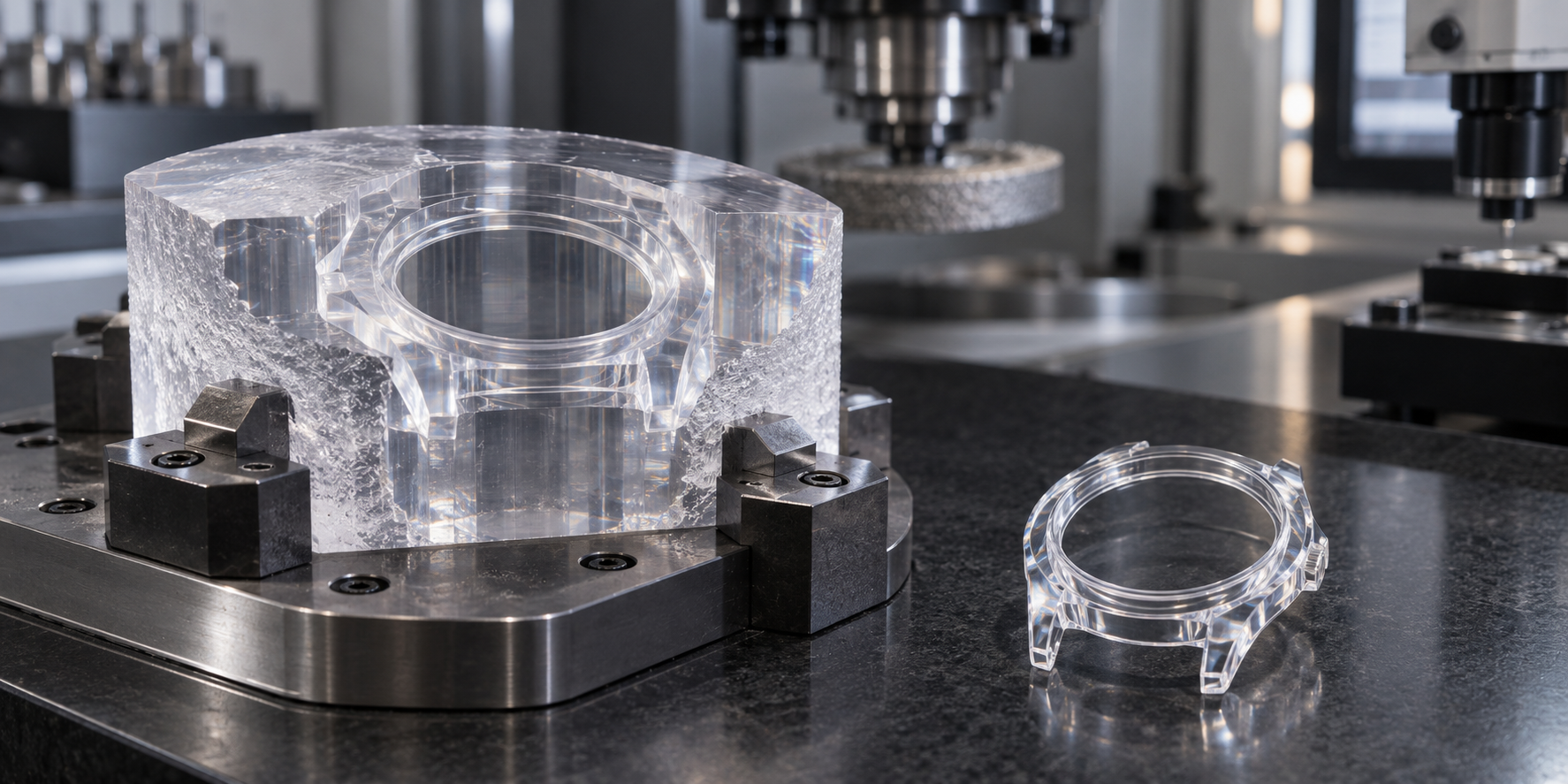
Transparent and coloured sapphire watch cases are now more visible across haute horlogerie, but most remain limited to dozens or a few hundred pieces. In 2026, Hublot introduced a diamond-set sapphire model limited to 20 watches and a Sapphire Sky Blue model limited to 100. Limited production supports exclusivity, but it also reflects the practical difficulty of turning a large synthetic crystal into a complex, optically polished and structurally reliable watch case.
A sapphire case should not be compared with an ordinary sapphire watch crystal. A flat watch crystal begins with a relatively thin disc and has comparatively accessible surfaces. A full case may require a thick, defect-controlled blank, extensive five-axis machining, deep internal cavities, small holes, curved lugs, sealing surfaces and polishing from several directions.
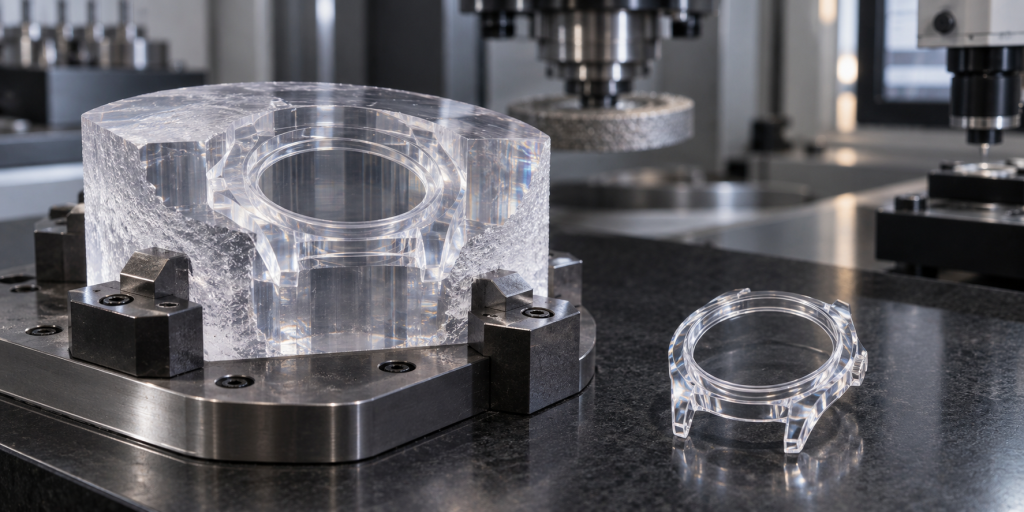
Every stage adds cost and risk. A defect discovered during final polishing can eliminate a component that has already consumed hundreds of processing hours. This combination of slow material removal, specialized equipment, manual finishing and late-stage yield loss is one reason full-sapphire cases still resist conventional mass production.
Limited Editions Are Both a Commercial Choice and a Manufacturing Reality
Luxury brands often use limited editions to create scarcity, support collector interest and differentiate a technically ambitious release. It would therefore be inaccurate to explain every low production number purely as a manufacturing limit.
At the same time, sapphire manufacturing creates genuine constraints that make a limited launch commercially rational. Compared with established metal watch-case production, capacity is restricted by:
- Availability of suitably large and consistent crystal blanks
- Long crystal-growth and blank-preparation cycles
- Slow diamond-tool machining
- Tool wear and multiple machine setups
- Complex internal and external polishing
- Specialist manual labour
- Tight cosmetic requirements for transparent surfaces
- Destructive and non-destructive validation
- Scrap that may occur late in the production route
These constraints do not make larger production impossible. They mean that scaling requires more than purchasing extra raw material. The complete chain—from crystal growth to polishing and inspection—must have sufficient qualified capacity.
A Full Sapphire Case Starts with a Much Larger Crystal Than the Finished Watch Suggests
Synthetic sapphire is single-crystal aluminium oxide. It can be grown through processes such as the Kyropoulos method, in which a seed crystal is used to develop a much larger crystal body under controlled thermal conditions.
The finished watch case may weigh only a fraction of the original crystal. Substantial surrounding material is needed so the case can be positioned correctly within the blank, rough-machined, supported during processing and finished without entering unsuitable regions.
Richard Mille’s published sapphire-manufacturing description states that a sapphire block weighing several dozen kilograms may be needed to produce the three components of one curved case. The same source describes a crystal-growth cycle lasting several weeks.
This does not mean every sapphire watch case requires the same blank weight or growth method. Blank requirements depend on case diameter, height, curvature, component architecture, crystal orientation and whether the design is monobloc or multi-part. It does illustrate the large difference between finished-part size and starting-material commitment.
Why Large Crystal Blanks Reduce Yield
As the required blank volume increases, it becomes more difficult to obtain a usable region that satisfies every requirement simultaneously.
Important considerations include:
- Crystal orientation
- Internal bubbles or inclusions
- Residual stress and strain patterns
- Cracks or damaged outer regions created during blank preparation
- Colour consistency in doped sapphire
- Dimensional allowance for every case component
- Position of the part within the grown crystal
A small optical window can sometimes be nested within a localized high-quality area. A full watch case occupies a much larger three-dimensional volume. Internal features, lugs and curved sides may extend through regions that would not matter in a simple flat component.
The blank must also provide machining allowance. A case cannot normally be extracted at its final dimensions. Rough grinding, semi-finishing, damage removal and polishing all consume material. Insufficient allowance creates a risk that the component will become undersized before the required optical and structural surface quality is reached.
For coloured sapphire, blank selection can be even more restrictive. Dopants must be distributed consistently enough to achieve the intended appearance across walls of different thickness and viewing directions. A colour variation that is acceptable in a small sample may become obvious in a transparent three-dimensional case.
Material Utilization Is Inherently Low
Most of the original crystal does not become part of the finished watch case. The central movement cavity, strap clearance, internal recesses and exterior contour all require material to be removed.
The utilization rate is influenced by:
- Case outline and lug projection
- Depth of the internal cavity
- Wall-thickness distribution
- Orientation constraints
- Sawing and grinding allowance
- Fixturing zones needed during machining
- Defect exclusion areas
- Whether multiple parts can be nested in one blank
An attractive rendering may therefore have a major effect on raw-material efficiency. Long integrated lugs, deep undercuts or strongly asymmetric forms can require a substantially larger blank even when they add little finished mass.
This is why sapphire-case quotation cannot be based simply on the final component’s weight.
Why CNC Machining Takes So Long
Sapphire’s hardness provides excellent scratch resistance in service, but it also makes controlled material removal slow. Machining generally relies on diamond abrasives and carefully managed cutting conditions.
The objective is not merely to remove material. The process must avoid creating damage that cannot be removed during later finishing. Excessive force, poor coolant control, worn tooling or an unsuitable toolpath can cause chipping, subsurface cracks or stress around thin features.
A complex case may require:
- Cutting and orienting the initial blank.
- Rough shaping of the exterior.
- Opening the movement cavity.
- Semi-finishing curved walls and lugs.
- Producing screw holes, crown openings and gasket features.
- Repositioning the part for surfaces that cannot be reached from one setup.
- Intermediate inspection and adjustment of remaining stock.
- Fine grinding before lapping and polishing.
Each setup needs a stable datum and a fixture that holds the crystal without applying damaging point loads. When the part is repositioned, small alignment errors can accumulate. Five-axis equipment improves access, but it does not remove the need for conservative cutting and repeated verification.
Richard Mille reports that a sapphire case can require more than 1,000 hours of milling and polishing. This figure applies to its own highly complex cases and should not be treated as a universal quotation benchmark. It does, however, show why machining time—not merely raw-material price—can dominate the economics of an ambitious design.
Machine Occupancy Is Only Part of CNC Cost
Long machining cycles create costs beyond the hourly rate of a machine tool.
They also involve:
- Diamond tooling and tool replacement
- Specialized coolant and filtration
- Fixture design and fabrication
- CAM programming and toolpath simulation
- Machine calibration and setup
- Operator monitoring
- Intermediate cleaning and metrology
- Rework or additional damage-removal stock
- Capacity reserved for prototypes and replacement parts
If one case occupies specialized equipment for an extended period, the opportunity cost is significant. Adding a second machine is not an immediate solution because the process, fixtures, programs and inspection correlation must also be qualified.
For limited production, development time is distributed over a small number of accepted parts. This raises unit cost even before raw material and polishing losses are considered.
Polishing Is Often the True Production Bottleneck
Machining creates the geometry, but polishing makes a sapphire case visually acceptable. A full case can contain convex surfaces, concave internal walls, narrow transitions, screw recesses, lug interiors and sealing lands. Each surface may require a different tool, access direction and support method.
Polishing must achieve several goals at once:
- Optical clarity
- Controlled surface roughness
- Removal of machining damage
- Preservation of dimensions
- Consistent edge geometry
- Minimal waviness and optical distortion
- Uniform appearance across connected surfaces
These requirements can conflict. More polishing may remove a scratch or subsurface damage, but it also changes wall thickness, radii, flatness and fit. A surface may look brighter while moving outside its dimensional tolerance.
Internal surfaces are especially difficult because tools have limited access and visual defects remain visible through the exterior. Transparent sapphire exposes polishing shadows, inconsistent transitions and trapped contamination that would be hidden inside an opaque metal case.
Why Polishing Yield Matters More Than Polishing Speed
Production yield is the percentage of started components that reach final acceptance. In sapphire-case manufacturing, yield must be considered at every stage, but losses during late polishing are particularly expensive.
By that point, the component has already consumed:
- A qualified crystal blank
- Rough and precision machining time
- Multiple fixtures and setups
- Intermediate metrology
- Cleaning and handling
- Earlier polishing operations
If the part is rejected for a deep scratch, edge chip, optical distortion or dimension that cannot be recovered, all of the accumulated value is lost.
An apparent improvement in polishing speed is not beneficial if it reduces final yield. Manufacturers therefore need to optimize accepted output rather than maximum removal rate.
Research on sapphire surface damage also shows why appearance alone is insufficient. NIST work on single-crystal sapphire found that samples with similar surface-roughness measurements could have different strength because subsurface fabrication damage remained. A brilliant visible finish does not automatically prove that the structural surface is damage-free.
Transparent Cases Create Stricter Cosmetic Expectations
The same transparency that attracts collectors makes inspection more demanding. A defect may be visible from several directions or magnified by refraction through a curved wall.
Typical inspection concerns include:
- Scratches and polishing trails
- Pits and localized haze
- Edge chips
- Internal inclusions
- Uneven colour
- Optical distortion
- Particles trapped during assembly
- Tool marks inside holes or recesses
- Inconsistent transitions between polished and frosted areas
The drawing should divide the case into cosmetic zones and define how each zone is inspected. A universal “no defects” note is rarely practical. Lighting, magnification, viewing background, viewing distance and permissible defect dimensions should be agreed before production.
Without a clear inspection standard, parts may pass the manufacturer’s review but fail the brand’s final aesthetic assessment. That uncertainty must be included in both schedule and cost.
Why Production Cost Does Not Scale with Finished Weight
For a metal component, raw-material mass may be a meaningful part of the cost estimate. For a high-complexity sapphire case, finished weight is often a poor indicator.
The main cost categories include:
Crystal and Blank Preparation
This covers crystal growth, orientation, quality selection, cutting and the unused volume surrounding the finished component.
Engineering and Development
Design-for-manufacturing review, fixture design, process trials, CAM programming and prototype inspection must be completed before stable production begins.
CNC and Grinding Time
Long cycles, specialized diamond tools, machine occupancy and multiple setups contribute heavily to cost.
Polishing Labour
Complex internal and external surfaces may require substantial skilled manual work in addition to controlled machine processes.
Metrology and Quality Control
Three-dimensional measurement, surface inspection, edge inspection, stress-related optical examination and traceability all add necessary processing time.
Qualification and Testing
Prototype cases may be consumed by pressure, shock, thermal or destructive validation. These development units must be included in the project quantity.
Yield Loss
The cost of rejected blanks and partially completed parts is ultimately carried by the accepted production lot.
For this reason, two cases of similar external size may have very different prices. A design with accessible surfaces and generous radii can be substantially more manufacturable than one with deep undercuts, thin lugs and sharp internal corners.
The Cost of Complexity Is Non-Linear
Adding one difficult feature can affect several operations rather than one.
For example, a deep decorative recess may require:
- A larger starting blank
- A special extended tool
- An additional machine setup
- Slower cutting to control vibration
- A custom polishing tool
- More inspection viewpoints
- Greater risk of trapped debris
- Additional handling protection
Similarly, tightening a cosmetic or dimensional tolerance may increase machining time, inspection time and rejection risk simultaneously.
This means cost is not calculated by simply counting features. The interaction between geometry, process access and acceptance criteria must be evaluated.
Why Low Production Volume Raises Unit Cost
A limited edition may contain only 20, 50 or 100 watches, but the project still requires engineering, tooling, fixtures, prototypes and qualification.
These non-recurring costs are spread across a small number of saleable cases. The manufacturer may also need to reserve additional blanks and machine capacity for development losses, final replacements and after-sales parts.
At the same time, increasing volume does not automatically reduce cost in a straight line. A larger lot increases purchasing power and distributes development costs more efficiently, but it also requires stable supplies of equivalent blanks, more polishing capacity and consistent inspection between operators and machines.
The relevant question is therefore not only “How many cases are needed?” It is “How many accepted cases are required, and how many development, test and contingency parts must enter the process?”
How Design Choices Can Improve Yield and Control Cost
High-quality sapphire cases will remain expensive, but several decisions can make production more predictable.
Review Manufacturability Before Freezing the Exterior
Moving a hole, increasing a local radius or improving polishing access may preserve the intended appearance while reducing considerable risk.
Use a Realistic Multi-Part Architecture
A monobloc case may offer visual purity, but a multi-part design can sometimes improve machining access, blank utilization, sealing control and replacement strategy. The choice should be based on the complete watch architecture.
Avoid Unnecessary Uniform Tolerances
Apply tight tolerances where they affect sealing, movement alignment or visible fit. Hidden non-functional surfaces may not require the same specification.
Define Cosmetic Zones
Separating critical visible surfaces from secondary and hidden areas creates a more objective inspection system and reduces unnecessary rejection.
Standardize Interfaces Where Possible
Repeated gasket sections, screw sizes, inserts and movement-support features can reduce development work across a product family.
Preserve Polishing Access
Small changes to an internal corner or lug transition may make the difference between a controllable polishing operation and an inaccessible defect zone.
Lock the Design Before Production Blanks Are Released
Late changes can invalidate fixtures, programs, polishing tools and inspection reports. Version control is essential when each started blank carries substantial value.
Production Planning for a Limited Sapphire Edition
A realistic plan should include more parts than the number of finished watches. The total may need to cover:
- Process-development samples
- First-article inspection
- Pressure and shock-test samples
- Expected manufacturing losses
- Brand approval samples
- Assembly trials
- Replacement parts
- After-sales inventory
The exact allowance depends on design maturity and demonstrated process capability. It should be agreed rather than hidden inside an optimistic final quantity.
Milestones can include blank approval, rough-machined inspection, polished first article, assembly validation and pilot-lot approval. Staged release prevents the entire material lot from being exposed to an unverified process.
What to Include in an RFQ for a Limited-Edition Sapphire Watch Case
A useful quotation package should include:
- Native 3D CAD files and controlled 2D drawings
- Case architecture: monobloc or multi-part
- Overall dimensions and local minimum wall thicknesses
- Sapphire colour and crystal-orientation requirements
- Polished, frosted and hidden surface definitions
- Screw, gasket, crown, pusher and movement interfaces
- Dimensional tolerances and datum strategy
- Cosmetic inspection criteria
- Water-resistance and shock requirements
- Prototype, test, production and spare-part quantities
- Required inspection reports and traceability
- Target schedule and design-freeze date
For early-stage concepts, sharing the 3D model before final detailing can produce a more useful estimate. The supplier can identify blank-size requirements, machining access, polishing difficulty and high-risk features before the commercial design is locked.
Conclusion
Sapphire watch cases continue to appear in limited editions in 2026 partly because scarcity is valuable in luxury watchmaking. Yet the production numbers also reflect a demanding manufacturing chain.
Large defect-controlled crystal blanks require time and careful selection. Much of the original material is removed. CNC machining is slow, tooling-intensive and sensitive to chipping. Polishing must create optical clarity while preserving geometry and removing damage. Defects found late in the process carry the cost of every previous operation.
The result is a production model in which accepted yield matters more than theoretical machine speed. Scaling from a prototype to 20 cases, and from 20 cases to 100, requires qualified capacity across crystal supply, machining, polishing, metrology and final inspection.
For a custom limited-edition project, provide the case model, drawings, material requirements, target quantity and inspection standard as early as possible. A manufacturing review can then separate unavoidable sapphire costs from design features that can be optimized—protecting both the visual concept and the production budget.