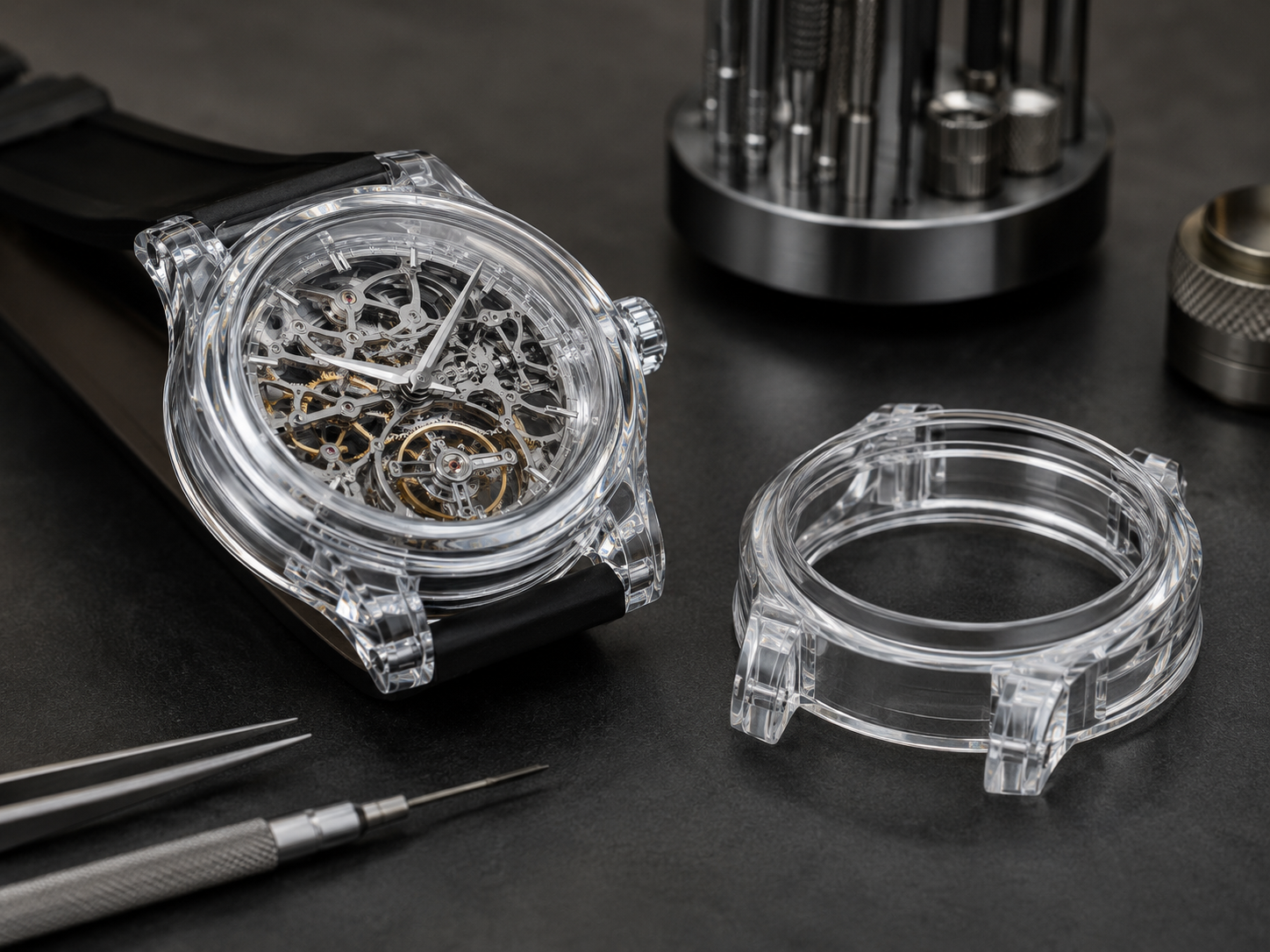
Transparent sapphire watch cases are becoming increasingly ambitious.
Early sapphire case designs often relied on relatively simple round geometries, flat surfaces and separate structural components. Today, luxury watch designers are pushing sapphire toward flowing side walls, integrated lugs, deep internal cavities, sculpted crown guards and highly three-dimensional case architectures.
This evolution creates striking watches, but it also changes the engineering challenge completely.
A shape that is easy to model in CAD is not necessarily practical to manufacture from sapphire.
Synthetic sapphire is extremely hard, rigid and scratch resistant, but it is also a brittle crystalline material. It cannot be machined like stainless steel, titanium or aluminum.
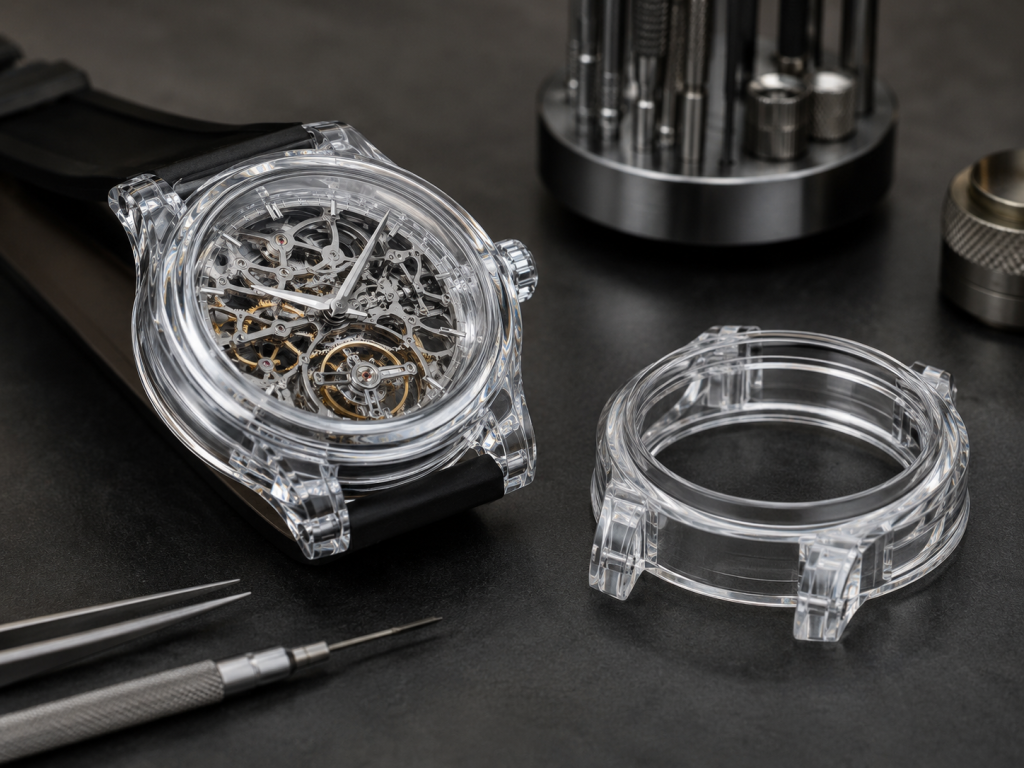
Every additional curve, hole, thin wall and internal transition can affect:
- machining accessibility
- diamond tool wear
- polishing accessibility
- edge chipping risk
- stress concentration
- dimensional accuracy
- manufacturing time
- production yield
For watch brands and designers developing a custom sapphire watch case, understanding these limitations before prototype machining can save substantial development time and cost.
Why Sapphire Case Geometry Is Becoming More Complex
A transparent case offers something that a conventional metal case cannot: the ability to use the entire three-dimensional structure of the watch as part of the visual design.
With metal cases, many internal and side-wall features remain hidden.
With sapphire, designers can deliberately expose:
- movement bridges
- tourbillon cages
- gears
- movement holders
- crown structures
- case screws
- internal case architecture
This encourages designers to move beyond simple cylindrical cases.
Curved side walls can interact with the movement.
Integrated lugs can create visual continuity from case to strap.
Sculpted edges can produce changing reflections.
Complex internal cavities can make a movement appear suspended inside the transparent structure.
The result is visually powerful, but manufacturing difficulty rises quickly.
A CAD Model Does Not Show Manufacturing Difficulty
Modern 3D CAD software allows almost any surface to be created.
Designers can easily generate:
- freeform curves
- compound surfaces
- sharp transitions
- deep pockets
- narrow slots
- tiny holes
- integrated lugs
- undercuts
From a digital perspective, all of these features may look completely achievable.
Sapphire machining works differently.
The manufacturer must answer several practical questions:
Can the diamond tool physically reach the surface?
Can the tool approach the feature at the required angle?
Can the surface be polished after machining?
Is there enough material around the feature to prevent cracking?
Can the component be held securely during machining?
Can the finished geometry be measured accurately?
Can the same result be repeated across multiple pieces?
This is why design-for-manufacturability is critical for sapphire watch cases.
Sapphire Is Not Machined Like Metal
Metal can generally be cut using conventional machining tools.
Sapphire requires abrasive and diamond-based machining processes.
Material removal is slower and more demanding.
A typical sapphire case manufacturing route may include:
- Crystal blank preparation
- Initial blank inspection
- Rough grinding
- Multi-axis precision machining
- Diamond grinding
- Hole machining
- Fine grinding
- Edge finishing
- Multiple polishing stages
- Dimensional inspection
- Optical inspection
- Trial assembly
Complex geometries may require the component to be repositioned several times.
Each additional setup introduces more manufacturing time and potential dimensional error.
Curved Sapphire Surfaces Create a Major CNC Challenge
A simple flat sapphire surface can be ground and polished relatively efficiently.
A continuously curved surface is much more demanding.
Examples include:
- domed case sides
- flowing tonneau profiles
- wave-shaped cases
- curved lug transitions
- compound convex surfaces
- concave internal walls
The difficulty increases significantly when curvature changes continuously across the same surface.
These are often called compound or freeform surfaces.
Instead of machining along one predictable radius, the tool must continuously change its position and angle.
This usually requires multi-axis CNC control.
Why Multi-Axis Machining Matters
Three-axis machining moves the tool along X, Y and Z directions.
This is sufficient for many relatively simple parts.
Complex sapphire cases may require 4-axis or 5-axis machining because the tool needs to approach the surface from different directions.
Multi-axis machining can improve access to:
- curved side walls
- integrated lugs
- angled crown guards
- recessed surfaces
- complex case corners
However, adding axes does not automatically solve every problem.
Tool diameter, spindle geometry, fixture interference and polishing access still limit what can actually be produced.
Tool Accessibility Sets a Real Design Limit
Every cutting or grinding tool has a physical size.
If a CAD design includes a very narrow internal corner, the required tool may simply be unable to reach it.
For example, imagine a deep internal pocket with a 0.2 mm corner radius.
The tool capable of creating such a small radius may be too thin or too fragile to machine a deep sapphire cavity efficiently.
This creates a conflict between:
small radius + deep feature + hard material
Designers therefore need to consider the relationship between:
- tool diameter
- feature depth
- internal radius
- wall thickness
- machining access
Increasing an internal radius slightly can sometimes make a dramatic difference in manufacturability.
Integrated Sapphire Lugs Are Visually Attractive but Difficult
Integrated lugs create a smooth transition between the main watch case and strap connection.
In transparent sapphire, they can produce a particularly elegant effect because the entire structure appears to flow from one crystal body.
But integrated lugs introduce several engineering challenges.
The lug region may contain:
- thin sections
- strap holes
- curved transitions
- sharp external edges
- narrow structural bridges
All of these features must survive machining and final assembly.
Lug Holes Are Particularly Sensitive
Strap attachment usually requires a spring-bar hole, screw hole or another connection feature.
Drilling through sapphire is possible, but hole position requires careful engineering.
Problems become more likely when the hole is:
- too close to an edge
- too close to another opening
- located in a thin section
- positioned near a sharp transition
- extremely small in diameter
Sufficient sapphire material should remain around the hole.
The designer should also consider the mechanical load transferred by the strap during daily wear.
A transparent lug is not simply a decorative feature.
It is a structural component.
Lug Transitions Need Smooth Radii
The transition from the case body into the lug is another critical region.
A sharp transition can create stress concentration.
A smoother radius can improve:
- structural strength
- grinding stability
- polishing access
- visual flow
This is a good example of a situation where manufacturing requirements and aesthetic requirements can support each other.
A smooth organic transition can be both visually attractive and more suitable for sapphire.
Deep Internal Cavities Increase Risk
Skeleton watches often require significant internal volume so that the movement remains visible.
This can lead to deep internal cavities.
Deep cavities are difficult for several reasons.
The machining tool must reach the bottom without interfering with the surrounding sapphire.
As depth increases:
- tool stiffness decreases
- vibration risk increases
- dimensional control becomes more difficult
- debris removal becomes more difficult
- polishing becomes harder
A deep cavity with narrow access can be especially problematic.
Polishing May Be Harder Than CNC Machining
This is one of the most important lessons in sapphire case design.
A geometry may technically be machinable but still be impractical to polish.
After grinding, sapphire surfaces do not automatically become optically transparent.
Microscopic machining damage and surface roughness scatter light.
The surface must therefore undergo controlled polishing.
For transparent watch cases, polishing is part of the optical manufacturing process.
If a polishing tool cannot reach a surface properly, the area may remain cloudy or visually inconsistent.
Design for Polishing Accessibility
Before approving the CAD model, designers should ask:
Can every visible surface be polished?
This includes:
- outer side walls
- internal walls
- curved transitions
- lug interiors
- crown openings
- deep pockets
- narrow channels
Complex concave surfaces are particularly challenging.
The problem becomes more severe when the opening leading to the surface is smaller than the polishing tool required to finish it.
Increasing access slightly may substantially improve the final optical quality.
Internal Surfaces Are Visible Through Sapphire
With a metal watch case, internal surfaces can often remain relatively functional.
Sapphire changes this completely.
The wearer may see internal:
- machining marks
- radii
- pockets
- shoulders
- holes
- assembly structures
through the finished case.
This means internal geometry must be treated almost like exterior design.
A technically acceptable internal surface may still be visually unacceptable.
For skeleton watches, internal finishing quality is particularly important.
Undercuts Are a Major Manufacturing Constraint
An undercut is a feature that cannot be reached directly from the main machining direction.
Metal CNC machining can sometimes solve undercuts using specialized tools or alternative setups.
In sapphire, undercuts can be significantly more difficult.
The manufacturer may need:
- additional setups
- specialized diamond tools
- alternative machining directions
- separate components
In some cases, redesigning the case as a multi-part structure is more practical than trying to create an extreme undercut inside one sapphire blank.
Monobloc Designs Push Manufacturing Further
A monobloc sapphire watch case is machined largely from one crystal blank.
This can create excellent visual continuity.
Advantages include:
- continuous transparency
- fewer visible interfaces
- integrated lugs
- clean side-wall appearance
- distinctive premium aesthetics
However, manufacturing complexity can be very high.
The manufacturer has fewer opportunities to access internal surfaces from separate directions.
Large amounts of crystal material may also need to be removed.
As machining progresses, the value invested in the unfinished component increases.
A crack or chip near the final stage can result in the loss of many hours of work.
Multi-Part Sapphire Cases Can Be More Practical
Complex designs do not always need to be monobloc.
A case can be divided into:
- bezel
- middle case
- caseback
- lug structures
- crown components
This can improve manufacturing accessibility.
Separate components may be easier to:
- machine
- polish
- inspect
- assemble
- replace
The disadvantage is the need to manage additional interfaces, dimensional stack-up and sealing.
The correct architecture depends on the design objective.
Sharp Internal Corners Are Dangerous
Sapphire does not respond well to sharp stress concentrators.
Very small internal corner radii can create high local stress during:
- machining
- assembly
- screw tightening
- impact
For this reason, internal corners should generally use suitable radii.
This is particularly important around:
- deep cavities
- screw bosses
- crown openings
- lug transitions
- gasket grooves
The larger radius must still match the intended aesthetics and assembly requirements.
Thin Walls Increase Both Visual Appeal and Risk
Designers often want thin sapphire walls because they create a lighter, more transparent appearance.
Reducing thickness can also increase available internal volume.
But very thin walls create manufacturing challenges.
They may be more susceptible to:
- vibration during grinding
- edge chipping
- cracking
- dimensional variation
- handling damage
The minimum practical wall thickness depends on geometry rather than one universal number.
A short flat wall behaves differently from a long curved wall.
A wall containing holes behaves differently from a continuous wall.
Minimum thickness should therefore be reviewed in the context of the complete case.
Wall Thickness Should Change Gradually
Sudden transitions between thick and thin sapphire sections should be evaluated carefully.
Gradual transitions can help reduce local stress concentration.
They can also improve visual appearance.
This is particularly relevant around:
- lugs
- crown guards
- caseback interfaces
- screw locations
A well-designed thickness transition can provide structural reinforcement without making the case appear unnecessarily heavy.
Cross Holes Are Another Difficult Feature
Some sapphire watch cases require holes that cross the main component horizontally.
Examples include:
- strap holes
- crown openings
- pusher holes
- screw channels
Cross drilling sapphire requires accurate positioning and stable support.
Problems may occur when the drilling path approaches another cavity or outer edge.
The remaining wall must be sufficient to maintain structural integrity.
The intersection between two holes also deserves careful attention because it can create small fragile sapphire features.
Crown Guards Can Become Complex Very Quickly
Crown guards look relatively simple in a rendering.
In reality, they can require:
- narrow sapphire bridges
- complex curves
- deep cutouts
- crown access
- polishing around multiple surfaces
If the guard is integrated into the sapphire middle case, machining and polishing access should be reviewed early.
A visually aggressive crown guard copied directly from a titanium case may not be ideal for sapphire.
Edge Chipping Is a Constant Risk
Edges are particularly vulnerable during sapphire processing.
Sharp external edges may chip during:
- grinding
- handling
- polishing
- assembly
Small controlled chamfers or radii can reduce this risk.
The edge treatment also affects the optical appearance.
Highly polished chamfers can create attractive reflections around a transparent sapphire case.
Edge engineering therefore combines:
- durability
- manufacturing yield
- aesthetics
Chamfers Can Become Optical Design Elements
In transparent materials, chamfers do more than protect edges.
They change how light travels through the case.
A polished chamfer can create bright highlights around:
- bezel edges
- lugs
- side walls
- crown openings
This allows the designer to use edge geometry as part of the watch’s visual identity.
However, very complicated networks of tiny facets dramatically increase polishing requirements.
The design should balance optical effect against manufacturing cost.
More Facets Mean More Manufacturing Operations
A highly faceted sapphire case can look spectacular.
Each facet, however, may require:
- controlled machining
- dimensional verification
- edge definition
- polishing
The challenge is not simply making one surface.
It is maintaining the relationship between every neighboring surface.
If polishing removes slightly too much material, sharp facet boundaries may become rounded or uneven.
For premium sapphire cases, this geometric consistency is critical.
CNC Accuracy Is Only Part of Final Accuracy
It is tempting to assume that CNC machining determines the final dimensions.
In sapphire manufacturing, polishing also changes dimensions.
Material is removed during polishing.
This is especially important for:
- sealing surfaces
- screw interfaces
- caseback seats
- bezel interfaces
- movement pockets
The manufacturer must therefore plan machining dimensions with polishing allowance in mind.
Critical tolerances should be identified clearly on the engineering drawing.
Surface Finish and Dimensional Tolerance Can Conflict
A designer may request:
- extremely tight dimensional tolerance
- extremely high optical polish
on the same surface.
These goals can sometimes conflict.
More polishing improves optical appearance but removes additional material.
The process therefore needs careful control.
For critical interfaces, the drawing should distinguish between:
- optical surfaces
- decorative surfaces
- sealing surfaces
- dimensional datum surfaces
This helps the manufacturer choose the correct processing strategy.
Complex Geometry Reduces Manufacturing Yield
Yield is one of the largest hidden costs in sapphire case manufacturing.
A simple component may progress through manufacturing with relatively predictable risk.
A complex monobloc case accumulates risk across many operations.
Possible failure modes include:
- crystal defects
- grinding damage
- edge chipping
- cracking
- dimensional error
- polishing defects
- optical distortion
If a defect occurs late in production, much of the previous machining investment may be lost.
Therefore, complex geometry increases price not only because it takes longer.
It also increases manufacturing risk.
Why Sapphire Cases Can Require Extremely Long Processing Times
Unlike metal, sapphire material removal cannot simply be accelerated by applying aggressive cutting conditions.
Grinding must remain controlled to avoid excessive subsurface damage and cracking.
Complex multi-axis surfaces require many machining passes.
Polishing can require additional stages.
As geometry becomes more complex, production time may be dominated by:
- machining
- repositioning
- fine grinding
- manual finishing
- polishing
- inspection
This explains why highly complex sapphire watch cases belong primarily to the high-end watch market.
Optical Distortion Should Be Designed Intentionally
Curved sapphire surfaces bend light.
This can change how the movement appears through the case.
Depending on geometry, internal components may appear:
- magnified
- shifted
- compressed
- distorted
This effect can either be undesirable or intentionally used as part of the design.
Thick curved side walls may create particularly strong optical effects.
Physical prototyping is therefore extremely valuable because standard CAD rendering may not accurately reproduce real optical behavior.
Colored Sapphire Adds Another Layer of Complexity
Complex geometry becomes even more visually interesting when colored sapphire is used.
But wall thickness affects perceived color.
Thick areas such as:
- lugs
- corners
- crown guards
may appear darker than thin case walls.
A complex colored sapphire case can therefore show natural variations in apparent saturation.
Designers should evaluate color on representative geometry rather than relying only on a flat material sample.
Fixtures Are an Overlooked Part of Manufacturing
The sapphire blank must be held securely during machining.
Complex cases can be difficult to fixture because the component changes shape as material is removed.
The manufacturer must avoid creating excessive clamping stress.
A fixture may also block access to certain surfaces.
This can require multiple setups during production.
Design geometry that allows stable fixturing can improve both dimensional accuracy and yield.
Inspection Becomes Harder as Geometry Becomes More Complex
Simple components can be measured using relatively straightforward dimensional methods.
Freeform sapphire cases may require:
- coordinate measurement
- optical measurement
- profile inspection
- specialized fixtures
Transparent surfaces can also create challenges for optical measuring systems.
Critical dimensions should therefore be clearly identified rather than assigning unnecessarily tight tolerances to every feature.
Not Every Dimension Needs Extreme Tolerance
Over-tolerancing is a common problem.
A designer may apply ±0.01 mm or similarly demanding tolerances across the entire case without distinguishing functional from non-functional features.
This increases cost unnecessarily.
Tight tolerances should focus on areas such as:
- movement fit
- crown alignment
- gasket interfaces
- screw positions
- caseback fit
- bezel fit
Decorative external geometry may tolerate a different specification.
A good engineering drawing distinguishes critical dimensions from visual surfaces.
Designing a More Manufacturable Sapphire Case
Several principles can improve manufacturing feasibility.
Use Larger Internal Radii
Avoid unnecessarily sharp internal corners.
Maintain Sufficient Wall Thickness
Do not reduce sapphire thickness only for visual reasons without structural review.
Keep Holes Away From Edges
Provide enough surrounding material around crown, strap and screw holes.
Avoid Deep Narrow Cavities
Improve tool and polishing access wherever possible.
Reduce Unnecessary Undercuts
Consider a multi-part structure when an undercut provides little functional value.
Design for Polishing
Every visible surface should be physically reachable during finishing.
Use Controlled Edge Radii or Chamfers
Avoid highly fragile sharp edges.
Identify Critical Tolerances
Do not apply extreme tolerance to every surface.
When Should a Case Be Divided Into Multiple Parts?
A monobloc design may look ideal in CAD but become unnecessarily risky in manufacturing.
Dividing the case may be worth considering when:
- internal polishing access is impossible
- extreme undercuts are required
- machining depth becomes excessive
- assembly access is limited
- sealing can be handled reliably between parts
The goal should be the best complete watch architecture, not simply the lowest number of components.
Prototype Before Production
Complex sapphire watch cases should almost always go through a prototype stage.
The first prototype allows the design team to evaluate:
- actual proportions
- transparency
- optical distortion
- polishing quality
- movement visibility
- lug strength
- crown access
- assembly
- sealing
- edge quality
Problems identified at this stage can then be corrected before production quantities are ordered.
Prototype Geometry May Need to Change
A prototype is not necessarily a final-production sample.
Manufacturing feedback may reveal that:
- an internal radius should be increased
- a wall should be slightly thickened
- a hole should move farther from an edge
- an undercut should be removed
- polishing access should be enlarged
These changes may appear minor in CAD but significantly improve production yield.
Designers should expect some optimization when moving from a metal case concept to sapphire.
Recommended Development Workflow
A practical complex sapphire case project can follow this process:
1. Define the Design Concept
Determine the desired case shape, dimensions and visual effect.
2. Build the Preliminary 3D Model
Establish the main geometry and movement envelope.
3. Perform Manufacturability Review
Evaluate wall thickness, radii, holes, undercuts and machining access.
4. Review Polishing Accessibility
Identify every surface that must achieve optical transparency.
5. Optimize Critical Geometry
Modify difficult areas before machining.
6. Define Functional Tolerances
Focus on movement, crown, sealing and assembly interfaces.
7. Machine the Prototype
Use the intended sapphire material and manufacturing process.
8. Inspect Dimensions and Surface Quality
Verify critical features before assembly.
9. Trial Assemble the Watch
Check movement fit, crown alignment, strap attachment and sealing.
10. Evaluate Optical Appearance
Review the case from multiple angles and lighting conditions.
11. Adjust the Design
Resolve manufacturing or aesthetic issues.
12. Freeze the Production Design
Create final controlled drawings and production specifications.
Information Needed for a Custom Complex Sapphire Watch Case
For an initial technical evaluation, it is useful to provide:
- 3D STEP file
- 2D engineering drawing
- overall case dimensions
- movement dimensions
- crown position
- lug structure
- screw locations
- required sapphire color
- critical tolerances
- required polished surfaces
- water-resistance requirement
- prototype quantity
- estimated production quantity
A STEP file is particularly important for freeform or curved case geometry because 2D drawings alone may not fully define complex surfaces.
Conclusion
Complex sapphire watch cases represent one of the most demanding applications of synthetic sapphire in luxury watchmaking.
The challenge is not simply cutting a hard material.
The manufacturer must control the complete relationship between:
- crystal structure
- curved geometry
- CNC accessibility
- diamond tooling
- wall thickness
- internal radii
- hole placement
- polishing accessibility
- optical performance
- dimensional tolerance
- manufacturing yield
Integrated lugs, flowing side walls and freeform surfaces can create spectacular transparent watches, but every design feature has a manufacturing consequence.
The most successful projects begin with collaboration between the watch designer and sapphire manufacturer before prototype machining starts.
In sapphire manufacturing, the objective should not be to ask:
“Can CNC produce this CAD geometry?”
The more useful question is:
“Can this geometry be machined, polished, assembled and repeated reliably in sapphire?”
That difference determines whether an attractive rendering becomes a successful production watch case.
Custom Complex Sapphire Watch Case Manufacturing
We support custom sapphire watch case development for watch brands, independent watchmakers and design studios.
Available manufacturing options can include:
- round sapphire watch cases
- tonneau sapphire cases
- curved sapphire cases
- integrated-lug sapphire cases
- monobloc sapphire cases
- multi-part sapphire cases
- clear sapphire
- colored sapphire
- sapphire bezels
- sapphire casebacks
- structural sapphire components
- prototype development
- small-batch manufacturing
For complex case projects, early design-for-manufacturability review can help identify risks related to:
- thin walls
- sharp corners
- deep cavities
- undercuts
- cross holes
- machining access
- polishing access
- lug geometry
- screw positions
- crown openings
Send us your 2D drawings, 3D STEP files, case dimensions, sapphire color and estimated quantity for technical evaluation.
FAQ
Can sapphire be CNC machined into complex watch-case shapes?
Yes, but sapphire requires diamond-based machining and often multi-axis equipment. Complex curves, deep cavities, undercuts and thin walls can substantially increase processing difficulty and manufacturing risk.
Can integrated lugs be machined directly into a sapphire watch case?
Yes. Integrated sapphire lugs are possible, but lug thickness, strap-hole position, transition radii and structural loading should be reviewed carefully.
Why are internal radii important in sapphire case design?
Sharp internal corners create stress concentration and are more difficult to machine. Suitable radii can improve structural reliability, machining stability and polishing access.
Can any CAD watch case design be converted directly into sapphire?
Not necessarily. A geometry developed for stainless steel or titanium may contain features that are difficult or risky in sapphire. Design-for-manufacturability review is recommended before prototype machining.
Why is polishing accessibility important?
Machined sapphire surfaces require finishing and polishing to achieve high transparency. A surface that can be CNC-machined but cannot be reached effectively during polishing may remain cloudy or visually inconsistent.
Does complex geometry increase sapphire case cost?
Yes. Complex geometry generally requires more machining operations, more setups, longer polishing time and carries a higher risk of rejected components, all of which affect the final manufacturing cost.
Is a monobloc sapphire case always better than a multi-part case?
No. Monobloc construction can provide excellent visual continuity, but multi-part structures may offer better machining access, polishing accessibility, assembly flexibility and production yield for some designs.