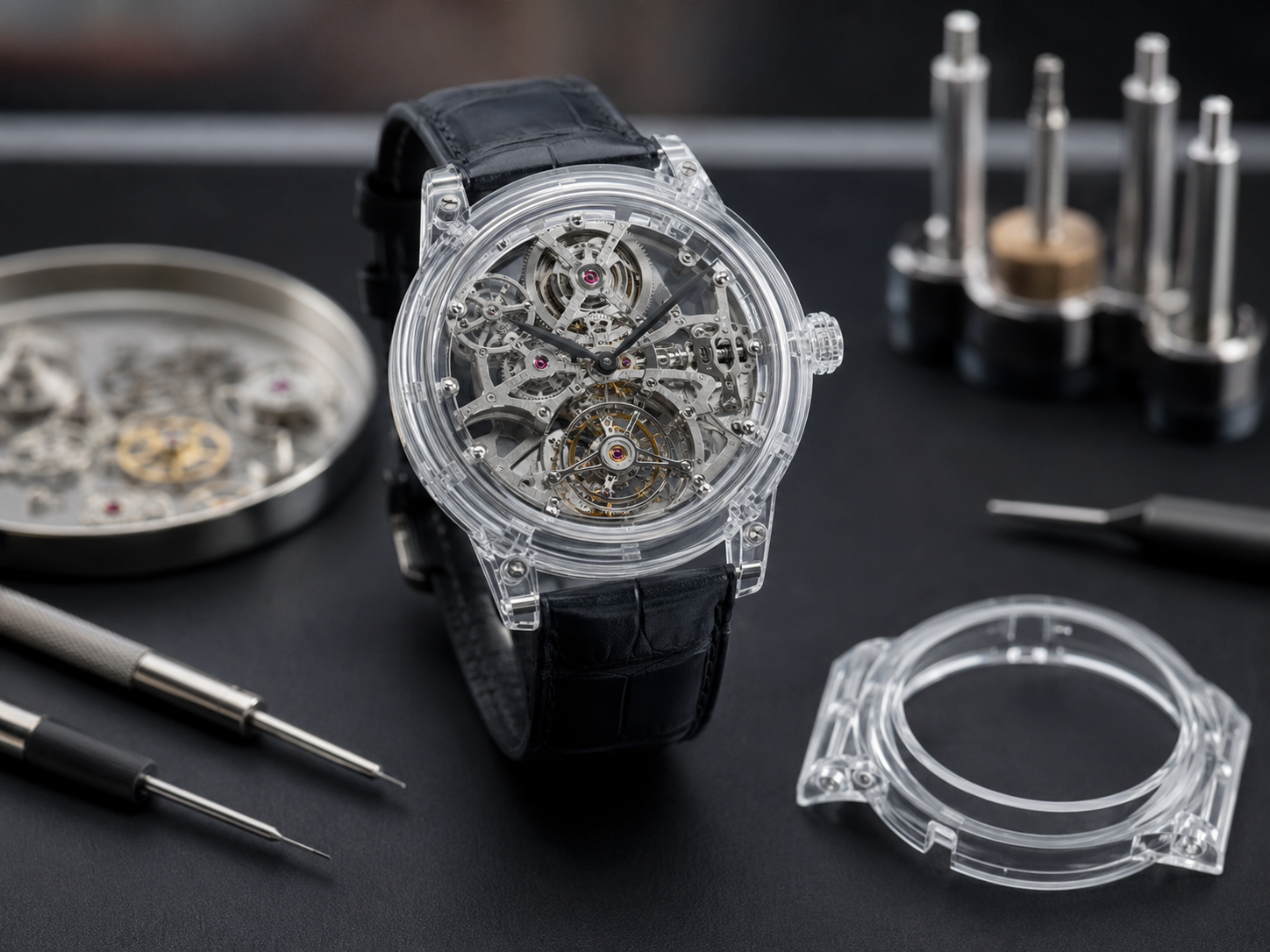
Skeleton watches are designed to reveal mechanical architecture rather than hide it.
Open-worked bridges, exposed gear trains, visible balance assemblies and suspended movement structures turn the movement itself into the visual center of the watch. In a traditional metal case, however, much of that mechanical architecture remains visible only from the front or through an exhibition caseback.
A sapphire watch case changes this relationship.
Instead of treating transparency as a feature limited to the crystal and caseback, a full sapphire case can make the movement visible through the side walls, lugs, bezel and other structural areas.
For skeleton watches, this creates a fundamentally different design approach.
The watch case is no longer simply a protective enclosure around the movement. It becomes part of the visual system that defines how the movement is viewed.
For watch brands, independent watchmakers and design teams developing a custom sapphire watch case, this means movement design and case design increasingly need to be considered together.
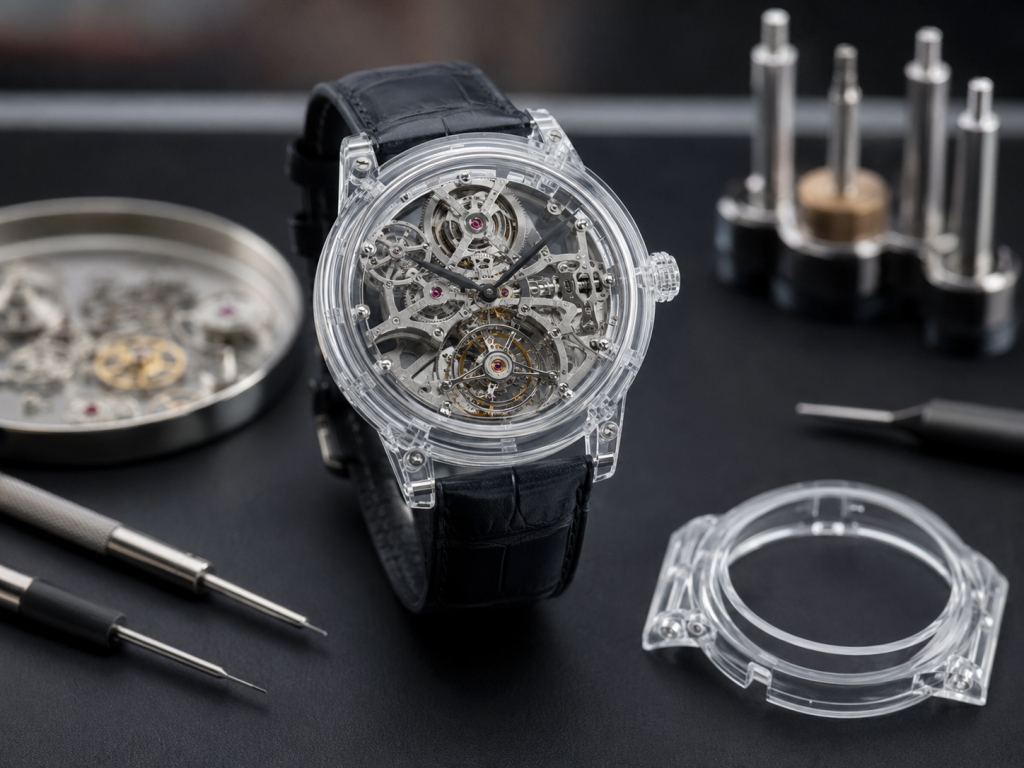
Why Skeleton Watches Pair Naturally With Sapphire Cases
Skeleton watches are built around visibility.
The purpose of skeletonization is to remove unnecessary material from the movement while preserving mechanical function. Bridges are opened, plates are reduced and internal components become visible.
A sapphire case supports this design philosophy by extending visibility beyond the dial side.
With a conventional metal case, the movement is often hidden from several angles.
A transparent sapphire case can expose:
- bridges
- gear trains
- tourbillon cages
- balance assemblies
- winding systems
- movement spacers
- movement rings
- case screws
- crown mechanisms
- internal structural elements
This allows the watch to be viewed almost like a mechanical object suspended inside a transparent shell.
The effect is particularly strong when the movement itself has been designed specifically for radial or multi-angle visibility.
Structural Transparency Changes the Role of the Case
In a metal watch, the case is usually visually dominant from the outside but visually absent from the inside.
In a sapphire watch, the situation is different.
The case remains physically present, but it becomes optically transparent.
This means the case geometry, internal walls, transitions and structural thicknesses all affect how the movement is perceived.
A sapphire case therefore has two simultaneous roles:
- Mechanical structure
- Optical structure
It must protect, locate and support the movement while also presenting it visually.
This is what makes structural transparency important.
The designer is no longer asking only:
“Can this case hold the movement?”
The better question becomes:
“How does this case shape the way the movement is seen?”
Movement Visibility Must Be Designed in Three Dimensions
Traditional watch design often focuses heavily on front-view appearance.
Skeleton watches already expand this by emphasizing depth.
A sapphire case pushes the design even further because the movement can be viewed from multiple angles.
For example, the wearer may see the movement:
- through the front
- through the rear
- from the 3 o’clock side
- from the 9 o’clock side
- through the lug area
- around the crown
- through lower case structures
This means components that would normally be visually unimportant can become highly visible.
Movement holders, spacers, screws, internal shoulders and cable-like gasket structures may suddenly become part of the visual composition.
For this reason, a movement designed for a sapphire case should ideally be evaluated in full three-dimensional context.
The Movement Envelope Becomes Critical
Every movement occupies a defined three-dimensional space inside the case.
This volume is often referred to as the movement envelope.
For a sapphire case, the relationship between the movement envelope and the transparent case wall has both mechanical and aesthetic importance.
The designer must consider:
- movement diameter
- movement height
- rotor clearance
- balance clearance
- bridge height
- crown stem axis
- movement ring dimensions
- caseback clearance
- hand stack height
- crystal clearance
If the movement sits too far away from the sapphire wall, the visual effect may feel disconnected.
If it sits too close, assembly tolerances and shock clearance may become difficult to control.
The correct spacing creates both mechanical safety and visual balance.
Movement-to-Case Clearance Affects the Visual Result
In metal cases, internal clearances are rarely visible.
In a sapphire watch case, they can become obvious.
A large empty gap between the movement and case wall may visually weaken the design.
On the other hand, placing the movement very close to the wall can create a more integrated appearance.
This is especially important for skeleton watches where the objective is often to make the movement appear suspended within the case.
Designers may therefore need to optimize:
- radial movement clearance
- vertical movement position
- movement ring thickness
- internal wall thickness
- caseback spacing
- crown-side geometry
These parameters influence not only assembly feasibility but also the final visual impression.
Internal Case Geometry Becomes Part of the Design
A metal case can hide internal machining.
A sapphire case cannot.
Internal pockets, shoulders, screw holes, undercuts and transition radii may all remain visible.
This means internal geometry should be designed with the same attention normally given to external surfaces.
Poorly planned internal features may create:
- distracting reflections
- visible machining transitions
- heavy-looking structural areas
- unnecessary optical distortion
- visual interference with the movement
For high-end skeleton watches, clean internal geometry is extremely important.
The inside of the sapphire case should be treated almost like an external decorative surface.
Internal Surface Polishing Matters
Transparency does not depend only on the quality of the crystal material.
Surface condition is equally important.
After machining, sapphire surfaces can contain micro-scale grinding marks, subsurface damage and matte regions.
These imperfections scatter light.
As a result, an internal surface that is not properly finished may appear cloudy even if the sapphire material itself is highly transparent.
For skeleton watch cases, polished internal surfaces can significantly improve movement visibility.
Important areas include:
- inner case walls
- internal bezel surfaces
- movement pockets
- caseback interfaces
- crown openings
- lug interiors
A transparent case should therefore be evaluated not only from the outside, but also from the perspective of internal optical quality.
Optical Distortion Must Be Considered
Sapphire has different optical behavior from air.
When light passes through curved or angled sapphire surfaces, it refracts.
This can make internal components appear shifted, enlarged, compressed or distorted depending on viewing angle.
For simple flat windows, this effect is relatively easy to manage.
For complex sapphire cases, however, the geometry may include:
- curved side walls
- beveled surfaces
- thick corners
- angled lugs
- cylindrical sections
- domed profiles
These features can behave like small optical elements.
For a skeleton watch, this matters because the movement is intentionally visible through these surfaces.
A design that looks perfect in CAD may produce unexpected visual distortion in the physical watch.
Prototype evaluation is therefore extremely important.
Case Wall Thickness Affects Both Strength and Visibility
Wall thickness is one of the most important variables in sapphire case design.
Thicker walls can improve structural robustness, but they also change the visual effect.
A thick sapphire wall may create:
- stronger reflections
- increased edge visibility
- more optical depth
- greater color saturation in colored sapphire
- more distortion at certain angles
A thinner wall may appear visually lighter, but it can increase manufacturing difficulty and reduce safety margin.
The ideal thickness depends on:
- case diameter
- geometry
- lug design
- screw locations
- assembly load
- machining accessibility
- target visual effect
For skeleton watches, the objective is usually to balance sufficient structural strength with maximum visual openness.
Sharp Internal Corners Should Be Avoided
Sapphire is extremely hard, but it is also brittle.
This makes stress concentration particularly important.
Sharp internal corners can create local stress zones and increase the risk of cracking during machining, assembly or impact.
This is especially relevant in complex skeleton-watch case designs that contain:
- deep internal pockets
- narrow bridges
- screw recesses
- crown-guard openings
- lug transitions
- rectangular internal features
Where possible, internal radii should be introduced.
This improves both machinability and structural reliability.
Designers coming from titanium, steel or aluminum cases should not assume that the same geometry can always be transferred directly to sapphire.
Crown and Stem Alignment Becomes More Visible
The crown system is one of the most mechanically sensitive areas of a watch case.
In a sapphire case, it also becomes visually important.
The crown tube, stem axis, seals and surrounding structural geometry may all be partially visible through the transparent case wall.
This means poor alignment can become more obvious.
Critical parameters include:
- crown hole position
- stem centerline
- crown tube diameter
- gasket location
- case wall thickness
- movement position
- crown engagement depth
Even small dimensional deviations can affect assembly.
For this reason, the movement and case should ideally be referenced from a common datum structure during engineering development.
Case Screws Become Part of the Visual Architecture
In a metal watch, screws may be partially hidden.
In a transparent sapphire case, they often become visible design features.
This creates both opportunities and challenges.
Screws can contribute to the mechanical aesthetic of a skeleton watch, but their position and finish must be carefully considered.
Designers should evaluate:
- screw head size
- screw material
- screw color
- screw symmetry
- visible thread length
- counterbore geometry
- hole position
- tightening load
Highly visible screws should look intentional.
Poorly placed hardware can make an otherwise refined transparent design appear mechanically cluttered.
The Movement Holder Must Also Be Designed Visually
Many mechanical movements require a movement ring or holder inside the case.
In a traditional opaque case, this component is often hidden.
In a sapphire case, it may become visible.
This means the movement holder may need to be redesigned as part of the watch architecture.
Possible strategies include:
- minimizing the holder
- matching its finish to the movement
- using a dark material to create contrast
- using titanium or polished metal
- integrating the holder into the movement architecture
- positioning it behind visually dominant movement structures
The goal is to avoid making the movement look like it has simply been inserted into a transparent container.
A well-designed skeleton watch should make the case, movement and holder appear as a unified system.
Monobloc Sapphire Cases Create Strong Visual Continuity
A monobloc sapphire watch case can provide excellent visual continuity because the primary case structure is machined from one sapphire blank.
This can reduce visible interfaces between separate parts.
For skeleton watches, the result can be highly architectural.
Advantages may include:
- uninterrupted transparency
- clean side-wall visibility
- fewer visible seams
- strong visual integration
However, monobloc manufacturing can also be more demanding.
Deep cavities, integrated lugs and complex internal geometry require extensive machining and polishing.
The larger and more complex the sapphire blank, the more important yield control becomes.
Multi-Part Sapphire Cases Offer More Engineering Flexibility
A multi-part sapphire case may use separate components such as:
- bezel
- middle case
- caseback
- crown components
- decorative sapphire elements
This can simplify some aspects of manufacturing and assembly.
It can also allow the designer to combine different materials or colors.
For example:
- clear sapphire case + titanium bezel
- blue sapphire middle case + clear caseback
- sapphire bezel + metal caseback
- colored sapphire body + clear sapphire crown
For skeleton watches, multi-part designs can also provide more options for controlling movement installation and serviceability.
The tradeoff is that more interfaces must be managed.
Gaskets and Seals Are Visible Too
Water resistance is a practical requirement for many luxury watches.
In a sapphire case, gaskets may become visible through the transparent material.
This creates an additional design consideration.
A gasket that is technically acceptable may not be visually acceptable.
Designers may therefore need to evaluate:
- gasket color
- gasket cross-section
- groove position
- compression
- visibility through sapphire
- interaction with metal components
Black, translucent or color-matched sealing elements may create very different visual effects.
The gasket system should therefore be considered early rather than added only at the end of the design process.
Skeleton Movements Benefit From Radial Architecture
Some movement layouts work better in transparent sapphire cases than others.
Movements with strong radial or layered architecture can be particularly effective.
Examples include movements with:
- exposed bridges
- peripheral structures
- visible balance wheels
- open gear trains
- suspended barrels
- tourbillon cages
- architectural movement plates
These designs take advantage of side visibility.
If the movement has decorative or functional components near the outer perimeter, the sapphire case can reveal them in ways that a metal case cannot.
This is one reason custom movement and case development can be especially valuable for sapphire watch projects.
Clear Sapphire vs. Colored Sapphire for Skeleton Watches
Both clear and colored sapphire can work well with skeleton movements.
Clear Sapphire
Clear sapphire offers maximum visibility and creates an almost invisible case effect.
It is suitable when the movement itself should dominate the design.
Colored Sapphire
Colored sapphire adds stronger identity and can make the case architecture more visually present.
Sky blue, sea blue or royal blue sapphire can create additional contrast between the movement and the case.
However, colored sapphire can reduce perceived transparency depending on shade and wall thickness.
This makes prototype evaluation particularly important.
Polishing Quality Determines the Final Visual Experience
A sapphire case can have excellent dimensional accuracy and still fail visually if polishing quality is insufficient.
Skeleton watches are especially sensitive because the eye is constantly looking through the case rather than only at the surface.
High-quality polishing helps reduce:
- haze
- grinding marks
- localized cloudiness
- surface scattering
- visual distortion
The polishing process becomes more difficult as geometry becomes more complex.
Deep internal cavities, narrow corners and small-radius transitions may be harder to polish uniformly.
For this reason, polishing accessibility should be considered during design.
Design for Manufacturability Is Essential
A skeleton watch case should not be designed only around appearance.
Manufacturing feasibility must be considered from the beginning.
Typical design-for-manufacturing topics include:
- minimum wall thickness
- internal radii
- hole-to-edge distance
- polishing access
- machining depth
- screw locations
- gasket grooves
- movement installation
- crown alignment
- structural bridges
- caseback assembly
Early manufacturability review can reduce prototype failures and unnecessary redesign.
Prototype Evaluation Should Include Optical Inspection
For a conventional metal case, prototype inspection may focus mainly on dimensions, assembly and finishing.
For a sapphire skeleton-watch case, optical evaluation is equally important.
A prototype should be reviewed under different lighting conditions and from multiple angles.
Important points include:
- movement visibility
- optical distortion
- internal reflections
- polished surface consistency
- side-wall appearance
- movement-to-case spacing
- screw visibility
- gasket visibility
- edge reflections
- overall visual balance
This type of evaluation often reveals issues that are difficult to predict from CAD renderings.
What Information Is Needed for a Custom Sapphire Skeleton Watch Case?
For an initial technical review, it is useful to provide:
- 2D engineering drawings
- 3D STEP files
- movement dimensions
- movement height
- crown and stem axis
- required case diameter
- case thickness
- target sapphire color
- bezel design
- caseback structure
- gasket requirements
- screw locations
- surface finish requirements
- prototype quantity
- expected production volume
If the movement is still under development, its preliminary envelope can usually be used for early feasibility analysis.
Conclusion
Sapphire changes the relationship between a skeleton movement and its case.
In a conventional watch, the case protects the movement while hiding much of its structure.
In a sapphire watch, the case becomes part of the visual architecture.
The movement can be seen from angles that were previously unavailable, but this also means that internal geometry, spacers, screws, gaskets and polishing quality become more important.
For this reason, sapphire skeleton-watch development works best when the case and movement are designed as one integrated system.
Successful projects require careful control of:
- movement-to-case clearance
- case wall thickness
- internal geometry
- optical distortion
- polishing accessibility
- crown alignment
- screw placement
- sealing structure
- assembly method
When these factors are addressed early, a sapphire case can transform a skeleton watch from a conventional open-worked design into a fully three-dimensional mechanical display.
Custom Sapphire Watch Cases for Skeleton Movements
We support the development of custom sapphire watch cases for skeleton watches, tourbillon watches and other high-end mechanical watch projects.
Available options can include:
- clear sapphire watch cases
- colored sapphire watch cases
- monobloc sapphire cases
- multi-part sapphire cases
- sapphire bezels
- sapphire casebacks
- transparent structural components
- prototype development
- small-batch production
Projects can be evaluated from existing watch-case drawings, movement specifications or 3D CAD files.
For new designs, early design-for-manufacturability review can help identify potential issues involving wall thickness, internal corners, polishing access, screw locations, movement clearance and assembly structure before prototype machining begins.
If you are developing a skeleton watch with a custom sapphire case, send us your 2D drawings, STEP files, movement dimensions and estimated quantity for technical evaluation.
FAQ
Why are sapphire cases especially suitable for skeleton watches?
Sapphire allows the movement to remain visible not only from the front and back, but also through the side walls and other structural areas of the case. This enhances the three-dimensional visual effect of a skeleton movement.
Does a sapphire watch case affect movement design?
It can. Because internal components become visible through the transparent case, movement holders, screws, spacers and movement positioning may need to be designed with both function and appearance in mind.
Can a metal watch case design be converted directly into sapphire?
Not always. Sapphire is much harder and more brittle than most metals, so thin walls, sharp internal corners and small holes near edges may require redesign.
Why is internal polishing important in a sapphire case?
Internal machining marks can scatter light and reduce transparency. Proper internal polishing improves movement visibility and overall optical quality.
Is a monobloc sapphire case better for a skeleton watch?
A monobloc case can provide strong visual continuity, but it is usually more difficult to machine and polish. Multi-part structures can provide greater flexibility for assembly and manufacturing.
What files are recommended for a custom sapphire skeleton-watch case project?
A 3D STEP file together with 2D drawings is ideal. Movement dimensions, crown position, tolerances, polished surfaces, gasket structure and assembly details should also be provided where available.