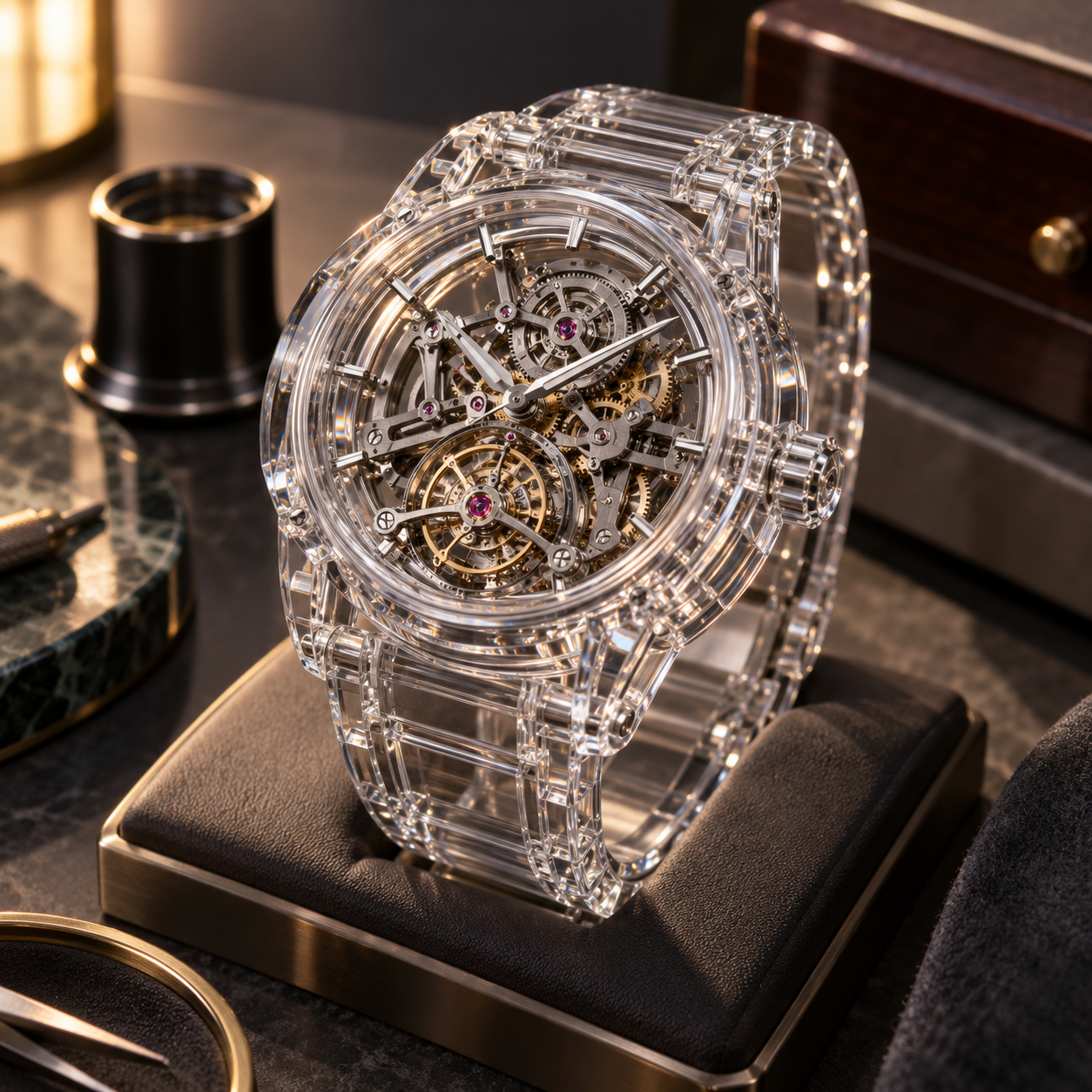
For decades, transparency in mechanical watches was primarily achieved through a sapphire crystal on the front or a sapphire display case back.
Skeletonized movements are changing that relationship.
When bridges, gears, barrels, tourbillons and peripheral mechanisms are designed to be viewed from multiple directions, a conventional opaque case can become a visual limitation. A fully transparent sapphire case allows the movement to be seen not only from the dial and case-back sides, but also through the caseband, lugs and surrounding structural surfaces.
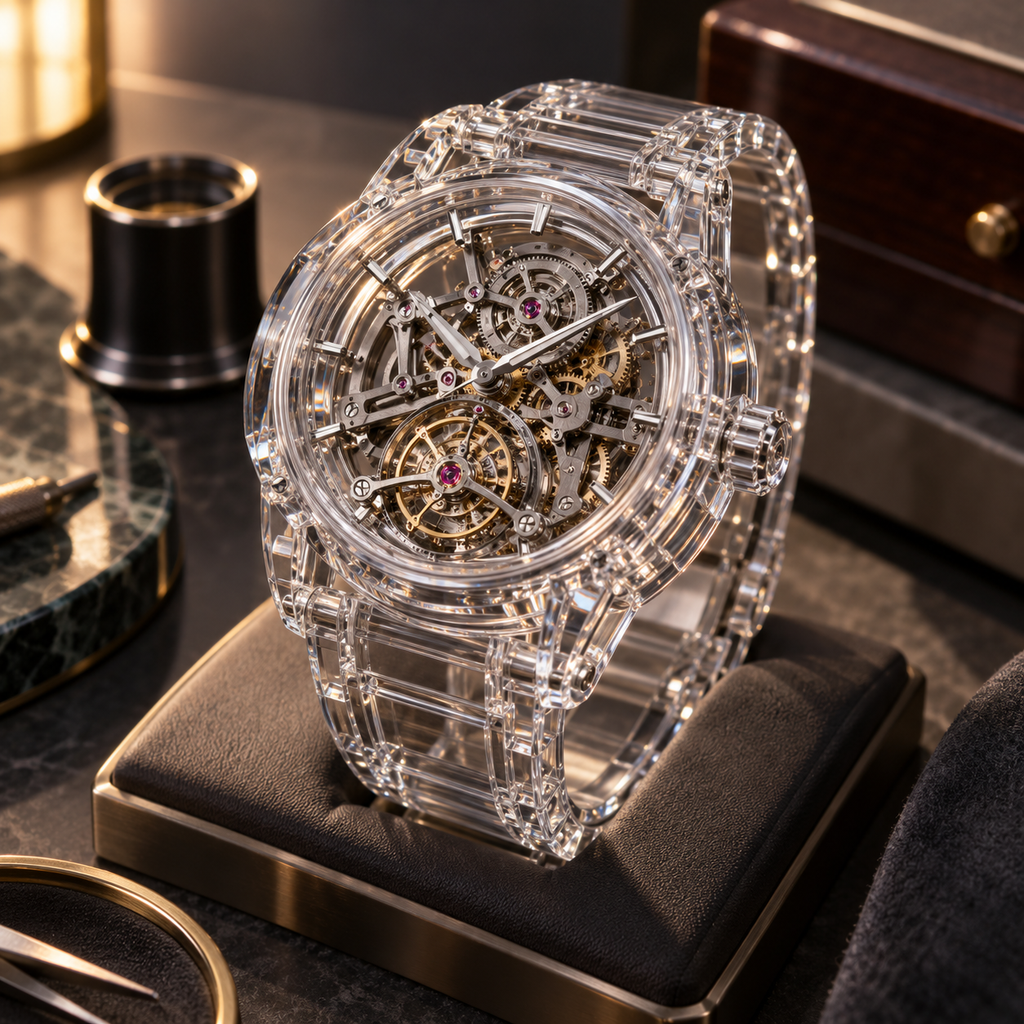
Recent high-end watchmaking continues to explore this idea. Sapphire cases are being paired with skeletonized movements, flying tourbillons and increasingly three-dimensional calibre architectures specifically designed to benefit from transparency. Richard Mille, for example, describes sapphire cases that expose movements from multiple angles, while 2026 releases continue to combine transparent sapphire structures with skeletonized movements.
But 360° transparency creates a much more complicated engineering problem than simply replacing metal with sapphire.
A successful transparent case must simultaneously control:
geometry, structural rigidity, optical distortion, reflections, surface quality, assembly accuracy and water resistance.
That makes the next generation of sapphire watch cases as much an optical and mechanical system as a cosmetic component.
From Display Back to 360° Movement Architecture
Traditional mechanical watches are generally designed around a front viewing direction.
The movement sits inside an opaque case middle, while the dial provides the primary visual interface.
Skeletonization changed this concept by removing material from bridges and plates to expose more of the mechanical system.
Transparent sapphire cases take the next step.
Instead of allowing the wearer to look into the watch through one window, the entire external structure can become a viewing surface.
This changes movement architecture.
A gear train that would normally be hidden beneath a caseband can become visible from the side.
A flying tourbillon can be viewed through both the front crystal and surrounding sapphire walls.
Barrels, bridges and peripheral indicators can be positioned to create depth rather than simply fit inside the smallest possible volume.
The result is increasingly similar to a three-dimensional mechanical sculpture.
For the sapphire manufacturer, however, this means that surfaces that were previously purely structural now become optical surfaces.
Multi-Level Geometry Is Becoming More Important
A conventional watch case may contain many different heights internally, but most of them are hidden.
A transparent case exposes these transitions.
Modern sapphire cases may therefore contain multiple visible levels:
a raised bezel,
a recessed movement cavity,
stepped internal shoulders,
screw seats,
gasket grooves,
crown interfaces,
lug transitions,
curved outer walls,
and complex case-back structures.
Every change in geometry modifies the way light travels through the sapphire.
A completely flat sapphire plate is comparatively predictable.
A three-dimensional case is not.
When transparent walls change from 2 mm to 5 mm or more in thickness, the apparent depth, brightness and distortion of the movement can change.
This means that multi-level geometry cannot be treated only as a CNC machining problem.
It is also an optical-design problem.
Transparency Does Not Automatically Mean Optical Neutrality
Synthetic sapphire can provide excellent transparency, but a thick three-dimensional sapphire structure does not behave like empty space.
Every interface between sapphire and air refracts light.
Curved walls amplify the effect.
Angled surfaces can shift the apparent position of movement components.
Thick sections can produce greater visual displacement than thin sections.
The result can be subtle optical distortion.
For a conventional watch case, this may not matter.
For a skeletonized complication in which the movement architecture is one of the primary selling points, it matters considerably.
A tourbillon cage viewed through a curved sapphire sidewall should still look deliberate.
Parallel bridges should not appear unexpectedly displaced.
Fine components should remain readable from the intended viewing angles.
This is why optical evaluation should begin during the CAD stage rather than after the first fully polished prototype has been completed.
Wall Curvature Changes the Viewing Experience
Curved sapphire surfaces are visually attractive because they soften the transition between the movement and the outside environment.
They also increase manufacturing and optical complexity.
A curved transparent wall effectively behaves as a lens.
Depending on its radius, thickness and viewing angle, it may magnify, compress or shift the appearance of structures behind it.
Designers can sometimes use these effects intentionally.
A carefully designed curved caseband may visually emphasize a tourbillon or create additional perceived depth around an openworked bridge.
Uncontrolled distortion, however, can reduce the clarity of the movement.
The objective is therefore not necessarily to eliminate every optical effect.
It is to understand and control it.
For future sapphire watch projects, optical simulation may increasingly become part of case development alongside conventional mechanical CAD.
Internal Reflections Are as Important as Transparency
A highly polished sapphire surface reflects part of the incoming light.
In a simple flat crystal, these reflections are relatively easy to manage.
A complete transparent case contains many interfaces.
Light can reflect from:
the external case wall,
the internal case wall,
the bezel,
the case back,
internal shoulders,
metallic movement bridges,
polished screws,
and nearby sapphire components.
Multiple reflections can create ghost images or bright highlights.
In extreme cases, they can visually obscure the movement that the transparent case was intended to reveal.
This problem becomes especially noticeable under strong retail lighting and photography lights.
Luxury watches are frequently photographed under precisely these conditions.
Therefore, the visual performance of a sapphire case should be evaluated not only under diffuse room lighting but also under directional light sources.
Anti-Reflective Treatments Become Part of the System
Anti-reflective coatings are widely used on watch crystals, but applying the same thinking to a complex sapphire case requires additional considerations.
Not every surface necessarily requires the same treatment.
External surfaces experience wear and handling.
Internal surfaces may be better protected but can be difficult to coat uniformly.
Highly curved geometries can complicate coating thickness control.
The optical result must also match the aesthetic intent of the watch.
In some cases, designers may prefer maximum visual clarity.
In others, controlled reflections contribute to the sculptural character of the watch.
The correct approach therefore depends on the complete optical architecture rather than a simple instruction to “apply AR coating.”
The importance of anti-reflection control is already visible in high-end transparent sapphire cases; documented sapphire tourbillon cases have used anti-glare treatment specifically to improve their optical performance.
Skeletonized Movements Increase the Importance of Internal Surface Quality
A transparent sapphire case makes the inside of the case visible.
This sounds obvious, but it has major manufacturing consequences.
With an opaque metal case, an internal machining surface may only need to satisfy dimensional and functional requirements.
Inside a sapphire case, that same surface may be visible beside a hand-finished bridge worth thousands of dollars.
Grinding haze, polishing marks, chips and inconsistent surface texture can therefore become cosmetic defects.
This is especially important in:
deep movement cavities,
internal shoulders,
recesses around the crown,
screw holes,
gasket channels,
and transitions between internal radii.
These areas are generally more difficult to polish than exterior surfaces.
As 360° transparent cases become more sophisticated, internal polishing capability becomes increasingly important.
Structural Rigidity Cannot Be Sacrificed for Transparency
One temptation in transparent case design is to reduce sapphire thickness as much as possible.
Thinner walls expose more of the movement and can make the case visually lighter.
But sapphire is not metal.
It is extremely hard and highly scratch resistant, yet it remains a brittle crystalline material.
The engineering objective is therefore different from designing an equivalent titanium or stainless-steel case.
High-stress regions require particular attention.
These can include:
lug roots,
screw holes,
crown openings,
pusher openings,
case-back interfaces,
sharp internal corners,
and transitions from thick to thin walls.
Small geometric changes can significantly alter local stress concentration.
The most visually transparent geometry is not necessarily the most mechanically robust geometry.
Successful designs balance both.
Complex Curves Increase Manufacturing Difficulty
Highly sculpted sapphire cases are already among the most difficult watch-case structures to manufacture.
Richard Mille, for example, describes triple-curved sapphire cases requiring multi-axis machining and exceptionally long manufacturing cycles. Its RM 53-02 uses sapphire for the bezel, caseband and case back specifically to expose the movement from multiple angles.
The challenge increases as curves interact with one another.
A surface may simultaneously change in:
X,
Y,
and Z directions.
The internal cavity must still align with the external geometry.
Wall thickness must remain within the required range.
Screw holes must meet assembly interfaces accurately.
Polished surfaces must maintain their intended form after material removal.
This makes multi-axis machining and precise intermediate inspection essential.
Sapphire Components Must Be Designed as an Assembly
A transparent case is rarely a single isolated sapphire block.
It may include:
a sapphire case middle,
sapphire bezel,
sapphire case back,
front sapphire crystal,
and sometimes additional sapphire structural components.
These components interact mechanically and optically.
If the gap between two transparent components is inconsistent, it can become visible.
If two polished surfaces are not parallel where intended, reflections may emphasize the discrepancy.
If screws generate uneven clamping force, local stress can develop.
The assembly therefore has to be designed as a complete system.
Individual parts may pass inspection independently while still producing an unacceptable final appearance when assembled.
Final inspection should consequently include the assembled case.
Sealing a Transparent Case Creates a Special Design Problem
Water resistance is often associated with gaskets rather than sapphire.
In reality, the geometry surrounding the gasket is just as important.
The sealing system depends on:
groove geometry,
gasket compression,
surface flatness,
parallelism,
contact width,
assembly force,
and dimensional repeatability.
With a metal case, a gasket channel can usually remain visually hidden.
With transparent sapphire, it may be clearly visible.
The designer therefore has to solve two problems simultaneously:
create an effective seal,
and maintain the intended visual appearance.
Historical fully sapphire tourbillon cases demonstrate that transparent structures can still achieve meaningful water resistance through carefully designed seals and screw systems. For example, Richard Mille has documented multi-part sapphire cases using O-ring seals and controlled screw assembly.
The Gasket Can Become Part of the Visual Design
A particularly interesting development is that transparent cases allow the gasket itself to become visible.
Instead of trying to hide it, designers can deliberately make it part of the aesthetic language.
A 2026 sapphire tourbillon release from ArtyA, for example, uses replaceable colored gaskets as a visible design feature within a transparent sapphire case.
This suggests a broader trend.
Components that were once purely functional can become visual elements when the entire enclosure is transparent.
Future projects may intentionally use gasket color to:
frame the movement,
identify a limited edition,
coordinate with the strap,
or create contrast inside a colorless sapphire case.
But once a sealing element becomes visible, cosmetic consistency becomes another manufacturing requirement.
Screw Interfaces Require Careful Engineering
Transparent sapphire cases frequently rely on metal screws to connect the bezel, case middle and back.
This creates a direct interface between a hard brittle ceramic crystal and a metallic fastener.
The assembly must avoid excessive local stress.
Screw seats require accurate geometry.
Contact surfaces must remain controlled.
Washers or other interface elements may be required depending on the design.
Torque consistency becomes important during assembly.
From an aesthetic perspective, screw position and alignment may also be visible from several directions.
A screw that is hidden in a metal watch can become a significant part of the visual architecture in a transparent case.
Mechanical fastening therefore becomes both an engineering and design feature.
Skeletonization Changes Case-Movement Integration
A skeletonized calibre can be designed to interact visually with the case.
This is especially powerful when movement and case development happen together.
Instead of inserting an existing movement into a transparent shell, designers can align movement structures with the case geometry.
A bridge may follow the contour of a sapphire wall.
A tourbillon may sit at a position that can be viewed from both the front and side.
A barrel may become visible through a dedicated opening.
A peripheral rotor may preserve an unobstructed central viewing area.
The absence of upper bridges in flying complications can further increase the feeling that components are suspended inside the transparent structure. Current high-end sapphire watches continue to use this approach to maximize the visual depth of skeletonized movements.
The strongest future sapphire watches are therefore likely to treat the case and movement as one visual architecture.
Movement Visibility Changes Quality-Control Requirements
The more transparent the watch becomes, the less room there is to hide manufacturing variation.
Small defects become noticeable.
A polished sapphire wall can reveal:
dust,
internal particles,
assembly marks,
gasket irregularities,
surface scratches,
small chips,
and residue around screw interfaces.
Final assembly conditions therefore become increasingly important.
Cleanliness standards that are adequate for an opaque watch may not be sufficient for a fully transparent one.
Manufacturing yield must account not only for dimensional conformity but also for optical and cosmetic acceptance after final assembly.
Transparent Cases Also Change Watch Photography
There is another practical consideration that manufacturers sometimes overlook.
Luxury watches are sold visually.
Product photographs, exhibition lighting, display cases and social media video all expose sapphire to intense directional lighting.
A sapphire case that appears excellent under ordinary workshop lighting may produce unexpected reflections when photographed.
Prototype validation should therefore include representative photography conditions.
This is particularly important for brands planning campaigns centered on movement transparency.
Optical performance has become part of marketing performance.
Design for Manufacturing Must Begin Earlier
With conventional watch cases, a manufacturer may receive a completed design and determine how to machine it.
Complex sapphire projects benefit from much earlier collaboration.
Before geometry is frozen, the sapphire manufacturer should ideally review:
minimum wall thickness,
internal radii,
hole locations,
lug transitions,
polishing access,
tool access,
gasket grooves,
screw seats,
optical surfaces,
and areas where large thickness changes occur.
This does not mean reducing creative freedom.
It means identifying expensive risks before prototype machining begins.
A 0.3 mm change in an internal radius may have almost no effect on the external design but significantly improve manufacturability.
Prototype Evaluation Should Be Optical and Mechanical
A transparent sapphire case prototype should not be approved solely from dimensional measurements.
A more complete review includes:
dimensional inspection,
surface-quality inspection,
edge inspection,
movement fit,
screw assembly,
gasket compression,
water-resistance testing,
visual evaluation from multiple angles,
and evaluation under different lighting conditions.
For curved structures, the movement should ideally be installed during optical evaluation.
An empty transparent case does not produce the same reflections and visual effects as a finished watch.
The relationship between sapphire and movement is the product.
The Future: Case and Movement Designed as One Transparent Machine
The most important development in sapphire watchmaking may not be a new sapphire color or a new machining tool.
It may be the disappearance of the traditional boundary between movement and case.
When a movement is visible from almost every direction, the exterior structure becomes part of the mechanical presentation.
And when the case itself is transparent, every functional component—screws, gaskets, bridges, openings and internal surfaces—contributes to the visual result.
This explains why increasingly sophisticated sapphire watches are pairing transparent cases with openworked calibres, flying tourbillons and three-dimensional movement structures.
The next generation of sapphire watch cases will therefore require several disciplines to work together:
crystal material engineering, multi-axis machining, optical design, structural analysis, sealing engineering, precision polishing and high-end watch assembly.
The objective is no longer simply to manufacture a transparent case.
It is to create a transparent mechanical environment in which the movement can be viewed, protected and experienced from almost every direction.
For skeletonized complications, that is the real potential of the 360° sapphire watch case.